Vector-Valued Functions and Motion: Background You’ll Need 4
Use the Fundamental Theorem of Calculus, Part 2, to evaluate definite integrals
Fundamental Theorem of Calculus, Part 2: The Evaluation Theorem
The Fundamental Theorem of Calculus, Part 2 (also called the Evaluation Theorem) provides a direct method for evaluating definite integrals. Instead of approximating area with rectangles, you can find an antiderivative and evaluate it at the endpoints.
The Fundamental Theorem of Calculus, Part 2
If [latex]f[/latex] is continuous over the interval [latex]\left[a,b\right][/latex] and [latex]F(x)[/latex] is any antiderivative of [latex]f(x),[/latex] then:
Notice that we did not include the “+ C” term when we wrote the antiderivative. The reason is that, according to the Fundamental Theorem of Calculus, Part 2, any antiderivative works. So, for convenience, we chose the antiderivative with [latex]C=0.[/latex] If we had chosen another antiderivative, the constant term would have canceled out. This always happens when evaluating a definite integral.
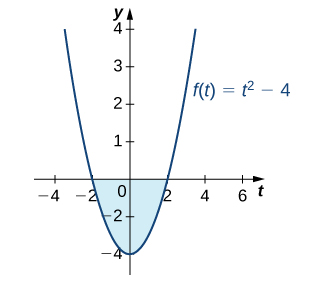
The region of the area we just calculated is depicted in Figure 3. Note that the region between the curve and the [latex]x[/latex]-axis is all below the [latex]x[/latex]-axis. Area is always positive, but a definite integral can still produce a negative number (a net signed area). For example, if this were a profit function, a negative number indicates the company is operating at a loss over the given interval.
Figure 3. The evaluation of a definite integral can produce a negative value, even though area is always positive.
Use the second part of the Fundamental Theorem of Calculus to evaluate [latex]{\displaystyle\int }_{1}^{2}{x}^{-4}dx.[/latex]
[latex]\frac{7}{24}[/latex]
James and Kathy are racing on roller skates. They race along a long, straight track, and whoever has gone the farthest after [latex]5[/latex] sec wins a prize. If James can skate at a velocity of [latex]f(t)=5+2t[/latex] ft/sec and Kathy can skate at a velocity of [latex]g(t)=10+ \cos (\frac{\pi }{2}t)[/latex] ft/sec, who is going to win the race?
We need to integrate both functions over the interval [latex]\left[0,5\right][/latex] and see which value is bigger. For James, we want to calculate
We know [latex]\sin t[/latex] is an antiderivative of [latex]\cos t,[/latex] so it is reasonable to expect that an antiderivative of [latex]\cos (\frac{\pi }{2}t)[/latex] would involve [latex]\sin (\frac{\pi }{2}t).[/latex] However, when we differentiate [latex]\sin (\frac{\pi }{2}t),[/latex] we get [latex]\frac{\pi }{2} \cos (\frac{\pi }{2}t)[/latex] as a result of the chain rule, so we have to account for this additional coefficient when we integrate. We obtain
Kathy has skated approximately [latex]50.6[/latex] ft after [latex]5[/latex] sec. Kathy wins, but not by much!
Watch the following video to see the worked solution to this example.
For closed captioning, open the video on its original page by clicking the Youtube logo in the lower right-hand corner of the video display. In YouTube, the video will begin at the same starting point as this clip, but will continue playing until the very end.