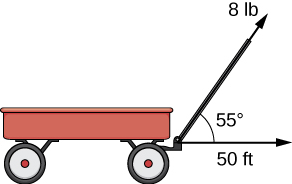
Now you can apply dot products to solve real-world problems. The most important application is calculating work—the amount of energy required to move an object with force.
In basic physics, when a constant force acts in the same direction as motion, work is simply: [latex]W = F \cdot d[/latex] (force times distance)
But what happens when the force acts at an angle to the motion? Think back to the child pulling a wagon at a 55° angle. Only part of that force actually moves the wagon forward—the component in the direction of motion. The dot product handles this perfectly. It automatically accounts for the angle between force and motion vectors.
work formula
When a constant force [latex]\mathbf{F}[/latex] moves an object from point [latex]P[/latex] to point [latex]Q[/latex], the work done is:
where [latex]\theta[/latex] is the angle between the force vector and displacement vector.
Let’s solve the wagon problem we introduced earlier. A child pulls a wagon with [latex]8[/latex] lb of force at a [latex]55[/latex]° angle to the horizontal. If the wagon moves [latex]50[/latex] ft, how much work is done?
Figure 5. The horizontal component of the force is the projection of [latex]{\bf{F}}[/latex] onto the positive [latex]x[/latex]-axis.
Notice that [latex]||\mathbf{F}|| \cos \theta[/latex] is exactly the magnitude of the projection of [latex]\mathbf{F}[/latex] onto the direction of motion. This confirms that work equals the force component in the direction of motion times the distance moved.
[latex]\theta = 0°[/latex]: Force and motion in same direction → [latex]W = ||\mathbf{F}|| ||\overrightarrow{PQ}||[/latex] (maximum work)
[latex]\theta = 90°[/latex]: Force perpendicular to motion → [latex]W = 0[/latex] (no work done)
[latex]\theta = 180°[/latex]: Force opposite to motion → [latex]W = -||\mathbf{F}|| ||\overrightarrow{PQ}||[/latex] (negative work)
Units of Work
Work units depend on your measurement system.
U.S. Standard Units:
Force: pounds (lb)
Distance: feet (ft)
Work: foot-pounds (ft⋅lb)
One foot-pound is the work needed to lift a 1-pound object straight up 1 foot.
Metric Units:
Force: newtons (N)
Distance: meters (m)
Work: newton-meters (N⋅m) or joules (J)
One joule equals one newton-meter.
Connection to Projections: The work formula [latex]W = \mathbf{F} \cdot \overrightarrow{PQ}[/latex] gives the same result as finding the projection of [latex]\mathbf{F}[/latex] onto [latex]\overrightarrow{PQ}[/latex] and multiplying by the distance: [latex]W = ||\text{proj}_{\overrightarrow{PQ}}\mathbf{F}|| \times ||\overrightarrow{PQ}||[/latex].A conveyor belt generates a force [latex]\mathbf{F} = 5\mathbf{i} - 3\mathbf{j} + \mathbf{k}[/latex] that moves a suitcase from point [latex](1, 1, 1)[/latex] to point [latex](9, 4, 7)[/latex] along a straight line. Find the work done by the conveyor belt. The distance is measured in meters and the force is measured in newtons.
The displacement vector [latex]\overrightarrow{PQ}[/latex] has initial point [latex](1, 1, 1)[/latex] and terminal point [latex](9, 4, 7)[/latex]: