Kepler’s Laws
During the early 1600s, Johannes Kepler used remarkably accurate astronomical data from his mentor Tycho Brahe to formulate three laws of planetary motion. These laws apply not only to planets but also to other objects orbiting the Sun, such as comets (like Halley’s comet) and asteroids. Variations of these laws apply to satellites orbiting Earth.
Kepler’s laws of planetary motion theorem
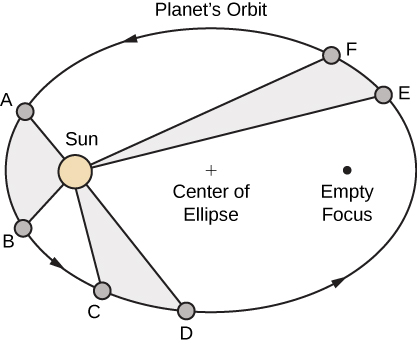
- The Law of Ellipses: The path of any planet about the Sun is elliptical in shape, with the center of the Sun located at one focus of the ellipse.
- The Law of Equal Areas: A line drawn from the center of the Sun to the center of a planet sweeps out equal areas in equal time intervals (Figure 1).
- The Law of Harmonies: The ratio of the squares of the periods of any two planets is equal to the ratio of the cubes of the lengths of their semi-major orbital axes.
Understanding Kepler’s Third Law
Kepler’s third law becomes especially useful when we use appropriate units. One astronomical unit (A.U.) is defined as the average distance from Earth to the Sun, approximately [latex]93,000,000[/latex] miles or [latex]149,597,870,700[/latex] meters. Since Earth takes [latex]1[/latex] year to orbit the Sun, we use Earth years for units of time.
Using these units, Kepler’s third law can be written simply as:
[latex]T^2_p=D^3_p[/latex]
where [latex]T_p[/latex] is the period of a planet measured in Earth years and [latex]D_p[/latex] is the average distance from that planet to the Sun measured in astronomical units.
Using Kepler’s Third Law
If you know the average distance from a planet to the Sun (in astronomical units), you can calculate the length of its year (in Earth years), and vice versa. For example:
- If a planet is [latex]4[/latex] A.U. from the Sun, then [latex]T^2_p=4^3=64[/latex], so [latex]T_p=8[/latex] Earth years
- If a planet’s year is [latex]27[/latex] Earth years, then [latex]D^3_p=27^2=729[/latex], so [latex]D_p=9[/latex] A.U.
Proof
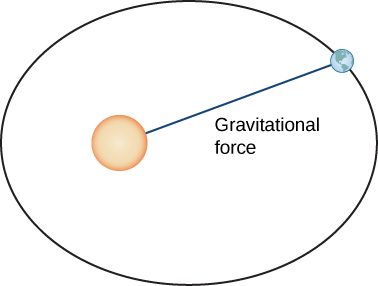
Let’s now prove Kepler’s first law using the calculus of vector-valued functions. First we need a coordinate system. Let’s place the Sun at the origin of the coordinate system and let the vector-valued function [latex]{\bf{r}}\,(t)[/latex] represent the location of a planet as a function of time. Newton proved Kepler’s law using his second law of motion and his law of universal gravitation. Newton’s second law of motion can be written as [latex]{\bf{F}}=m{\bf{a}}[/latex], where [latex]{\bf{F}}[/latex] represents the net force acting on the planet. His law of universal gravitation can be written in the form [latex]{\bf{F}}=-\frac{GmM}{\left\Vert{\bf{r}}\right\Vert^{2}}\cdot\frac{{\bf{r}}}{\left\Vert{\bf{r}}\right\Vert}[/latex], which indicates that the force resulting from the gravitational attraction of the Sun points back toward the Sun, and has magnitude [latex]\frac{GmM}{\left\Vert{\bf{r}}\right\Vert^{2}}[/latex] (Figure 9).
Setting these two forces equal to each other, and using the fact that [latex]{\bf{a}}\,(t)={\bf{v}}'\,(t)[/latex], we obtain
[latex]\large{m{\bf{v}}'\,(t)=-\frac{GmM}{\left\Vert{\bf{r}}\right\Vert^{2}}\cdot\frac{{\bf{r}}}{\left\Vert{\bf{r}}\right\Vert}}[/latex],
which can be rewritten as
[latex]\large{\frac{d{\bf{v}}}{dt}=-\frac{GM}{\left\Vert{\bf{r}}\right\Vert^{3}}{\bf{r}}}.[/latex]
This equation shows that the vectors [latex]d{\bf{v}}/dt[/latex] and [latex]{\bf{r}}[/latex] are parallel to each other, so [latex]d{\bf{v}}/dt\,\times\,{\bf{r}}=0[/latex]. Next, let’s differentiate [latex]{\bf{r}}\,\times\,{\bf{v}}[/latex] with respect to time:
[latex]\large{\frac{d}{dt}({\bf{r}}\,\times\,{\bf{v}})=\frac{d{\bf{r}}}{dt}\,\times\,{\bf{v}}+{\bf{r}}\,\times\frac{d{\bf{v}}}{dt}={\bf{v}}\,\times\,{\bf{v}}+{\bf{0}}={\bf{0}}}.[/latex]
This proves that [latex]{\bf{r}}\,\times\,{\bf{v}}[/latex] is a constant vector, which we call [latex]{\bf{C}}[/latex]. Since [latex]{\bf{r}}[/latex] and [latex]{\bf{v}}[/latex] are both perpendicular to [latex]{\bf{C}}[/latex] for all values of [latex]t[/latex], they must lie in a plane perpendicular to [latex]{\bf{C}}[/latex]. Therefore, the motion of the planet lies in a plane.
Next we calculate the expression [latex]d{\bf{v}}/dt\,\times\,{\bf{C}}[/latex]:
[latex]\frac{d{\bf{v}}}{dt}\,\times\,{\bf{C}}=-\frac{GM}{\left\Vert{\bf{r}}\right\Vert^{3}}{\bf{r}}\,\times\,({\bf{r}}\,\times\,{\bf{v}})=-\frac{GM}{\left\Vert{\bf{r}}\right\Vert^{3}}[({\bf{r}}\cdot{\bf{v}})\,{\bf{r}}-({\bf{r}}\cdot{\bf{r}})\,{\bf{v}}].[/latex]
The last equality in the above equation is from the triple cross product formula (Introduction to Vectors in Space). We need an expression for [latex]{\bf{r}}\cdot{\bf{v}}[/latex]. To calculate this, we differentiate [latex]{\bf{r}}\cdot{\bf{r}}[/latex] with respect to time:
[latex]\frac{d}{dt}({\bf{r}}\,\cdot\,{\bf{r}})=\frac{d{\bf{r}}}{dt}\cdot{\bf{r}}+{\bf{r}}\cdot\frac{d{\bf{r}}}{dt}=2{\bf{r}}\cdot\frac{d{\bf{r}}}{dt}=2{\bf{r}}\cdot{\bf{v}}.[/latex]
Since [latex]{\bf{r}}\,\cdot\,{\bf{r}}=\left\Vert{\bf{r}}\right\Vert^{2}[/latex], we also have
[latex]\frac{d}{dt}({\bf{r}}\cdot{\bf{r}})=\frac{d}{dt}\left\Vert{\bf{r}}\right\Vert^{2}=2\left\Vert{\bf{r}}\right\Vert\,\frac{d}{dt}\left\Vert{\bf{r}}\right\Vert[/latex].
Combining the last two equations, we get
[latex]\begin{array}{ccc}\hfill {2{\bf{r}}\cdot{\bf{v}}} & =\hfill & {2\left\Vert{\bf{r}}\right\Vert\,\frac{d}{dt}\left\Vert{\bf{r}}\right\Vert} \hfill \\ \hfill {{\bf{r}}\cdot{\bf{v}}}& =\hfill & {\left\Vert{\bf{r}}\right\Vert\,\frac{d}{dt}\left\Vert{\bf{r}}\right\Vert{.}}\hfill \\ \hfill \end{array}[/latex]
Substituting into our expression for [latex]\frac{d{\bf{v}}}{dt}\,\times\,{\bf{C}}[/latex] gives us
[latex]\begin{array}{ccc}\hfill {\frac{d{\bf{v}}}{dt}\,\times\,{\bf{C}}} & =\hfill & {-\frac{GM}{\left\Vert{\bf{r}}\right\Vert^{3}}[({\bf{r}}\cdot{\bf{r}})\,{\bf{r}}-({\bf{r}}\cdot{\bf{r}})\,{\bf{v}}]} \hfill \\ \hfill & =\hfill & {-\frac{GM}{\left\Vert{\bf{r}}\right\Vert^{3}}\big[\left\Vert{\bf{r}}\right\Vert{\big(}\frac{d}{dt}\left\Vert{\bf{r}}\right\Vert\big)\,{\bf{r}}-\left\Vert{\bf{r}}\right\Vert^{2}{\bf{v}}\big]}\hfill \\ \hfill & =\hfill & {-GM\Big[\frac{1}{\left\Vert{\bf{r}}\right\Vert^{2}}\big(\frac{d}{dt}\left\Vert{\bf{r}}\right\Vert\big)\,{\bf{r}}-\frac{1}{\left\Vert{\bf{r}}\right\Vert}{\bf{v}}\Big]}\hfill \\ \hfill & =\hfill & {GM\Big[\frac{\bf{v}}{\left\Vert{\bf{r}}\right\Vert}-\frac{{\bf{r}}}{\left\Vert{\bf{r}}\right\Vert^{2}}\big(\frac{d}{dt}\left\Vert{\bf{r}}\right\Vert\big)\Big].}\hfill \\ \hfill \end{array}[/latex]
However,
[latex]\begin{array}{ccc}\hfill {\frac{d}{dt}\,\frac{{\bf{r}}}{\left\Vert{\bf{r}}\right\Vert}} & =\hfill & {\frac{\frac{d}{dt}({\bf{r}})\left\Vert{\bf{r}}\right\Vert-{\bf{r}}\frac{d}{dt}\left\Vert{\bf{r}}\right\Vert}{\left\Vert{\bf{r}}\right\Vert}} \hfill \\ \hfill & =\hfill & {\frac{\frac{d{\bf{r}}}{dt}}{\left\Vert{\bf{r}}\right\Vert}-\frac{{\bf{r}}}{\left\Vert{\bf{r}}\right\Vert^{2}}\,\frac{d}{dt}\left\Vert{\bf{r}}\right\Vert}\hfill \\ \hfill & =\hfill & {\frac{\bf{v}}{\left\Vert{\bf{r}}\right\Vert}-\frac{{\bf{r}}}{\left\Vert{\bf{v}}\right\Vert^{2}}\,\frac{d}{dt}\left\Vert{\bf{r}}\right\Vert.}\hfill \\ \hfill \end{array}[/latex]
Therefore, we get
[latex]\large{\frac{d{\bf{v}}}{dt}\,\times\,{\bf{C}}=GM\Big(\frac{d}{dt}\,\frac{\bf{r}}{\left\Vert{\bf{r}}\right\Vert}\Big)}.[/latex]
Since [latex]\bf{C}[/latex] is a constant vector, we can integrate both sides and obtain
[latex]{\bf{v}}\,\times\,{\bf{C}}=GM\frac{{\bf{r}}}{\left\Vert{\bf{r}}\right\Vert}+{\bf{D}},[/latex]
where [latex]\bf{D}[/latex] is a constant vector. Our goal is to solve for [latex]\left\Vert{\bf{r}}\right\Vert[/latex]. Let’s start by calculating [latex]{\bf{r}}\cdot({\bf{v}}\,\times\,{\bf{C}})[/latex]:
[latex]{\bf{r}}\cdot({\bf{v}}\,\times\,{\bf{C}})={\bf{r}}\cdot\Big(GM\frac{\bf{r}}{\left\Vert{\bf{r}}\right\Vert}+{\bf{D}}\Big)=GM\frac{\left\Vert{\bf{r}}\right\Vert^{2}}{\left\Vert{\bf{r}}\right\Vert}+{\bf{r}}\cdot{\bf{D}}=GM\left\Vert{\bf{r}}\right\Vert+{\bf{r}}\cdot{\bf{D}}.[/latex]
However, [latex]{\bf{r}}\cdot({\bf{v}}\,\times\,{\bf{C}})=({\bf{r}}\,\times\,{\bf{v}})\,\times\,{\bf{C}}[/latex], so
[latex]({\bf{r}}\,\times\,{\bf{v}})\,\times\,{\bf{C}}=GM\left\Vert{\bf{r}}\right\Vert+{\bf{r}}\cdot{\bf{D}}[/latex].
Since [latex]{\bf{r}}\,\times\,{\bf{v}}={\bf{C}}[/latex], we have
[latex]\left\Vert{\bf{C}}\right\Vert^{2}=GM\left\Vert{\bf{r}}\right\Vert+{\bf{r}}\cdot{\bf{D}}[/latex].
Note that [latex]{\bf{r}}\cdot{\bf{D}}=\left\Vert{\bf{r}}\right\Vert\,\left\Vert{\bf{D}}\right\Vert\cos{\theta}[/latex], where [latex]\theta[/latex] is the angle between [latex]\bf{r}[/latex] and [latex]\bf{D}[/latex]. Therefore,
[latex]\left\Vert{\bf{C}}\right\Vert^{2}=GM\left\Vert{\bf{r}}\right\Vert+\left\Vert{\bf{r}}\right\Vert\,\left\Vert{\bf{D}}\right\Vert\cos{\theta}[/latex].
Solving for [latex]\left\Vert{\bf{r}}\right\Vert[/latex],
[latex]\left\Vert{\bf{r}}\right\Vert=\frac{\left\Vert{\bf{C}}\right\Vert^{2}}{GM+\left\Vert{\bf{D}}\right\Vert\cos{\theta}}=\frac{\left\Vert{\bf{C}}\right\Vert^{2}}{GM}\bigg(\frac{1}{1+e\cos{\theta}}\bigg)[/latex],
where [latex]e=\left\Vert{\bf{D}}\right\Vert/GM[/latex]. This is the polar equation of a conic with a focus at the origin, which we set up to be the Sun. It is a hyperbola if [latex]e\,>\,1[/latex], a parabola if [latex]e=1[/latex], or an ellipse if [latex]e\,<\,1[/latex]. Since planets have closed orbits, the only possibility is an ellipse. However, at this point it should be mentioned that hyperbolic comets do exist. These are objects that are merely passing through the solar system at speeds too great to be trapped into orbit around the Sun. As they pass close enough to the Sun, the gravitational field of the Sun deflects the trajectory enough so the path becomes hyperbolic. [latex]_\blacksquare[/latex]
[latex]\large{P^{2}=\frac{4\pi^{2}a^{3}}{G(m+M)}},[/latex]
where [latex]m[/latex] is the mass of the Moon and [latex]M[/latex] is the mass of Earth, [latex]a[/latex] represents the length of the major axis of the elliptical orbit, and [latex]P[/latex] represents the period.
Find the length of the major axis of the orbit of the Moon around Earth.
Relevant Information:
- The mass of the Moon is [latex]7.35\ \times\ 10^{22}\text{ kg}[/latex]
- The mass of the Earth is [latex]5.97\ \times\ 10^{24}\text{ kg}[/latex]
- [latex]G=6.67\ \times\ 10^{-11}\text{m}_{\small{3}}/\text{kg}\cdot\text{sec}^{2}[/latex]
- The period of the moon is [latex]27.3[/latex] days.