Now that we can parameterize surfaces and calculate their surface areas, we can define surface integrals. Let’s start with the surface integral of a scalar-valued function.
A surface integral of a scalar-valued function is similar to a scalar line integral, but in one higher dimension. For a line integral, the domain of integration is a parameterized curve (one-dimensional). For a surface integral, the domain of integration is a parameterized surface (two-dimensional).
The definition follows the same logic as line integrals. For scalar line integrals, we chop the domain curve into tiny pieces, choose a point in each piece, evaluate the function at that point, and take a limit of the corresponding Riemann sum. For scalar surface integrals, we chop the domain surface into tiny pieces and proceed in the same fashion.
Defining the Surface Integral
Let [latex]S[/latex] be a piecewise smooth surface with parameterization [latex]\mathbf{r}(u,v) = \langle x(u,v), y(u,v), z(u,v) \rangle[/latex] with parameter domain [latex]D[/latex]. Let [latex]f(x,y,z)[/latex] be a function with a domain that contains [latex]S[/latex].
For simplicity, assume the parameter domain [latex]D[/latex] is a rectangle (we can extend this to any parameter domain). Divide rectangle [latex]D[/latex] into subrectangles [latex]D_{ij}[/latex] with horizontal width [latex]\Delta u[/latex] and vertical length [latex]\Delta v[/latex].
Suppose [latex]i[/latex] ranges from [latex]1[/latex] to [latex]m[/latex] and [latex]j[/latex] ranges from [latex]1[/latex] to [latex]n[/latex], so [latex]D[/latex] is subdivided into [latex]mn[/latex] rectangles. This division of [latex]D[/latex] into subrectangles gives a corresponding division of [latex]S[/latex] into pieces [latex]S_{ij}[/latex].
Choose point [latex]P_{ij}[/latex] in each piece [latex]S_{ij}[/latex], evaluate [latex]f[/latex] at [latex]P_{ij}[/latex], and multiply by the area of [latex]S_{ij}[/latex] to form the Riemann sum:
Notice the similarities between this definition and the definition of a scalar line integral. In the line integral, we chop a curve into pieces, evaluate a function at a point in each piece, and let the length of the pieces shrink to zero. In the surface integral, we chop a surface into pieces, evaluate a function at a point in each piece, and let the area of the pieces shrink to zero.
This definition extends to parameter domains that are not rectangles by using the same logic. The basic idea is to chop the parameter domain into small pieces, choose a sample point in each piece, and so on. The exact shape of each piece becomes irrelevant as the areas shrink to zero.
Computing Surface Integrals
Scalar surface integrals are difficult to compute from the definition, just as scalar line integrals are. To make surface integrals easier to compute, we approximate surface areas [latex]\Delta S_{ij}[/latex] with small pieces of a tangent plane, as we did when calculating surface area.
Recall the definition of vectors [latex]{\bf{t}}_u[/latex] and [latex]{\bf{t}}_v[/latex]:
This approximation becomes arbitrarily close to [latex]\displaystyle\lim_{m,n\to\infty}\displaystyle\sum_{i=1}^m\displaystyle\sum_{j=1}^nf(P_{ij})\Delta{S}_{ij}[/latex] as we increase the number of pieces [latex]S_{ij}[/latex] by letting [latex]m[/latex] and [latex]n[/latex] go to infinity.
We can now state the formula for calculating scalar surface integrals:
Let [latex]S[/latex] be a smooth surface with parameterization [latex]\mathbf{r}(u,v) = \langle x(u,v), y(u,v), z(u,v) \rangle[/latex] over parameter domain [latex]D[/latex]. Then:
In the surface integral case, vector [latex]\mathbf{t}_u \times \mathbf{t}_v[/latex] is perpendicular to the surface. In the line integral case, vector [latex]\mathbf{r}'[/latex] is tangent to the curve.
Calculate surface integral [latex]\displaystyle\iint_S5dS[/latex], where [latex]S[/latex] is the surface with parameterization [latex]{\bf{r}}(u,v)=\langle{v},u^2,v\rangle[/latex] for [latex]0\leq{u}\leq2[/latex] and [latex]0\leq{v}\leq{u}[/latex].
Notice that this parameter domain [latex]D[/latex] is a triangle, and therefore the parameter domain is not rectangular. This is not an issue though, because the surface integral equation does not place any restrictions on the shape of the parameter domain.
To use the surface integral equation to calculate the surface integral, we first find vector [latex]{\bf{t}}_u[/latex] and [latex]{\bf{t}}_v[/latex]. Note that [latex]{\bf{t}}_u=\langle1,2u,0\rangle[/latex] and [latex]{\bf{t}}_v=\langle0,0,1\rangle[/latex]. Therefore,
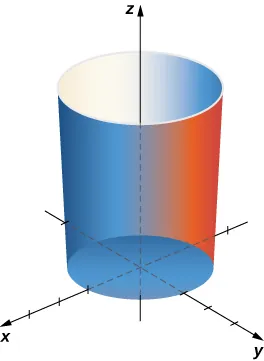
Calculate surface integral [latex]\displaystyle\iint_S(x+y^2)dS[/latex], where [latex]S[/latex] is cylinder [latex]x^2+y^2=4[/latex], [latex]0\leq{z}\leq3[/latex] (Figure 1).
Figure 1. Integrating function [latex]f(x,y,z)=x+y^2[/latex] over a cylinder.
To calculate the surface integral, we first need a parameterization of the cylinder. Following our previous examples, a parameterization is:
and [latex]||{\bf{t}}_u\times{\bf{t}}_v||=\sqrt{\cos^2u+\sin^2u}=1[/latex]. By the surface integral equation,
[latex]\begin{aligned} \displaystyle\iint_Sf(x,y,z)dS&=\displaystyle\iint_Df({\bf{r}}(u,v))||{\bf{t}}_u\times{\bf{t}}_v|| \ dA \\ &=\displaystyle\int_0^3\displaystyle\int_0^{2\pi}(2\cos{u}+4\sin^2u)dydv \\ &=\displaystyle\int_0^3[2\sin{u}+2u-\sin(2u)]_0^{2\pi}dv=\displaystyle\int_0^34\pi{d}v=12\pi \end{aligned}[/latex].
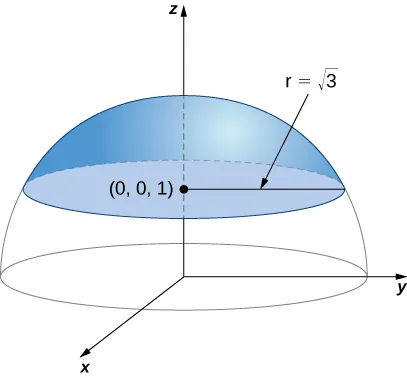
Calculate surface integral [latex]\displaystyle\iint_Sf(x,y,z)dS[/latex], where [latex]f(x, y, z)=z^{2}[/latex] and [latex]S[/latex] is the surface that consists of the piece of sphere [latex]x^{2}+y^{2}+z^{2}=4[/latex] that lies on or above plane [latex]z=1[/latex] and the disk that is enclosed by intersection plane [latex]z=1[/latex] and the given sphere (Figure 2).
Figure 2. Calculating a surface integral over surface [latex]S[/latex].
Notice that [latex]S[/latex] is not smooth but is piecewise smooth; [latex]S[/latex] can be written as the union of its base [latex]S_1[/latex] and its spherical top [latex]S_2[/latex], and both [latex]S_1[/latex] and [latex]S_2[/latex] are smooth. Therefore, to calculate [latex]\displaystyle\iint_Sz^2dS[/latex], we write this integral as [latex]\displaystyle\iint_Sz^2d{S_1}+\displaystyle\iint_{S_2}z^2dS[/latex] and we calculate integrals [latex]\displaystyle\iint_{S_1}z^2dS[/latex] and [latex]\displaystyle\iint_{S_2}z^2dS[/latex].
First, we calculate [latex]\displaystyle\iint_{S_1}z^2dS[/latex]. To calculate this integral we need a parameterization of [latex]S_1[/latex]. This surface is a disk in plane [latex]z=1[/latex] centered at [latex](0, 0, 1)[/latex]. To parameterize this disk, we need to know its radius. Since the disk is formed where plane [latex]z=1[/latex] intersects sphere [latex]x^{2}+y^{2}+z^{2}=4[/latex], we can substitute [latex]z=1[/latex] into equation [latex]x^{2}+y^{2}+z^{2}=4[/latex]:
[latex]x^2+y^2+1=4\Rightarrow{x}^2+y^2=3[/latex].
Therefore, the radius of the disk is [latex]\sqrt3[/latex] and a parameterization of [latex]S_1[/latex] is [latex]{\bf{r}}(u,v)=\langle{u}\cos{v},u\sin{v},1\rangle[/latex], [latex]0\leq{u}\leq\sqrt3[/latex],[latex]0\leq{v}\leq2\pi[/latex]. The tangent vectors are [latex]{\bf{t}}_u=\langle\cos{v},\sin{v},0\rangle[/latex] and [latex]{\bf{t}}_v=\langle-u\sin{v},u\cos{v},0\rangle[/latex], and thus
Now we calculate [latex]\displaystyle\iint_{S_2} \ dS[/latex]. To calculate this integral, we need a parameterization of [latex]S_2[/latex]. The parameterization of full sphere [latex]x^{2}+y^{2}+z^{2}=4[/latex] is
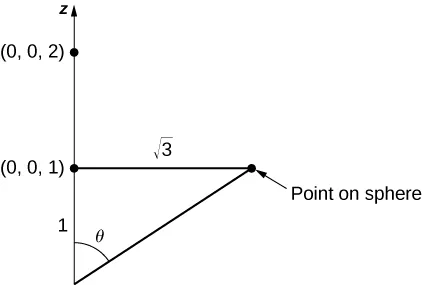
Since we are only taking the piece of the sphere on or above plane [latex]z=1[/latex], we have to restrict the domain of [latex]\phi[/latex]. To see how far this angle sweeps, notice that the angle can be located in a right triangle, as shown in Figure 3 (the [latex]\sqrt3[/latex] comes from the fact that the base of [latex]S[/latex] is a disk with radius [latex]\sqrt3[/latex]). Therefore, the tangent of [latex]\phi[/latex] is [latex]\sqrt3[/latex], which implies that [latex]\phi[/latex] is [latex]\pi/6[/latex]. We now have a parameterization of [latex]S_2[/latex]:
Figure 3. The maximum value of [latex]\phi[/latex] has a tangent value of [latex]{\sqrt3}[/latex]
The tangent vectors are
[latex]{\bf{t}}_\phi=\langle2\cos\theta\cos\phi,2\sin\theta\cos\phi,-2\sin\phi\rangle\text{ and }{\bf{t}}_\theta=\langle-2\sin\theta\sin\phi,u\cos\theta\sin\phi,0\rangle[/latex],
In this example we broke a surface integral over a piecewise surface into the addition of surface integrals over smooth subsurfaces. There were only two smooth subsurfaces in this example, but this technique extends to finitely many smooth subsurfaces.
Scalar surface integrals have several real-world applications. Recall that scalar line integrals can be used to compute the mass of a wire given its density function. In a similar fashion, we can use scalar surface integrals to compute the mass of a sheet given its density function. If a thin sheet of metal has the shape of surface [latex]S[/latex] and the density of the sheet at point [latex](x, y, z)[/latex] is [latex]\rho(x,y,z)[/latex], then mass [latex]m[/latex] of the sheet is:
A flat sheet of metal has the shape of surface [latex]z=1+x+2y[/latex] that lies above rectangle [latex]0\leq{x}\leq4[/latex] and [latex]0\leq{y}\leq2[/latex]. If the density of the sheet is given by [latex]\rho(x,y,z)=x^2yz[/latex], what is the mass of the sheet?
Let [latex]S[/latex] be the surface that describes the sheet. Then, the mass of the sheet is given by [latex]m=\displaystyle\iint_Sx^2yzdS[/latex]. To compute this surface integral, we first need a parameterization of [latex]S[/latex]. Since [latex]S[/latex] is given by the function [latex]f(x,y)=1+x+2y[/latex], a parameterization of [latex]S[/latex] is [latex]{\bf{r}}(x,y)=\langle{x},y,1+x+2y\rangle[/latex], [latex]0\leq{x}\leq4[/latex], [latex]0\leq{y}\leq2[/latex].
The tangent vectors are [latex]{\bf{t}}_x=\langle1,0,1\rangle[/latex] and [latex]{\bf{t}}_y=\langle1,0,2\rangle[/latex]. Therefore, [latex]{\bf{t}}_x\times{\bf{t}}_y=\langle-1,-2,1\rangle[/latex] and [latex]||{\bf{t}}_x\times{\bf{t}}_y||=\sqrt6[/latex]. By the scalar line integral equation,