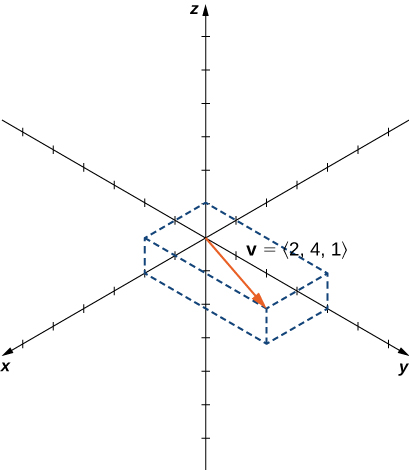
Three-dimensional vectors work exactly like their 2D counterparts—they’re quantities with both magnitude and direction, represented by directed line segments (arrows). The only difference is that 3D vectors point in three-dimensional space.
A vector [latex]\mathbf{v} = \langle x,y,z \rangle[/latex] has the initial point at the origin [latex](0, 0, 0)[/latex] and terminal point [latex](x, y, z)[/latex].
The zero vector in 3D is [latex]\mathbf{0} = \langle 0,0,0 \rangle[/latex].
The three dimensional vector [latex]\mathbf{v} = \langle 2,4,1 \rangle[/latex] is represented by a directed line segment from point [latex](0, 0, 0)[/latex] to point [latex](2, 4, 1)[/latex] (Figure 1).
Figure 1. Vector [latex]v=⟨2,4,1⟩[/latex] is represented by a directed line segment from point [latex](0,0,0)[/latex] to point [latex](2,4,1)[/latex].
Vector Operations in 3D
All the vector operations you know from 2D extend naturally to 3D. For vectors [latex]\mathbf{v} = \langle x_1,y_1,z_1 \rangle[/latex] and [latex]\mathbf{w} = \langle x_2,y_2,z_2 \rangle[/latex], and scalar [latex]k[/latex]:
Vector addition and other geometric operations work the same way in 3D as in 2D. The parallelogram rule, triangle method, and all the visual techniques you learned for 2D vectors apply directly to 3D.
Figure 3. To add vectors in three dimensions, we follow the same procedures we learned for two dimensions.
Standard Unit Vectors in 3D
The 2D standard unit vectors [latex]\mathbf{i}[/latex] and [latex]\mathbf{j}[/latex] get a third companion in 3D:
[latex]\mathbf{i} = \langle 1,0,0 \rangle[/latex] (points along positive [latex]x[/latex]-axis)
[latex]\mathbf{j} = \langle 0,1,0 \rangle[/latex] (points along positive [latex]y[/latex]-axis)
[latex]\mathbf{k} = \langle 0,0,1 \rangle[/latex] (points along positive [latex]z[/latex]-axis)
Any 3D vector can be written in standard unit vector form:
Let [latex]\overrightarrow{PQ}[/latex] be the vector with initial point [latex]P=(3, 12, 6)[/latex] and terminal point [latex]Q=(-4, -3, 2)[/latex] as shown in Figure 2. Express [latex]\overrightarrow{PQ}[/latex] in both component form and using standard unit vectors.
Figure 2. The vector with initial point [latex]P=(3,12,6)[/latex] and terminal point [latex]Q=(−4,−3,2)[/latex].
We have already seen how some of the algebraic properties of vectors, such as vector addition and scalar multiplication, can be extended to three dimensions. Other properties can be extended in similar fashion. They are summarized here for our reference.
3D vector operations
For vectors [latex]\mathbf{v} = \langle x_1,y_1,z_1 \rangle[/latex] and [latex]\mathbf{w} = \langle x_2,y_2,z_2 \rangle[/latex], and scalar [latex]k[/latex]:
3D vectors satisfy all the same algebraic properties as 2D vectors: commutative and associative properties for addition, distributive property for scalar multiplication, and the zero vector acts as the additive identity.
Let [latex]\mathbf{v} = \langle -2,9,5 \rangle[/latex] and [latex]\mathbf{w} = \langle 1,-1,0 \rangle[/latex] (Figure 4). Find the following vectors.
[latex]3\mathbf{v} -2\mathbf{w}[/latex]
[latex]5\|\mathbf{w}\|[/latex]
[latex]\|5\mathbf{w}\|[/latex]
A unit vector in the direction of [latex]\textbf v[/latex]
First, use scalar multiplication of each vector, then subtract:
A quarterback is standing on the football field preparing to throw a pass. His receiver is standing 20 yd down the field and 15 yd to the quarterback’s left. The quarterback throws the ball at a velocity of 60 mph toward the receiver at an upward angle of [latex]30^\circ[/latex] (see the following figure). Write the initial velocity vector of the ball, [latex]\textbf v[/latex], in component form.
Figure 5. The receiver is standing [latex]20[/latex] yd down the field and [latex]15[/latex] yd to the quarterback’s left. The quarterback throws the ball at a velocity of [latex]60[/latex] mph toward the receiver at an upward angle of [latex]30°[/latex]
The first thing we want to do is find a vector in the same direction as the velocity vector of the ball. We then scale the vector appropriately so that it has the right magnitude. Consider the vector [latex]\textbf w[/latex] extending from the quarterback’s arm to a point directly above the receiver’s head at an angle of [latex]30^\circ[/latex] (see the following figure). This vector would have the same direction as [latex]\textbf v[/latex], but it may not have the right magnitude.
Figure 6. Vector [latex]{\bf{w}}[/latex] extending from the quarterback’s arm at an angle of [latex]30°[/latex]
The receiver is 20 yd down the field and 15 yd to the quarterback’s left. Therefore, the straight-line distance from the quarterback to the receiver is
[latex]\text{Dist from QB to receiver} = \sqrt{15^2 + 20^2} = \sqrt{225 + 400} = \sqrt{625} = 25[/latex] yd.
We have [latex]\frac{25}{\|\mathbf{w}\|} = \cos{30^\circ}[/latex]. Then the magnitude of [latex]\textbf w[/latex] is given by
and the vertical distance from the receiver to the terminal point of [latex]\textbf w[/latex] is
[latex]\text{Vert dist from receiver to terminal point of } \textbf w = \textbf w \sin{30^\circ} = \frac{50}{\sqrt{3}} * \frac{1}{2} = \frac{25}{\sqrt{3}}[/latex]yd.
Then [latex]\mathbf{w} = \langle 20,15,\frac{25}{\sqrt{3}} \rangle[/latex], and has the same direction as [latex]\textbf v[/latex].
Recall, though, that we calculated the magnitude of [latex]\textbf w[/latex]to be [latex]\|\textbf w\| = \frac{50}{\sqrt{3}}[/latex], and [latex]\textbf v[/latex] has magnitude 60 mph. So, we need to multiply vector [latex]\textbf w[/latex] by an appropriate constant, [latex]k[/latex]. We want to find a value of [latex]k[/latex] so that [latex]\|k \textbf{w}\| = 60[/latex] mph. We have
[latex]\|k \textbf{w} \|= k \|\textbf{w}\| = k\frac{50}{\sqrt{3}}[/latex] mph,
so we want
[latex]\begin{align*} k\frac{50}{\sqrt{3}} &= 60 \\ k &= \frac{60\sqrt{3}}{50}\\ k &= \frac{6\sqrt{3}}{5}\\ \end{align*}[/latex]
So, we have found the correct components for [latex]\textbf v[/latex].
Assume the quarterback and the receiver are in the same place as in the previous example. This time, however, the quarterback throws the ball at velocity of 40 mph and an angle of [latex]45^\circ[/latex]. Write the initial velocity vector of the ball, [latex]\textbf v[/latex], in component form.