- Identify simple and closed curves in various regions
- Find potential functions for conservative fields
- Apply the Fundamental Theorem for Line Integrals
- Test a vector field to determine whether it is conservative
Curves and Regions
Before we can work with the theorems in this section, we need to establish some geometric vocabulary about curves and regions. The definitions here will set us up for generalizing the Fundamental Theorem of Calculus to line integrals.
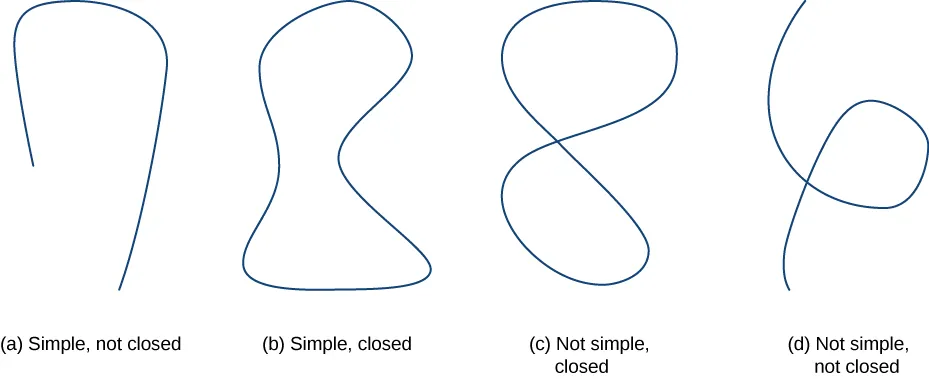
Let’s start with two important types of curves. A closed curve begins and ends at the same point. A simple curve doesn’t cross itself. When a curve is both closed and simple, we call it a simple closed curve (Figure 1).
closed and simple curves
A curve [latex]C[/latex] is closed if it has a parameterization [latex]\mathbf{r}(t)[/latex], [latex]a\leq t\leq b[/latex], where [latex]\mathbf{r}(a)=\mathbf{r}(b)[/latex] and the parameterization traverses the curve exactly once.
[latex]\\[/latex]
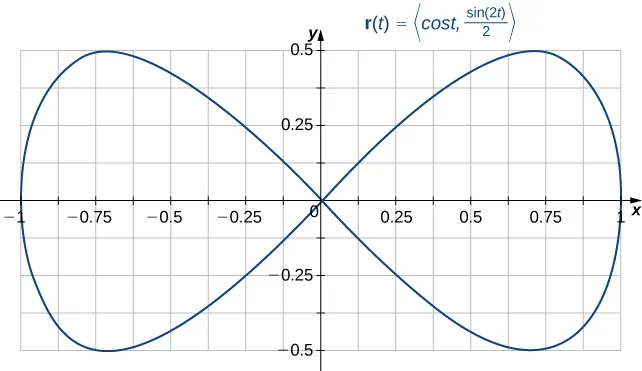
A curve [latex]C[/latex] is simple if it doesn’t cross itself. More precisely, [latex]C[/latex] is simple if it has a parameterization [latex]\mathbf{r}(t)[/latex], [latex]a\leq t\leq b[/latex], where [latex]\mathbf{r}[/latex] is one-to-one over [latex](a, b)[/latex]. Note that we can have [latex]\mathbf{r}(a)=\mathbf{r}(b)[/latex], which would make the simple curve also closed.
Now we need to define two types of regions. Many theorems in this module relate an integral over a region to an integral over its boundary. For these theorems to work, we need the region to be either connected or simply connected.
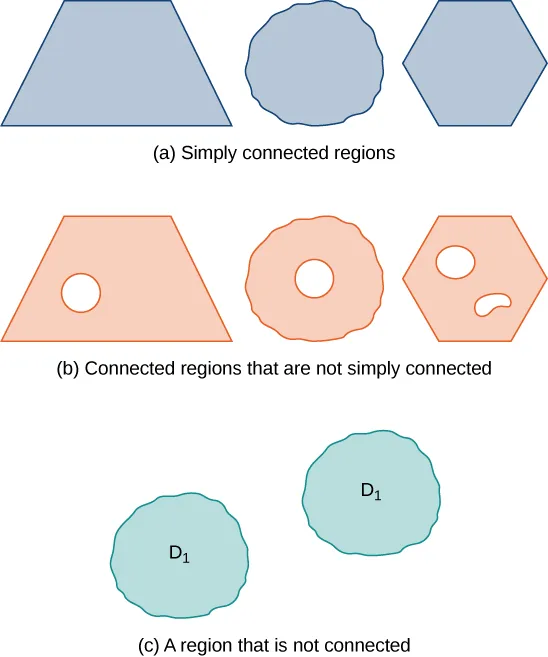
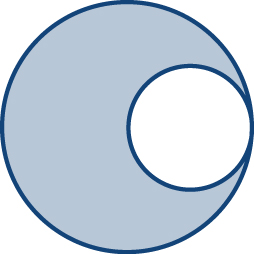
A connected region is one where you can draw a path between any two points without leaving the region. A simply connected region goes further—it’s a connected region with no holes in it.
connected and simply connected regions
A region [latex]D[/latex] is connected if, for any two points [latex]P_1[/latex] and [latex]P_2[/latex] in [latex]D[/latex], there exists a path from [latex]P_1[/latex] to [latex]P_2[/latex] that stays entirely inside [latex]D[/latex].
[latex]\\[/latex]
A region [latex]D[/latex] is simply connected if [latex]D[/latex] is connected and any simple closed curve [latex]C[/latex] inside [latex]D[/latex] can be continuously shrunk to a point while staying entirely inside [latex]D[/latex]. In two dimensions, this means the region is connected and has no holes.
All simply connected regions are connected, but not all connected regions are simply connected (Figure 3).