Projections
Vector addition combines vectors to create a resultant vector. But what if you need to work in reverse—breaking a vector into its component parts? Vector projections solve this problem by showing how much of one vector acts in the direction of another.
Consider a child pulling a wagon handle at a 55° angle. Only part of that pulling force actually moves the wagon forward—the horizontal component. Projections help us find exactly how much force is working in the direction we care about.
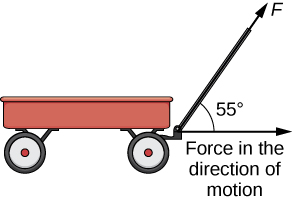
The vector projection of [latex]\mathbf{v}[/latex] onto [latex]\mathbf{u}[/latex], written as [latex]\text{proj}_{\mathbf{u}}\mathbf{v}[/latex], represents the component of [latex]\mathbf{v}[/latex] that acts in the direction of [latex]\mathbf{u}[/latex].
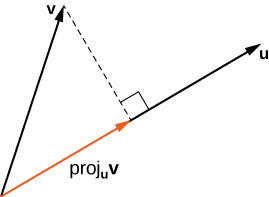
From the geometry of the situation, if [latex]\theta[/latex] is the angle between [latex]\mathbf{u}[/latex] and [latex]\mathbf{v}[/latex], then the length of the projection is:
[latex]||\text{proj}_{\mathbf{u}}\mathbf{v}|| = ||\mathbf{v}|| \cos \theta[/latex]
Using the dot product formula [latex]\cos \theta = \frac{\mathbf{u} \cdot \mathbf{v}}{||\mathbf{u}|| , ||\mathbf{v}||}[/latex], this becomes:
[latex]||\text{proj}_{\mathbf{u}}\mathbf{v}|| = ||\mathbf{v}|| \cdot \frac{|\mathbf{u} \cdot \mathbf{v}|}{||\mathbf{u}|| , ||\mathbf{v}||} = \frac{|\mathbf{u} \cdot \mathbf{v}|}{||\mathbf{u}||}[/latex]
To get the actual projection vector (not just its length), we multiply by a unit vector in the direction of [latex]\mathbf{u}[/latex]:
[latex]||\text{proj}_{\mathbf{u}}\mathbf{v}|| = \frac{\mathbf{u}\cdot\mathbf{v}}{||\mathbf{u}||}(\frac{1}{||\mathbf{u}||}\mathbf{u}) = \frac{\mathbf{u} \cdot \mathbf{v}}{||\mathbf{u}||^2}\mathbf{u}[/latex].
The length of this vector is also known as the scalar projection of [latex]\mathbf{v}[/latex] onto [latex]\mathbf{u}[/latex] and is denoted by
vector projection
Vector Projection Formula
[latex]\text{proj}_{\mathbf{u}}\mathbf{v} = \frac{\mathbf{u} \cdot \mathbf{v}}{||\mathbf{u}||^2}\mathbf{u}[/latex]
Scalar Projection (length only)
[latex]||\text{proj}_{\mathbf{u}}\mathbf{v}|| = \text{comp}_{\mathbf{u}}\mathbf{v} = \frac{\mathbf{u} \cdot \mathbf{v}}{||\mathbf{u}||}[/latex]
Find the projection of [latex]\mathbf{v}[/latex] onto [latex]\mathbf{u}[/latex].
- [latex]\mathbf{v} = \langle 3,5,1 \rangle[/latex] and [latex]\mathbf{u} = \langle -1,4,3 \rangle[/latex]
- [latex]\mathbf{v} = 3\mathbf{i} -2\mathbf{j}[/latex] and [latex]\mathbf{u} = \mathbf{i} +6\mathbf{j}[/latex]
Decomposing Vectors into Orthogonal Components
Projections allow us to decompose (break apart) vectors into orthogonal components. This process is called resolution of a vector into components.
Let [latex]\mathbf{v} = \langle 6,-4 \rangle[/latex] and [latex]\mathbf{u} = \langle 3,1 \rangle[/latex]. Decompose [latex]\mathbf{v}[/latex] into orthogonal components where one component has the same direction as [latex]\mathbf{u}[/latex].
Step 1: Find the projection of [latex]\mathbf{v}[/latex] onto [latex]\mathbf{u}[/latex]: [latex]\mathbf{p} = \text{proj}_{\mathbf{u}}\mathbf{v} = \frac{\mathbf{u} \cdot \mathbf{v}}{||\mathbf{u}||^2}\mathbf{u}[/latex]
[latex]\mathbf{u} \cdot \mathbf{v} = (3)(6) + (1)(-4) = 18 - 4 = 14[/latex]
[latex]||\mathbf{u}||^2 = 3^2 + 1^2 = 10[/latex]
[latex]\mathbf{p} = \frac{14}{10}\langle 3,1 \rangle = \frac{7}{5}\langle 3,1 \rangle = \left\langle \frac{21}{5}, \frac{7}{5} \right\rangle[/latex]
Step 2: Find the orthogonal component:
[latex]\mathbf{q} = \mathbf{v} - \mathbf{p} = \langle 6,-4 \rangle - \left\langle \frac{21}{5}, \frac{7}{5} \right\rangle = \left\langle \frac{9}{5}, -\frac{27}{5} \right\rangle[/latex]
Step 3: Verify orthogonality:
[latex]\mathbf{q} \cdot \mathbf{p} = \left\langle \frac{9}{5}, -\frac{27}{5} \right\rangle \cdot \left\langle \frac{21}{5}, \frac{7}{5} \right\rangle = \frac{189}{25} - \frac{189}{25} = 0[/latex] ✓
Therefore: [latex]\mathbf{v} = \mathbf{p} + \mathbf{q}[/latex] where [latex]\mathbf{p}[/latex] and [latex]\mathbf{q}[/latex] are orthogonal.
vector decomposition
Any vector [latex]\mathbf{v}[/latex] can be written as [latex]\mathbf{v} = \mathbf{p} + \mathbf{q}[/latex] where:
- [latex]\mathbf{p} = \text{proj}_{\mathbf{u}}\mathbf{v}[/latex] (component parallel to [latex]\mathbf{u}[/latex])
- [latex]\mathbf{q} = \mathbf{v} - \mathbf{p}[/latex] (component orthogonal to [latex]\mathbf{u}[/latex])
This decomposition is unique and [latex]\mathbf{p} \cdot \mathbf{q} = 0[/latex].