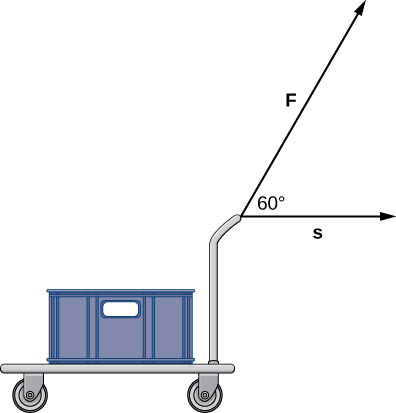
- Calculate the dot product of two given vectors
- Find angles between vectors and determine when vectors are perpendicular using dot products
- Explain what is meant by the vector projection of one vector onto another vector, and describe how to compute it
- Calculate the work done by a given force
The Dot Product
The Main Idea
The dot product is a way to “multiply” two vectors, but the result is a scalar (a number), not another vector. It measures how much two vectors align with each other and is essential for calculating work, finding angles between vectors, and determining if vectors are perpendicular.
Calculating the Dot Product
For vectors [latex]\mathbf{u} = \langle u_1, u_2, u_3 \rangle[/latex] and [latex]\mathbf{v} = \langle v_1, v_2, v_3 \rangle[/latex]:
[latex]\mathbf{u} \cdot \mathbf{v} = u_1v_1 + u_2v_2 + u_3v_3[/latex]
Process: Multiply corresponding components, then add the results.
For 2D vectors [latex]\mathbf{u} = \langle u_1, u_2 \rangle[/latex] and [latex]\mathbf{v} = \langle v_1, v_2 \rangle[/latex], it’s the same: [latex]\mathbf{u} \cdot \mathbf{v} = u_1v_1 + u_2v_2[/latex].
Example: [latex]\langle 3, 5, 2 \rangle \cdot \langle -1, 3, 0 \rangle = (3)(-1) + (5)(3) + (2)(0) = -3 + 15 + 0 = 12[/latex]
Key Properties
- Commutative: [latex]\mathbf{u} \cdot \mathbf{v} = \mathbf{v} \cdot \mathbf{u}[/latex]
- Distributive: [latex]\mathbf{u} \cdot (\mathbf{v} + \mathbf{w}) = \mathbf{u} \cdot \mathbf{v} + \mathbf{u} \cdot \mathbf{w}[/latex]
- Magnitude relationship: [latex]\mathbf{v} \cdot \mathbf{v} = ||\mathbf{v}||^2[/latex]
Important Observations
- [latex]\mathbf{0} \cdot \mathbf{v} = 0[/latex] for any vector
- A vector’s dot product with itself equals its magnitude squared: [latex]\mathbf{v} \cdot \mathbf{v} = ||\mathbf{v}||^2[/latex]
- Only the zero vector has a dot product of zero with itself
The dot product tells you how much two vectors point in the same direction. It’s the foundation for calculating work (force in the direction of motion) and finding angles between vectors.
Find the following products for [latex]\mathbf{p} = \langle 7,0,2 \rangle[/latex], [latex]\mathbf{q} = \langle -2,2,-2 \rangle[/latex], and [latex]\mathbf{r} = \langle 0,2,-3 \rangle[/latex].
- [latex](\mathbf{r} \cdot \mathbf{p})\mathbf{q}[/latex]
- [latex]||\mathbf{p}||^2[/latex]
Using the Dot Product to Find the Angle between Two Vectors
The Main Idea
The dot product has a geometric interpretation that connects it to angles between vectors. This makes it a powerful tool for finding angles and determining if vectors are perpendicular.
Geometric Dot Product Formula
For nonzero vectors [latex]\mathbf{u}[/latex] and [latex]\mathbf{v}[/latex] with angle [latex]\theta[/latex] between them:
[latex]\mathbf{u} \cdot \mathbf{v} = ||\mathbf{u}|| , ||\mathbf{v}|| \cos \theta[/latex]
Rearranging to solve for the angle:
[latex]\cos \theta = \frac{\mathbf{u} \cdot \mathbf{v}}{||\mathbf{u}|| , ||\mathbf{v}||}[/latex]
Then [latex]\theta = \arccos\left(\frac{\mathbf{u} \cdot \mathbf{v}}{||\mathbf{u}|| , ||\mathbf{v}||}\right)[/latex]
What the Angle Tells You
The sign of [latex]\cos \theta[/latex] reveals the relationship between vectors:
- [latex]\cos \theta > 0[/latex]: Acute angle (vectors point in similar directions)
- [latex]\cos \theta = 0[/latex]: Right angle (vectors are perpendicular)
- [latex]\cos \theta < 0[/latex]: Obtuse angle (vectors point in opposite-ish directions)
Orthogonal Vectors: The Perpendicular Test
Nonzero vectors [latex]\mathbf{u}[/latex] and [latex]\mathbf{v}[/latex] are orthogonal (perpendicular) if and only if [latex]\mathbf{u} \cdot \mathbf{v} = 0[/latex].
To test if vectors are perpendicular, just compute their dot product. If it’s zero, they’re orthogonal.
Direction Angles and Cosines
A vector’s direction angles ([latex]\alpha[/latex], [latex]\beta[/latex], [latex]\gamma[/latex]) are the angles it makes with the positive [latex]x[/latex]-, [latex]y[/latex]-, and [latex]z[/latex]-axes. Find them by taking dot products with [latex]\mathbf{i}[/latex], [latex]\mathbf{j}[/latex], and [latex]\mathbf{k}[/latex].
Let [latex]\mathbf{v} = \langle 3,-5,1 \rangle[/latex]. Find the measure of the angles formed by each pair of vectors.
- [latex]\mathbf{v}[/latex] and [latex]\mathbf{i}[/latex]
- [latex]\mathbf{v}[/latex] and [latex]\mathbf{j}[/latex]
- [latex]\mathbf{v}[/latex] and [latex]\mathbf{k}[/latex]
Projections
The Main Idea
Sometimes you need to know how much of one vector acts in the direction of another. Vector projection answers this question by finding the component of vector [latex]\mathbf{v}[/latex] that points in the direction of vector [latex]\mathbf{u}[/latex].
The vector projection of [latex]\mathbf{v}[/latex] onto [latex]\mathbf{u}[/latex]:
[latex]\text{proj}_{\mathbf{u}}\mathbf{v} = \frac{\mathbf{u} \cdot \mathbf{v}}{||\mathbf{u}||^2}\mathbf{u}[/latex]
The scalar projection (just the length, not the vector):
[latex]\text{comp}_{\mathbf{u}}\mathbf{v} = \frac{|\mathbf{u} \cdot \mathbf{v}|}{||\mathbf{u}||}[/latex]
Think of projection as the “shadow” [latex]\mathbf{v}[/latex] casts onto [latex]\mathbf{u}[/latex] when light shines perpendicular to [latex]\mathbf{u}[/latex].
Decomposing Vectors
Any vector [latex]\mathbf{v}[/latex] can be split into two orthogonal (perpendicular) parts:
[latex]\mathbf{v} = \mathbf{p} + \mathbf{q}[/latex]
where:
- [latex]\mathbf{p} = \text{proj}_{\mathbf{u}}\mathbf{v}[/latex] (component parallel to [latex]\mathbf{u}[/latex])
- [latex]\mathbf{q} = \mathbf{v} - \mathbf{p}[/latex] (component perpendicular to [latex]\mathbf{u}[/latex])
These components satisfy [latex]\mathbf{p} \cdot \mathbf{q} = 0[/latex], confirming they’re orthogonal.
Process:
- Calculate [latex]\mathbf{p} = \text{proj}_{\mathbf{u}}\mathbf{v}[/latex]
- Find [latex]\mathbf{q} = \mathbf{v} - \mathbf{p}[/latex]
- Verify: Check that [latex]\mathbf{p} \cdot \mathbf{q} = 0[/latex]
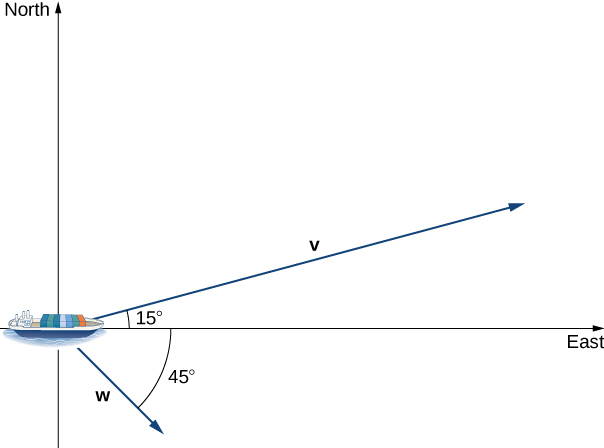
A container ship leaves port traveling [latex]15^\circ[/latex] north of east. Its engine generates a speed of [latex]20[/latex] knots along that path (see the following figure). In addition, the ocean current moves the ship southeast at a speed of [latex]2[/latex] knots. Considering both the engine and the current, how fast is the ship moving in the direction [latex]15^\circ[/latex] north of east? Round the answer to two decimal places.
Work
The Main Idea
The most important real-world application of the dot product is calculating work—the energy required to move an object with force.
When force and motion point in the same direction, work is simple: [latex]W = F \cdot d[/latex] (force times distance). But when force acts at an angle to the motion—like pulling a wagon handle at 55°—only part of the force actually moves the object. The dot product automatically accounts for this angle.
Work Formula
When constant force [latex]\mathbf{F}[/latex] moves an object from point [latex]P[/latex] to point [latex]Q[/latex]:
[latex]W = \mathbf{F} \cdot \overrightarrow{PQ} = ||\mathbf{F}|| , ||\overrightarrow{PQ}|| \cos \theta[/latex]
where [latex]\theta[/latex] is the angle between the force and displacement vectors.
The term [latex]||\mathbf{F}|| \cos \theta[/latex] is the component of force in the direction of motion—exactly what you get from projection. Work equals this component times the distance moved.
Special Cases
- [latex]\theta = 0°[/latex] (same direction): Maximum work, [latex]W = ||\mathbf{F}|| , ||\overrightarrow{PQ}||[/latex]
- [latex]\theta = 90°[/latex] (perpendicular): No work, [latex]W = 0[/latex]
- [latex]\theta = 180°[/latex] (opposite direction): Negative work, [latex]W = -||\mathbf{F}|| , ||\overrightarrow{PQ}||[/latex]
Units
- U.S. Standard: Force (pounds) × Distance (feet) = Work (foot-pounds or ft⋅lb)
- Metric: Force (newtons) × Distance (meters) = Work (joules or J)
One joule equals one newton-meter.