Advanced Partial Derivatives: Background You’ll Need 3
Use implicit differentiation to find derivatives and the equations for tangent lines
What is Implicit Differentiation?
When an equation relates [latex]x[/latex] and [latex]y[/latex] without explicitly solving for one variable, you can still find derivatives using implicit differentiation.
Explicit function: [latex]y[/latex] is isolated on one side
Example: [latex]y = x^2 + 1[/latex]
Implicit function: [latex]x[/latex] and [latex]y[/latex] are interrelated in an equation
Example: [latex]x^2 + y^2 = 25[/latex]
Implicit differentiation is essential for finding the slopes of tangent lines to curves that are not explicit functions. For example, the equation [latex]y-x^2=1[/latex] implicitly defines [latex]y[/latex] because it does not isolate [latex]y[/latex] on one side of the equation. This method allows us to derive relations where [latex]y[/latex] is defined implicitly by differentiating both sides of the equation with respect to [latex]x[/latex], treating [latex]y[/latex] as a function of [latex]x[/latex] where necessary.
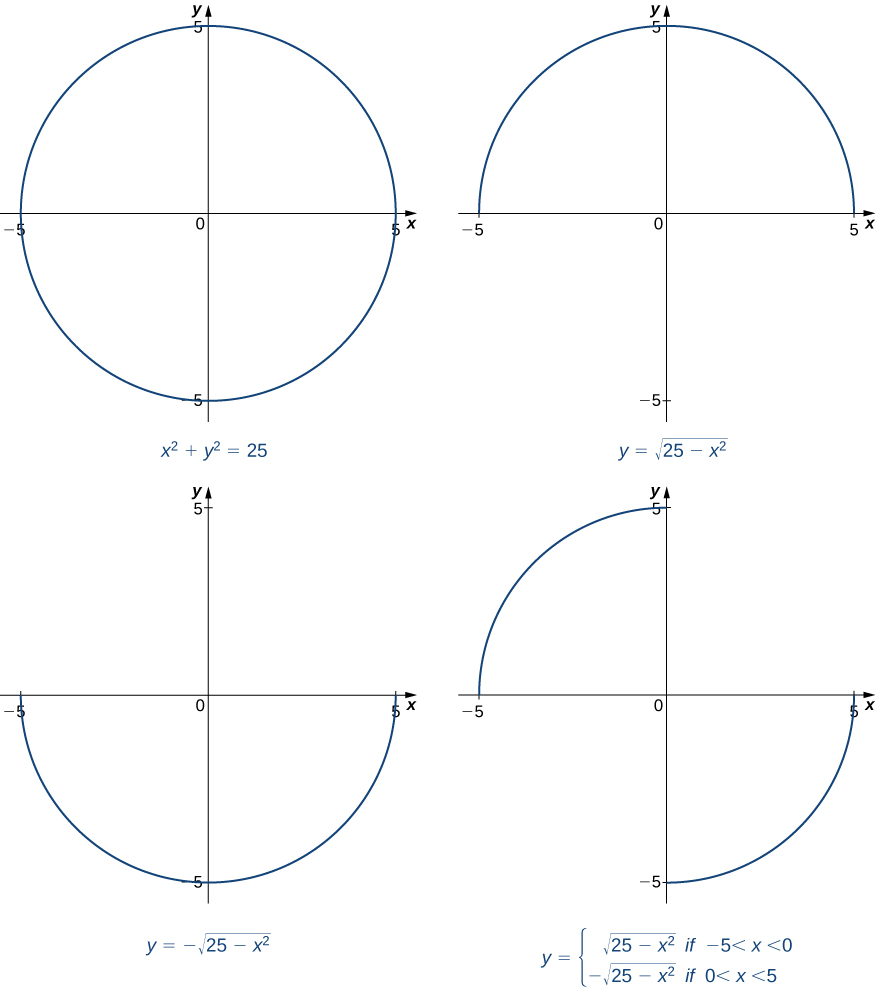
An equation defines a function implicitly if it holds for [latex]y[/latex] and [latex]x[/latex] without isolating one variable on one side. For instance, the equations:
[latex]y=\sqrt{25-x^2}[/latex], [latex]y = -\sqrt{25-x^2}[/latex], and [latex]y=\begin{cases} \sqrt{25-x^2} & \text{ if } \, -5 \le x < 0 \\ -\sqrt{25-x^2} & \text{ if } \, 0 \le x \le 5 \end{cases}[/latex],
are all examples of functions defined implicitly by the circle equation [latex]x^2+y^2=25[/latex].
Figure 1 illustrates how the equation [latex]x^2+y^2=25[/latex] defines multiple functions implicitly, showcasing different ways [latex]y[/latex] can be expressed in relation to [latex]x[/latex]. These representations include the full circle and its segments, dependent on [latex]x[/latex] values, demonstrating the versatility of implicit functions.
Figure 1. The equation [latex]{x}^{2}+{y}^{2}=25[/latex] defines many functions implicitly.
To apply implicit differentiation practically, consider finding the slope of the tangent line to the circle at a specific point.
For example, to determine the slope at point [latex](3,4)[/latex], one might initially think to differentiate [latex]y=\sqrt{25-x^2}[/latex] directly at [latex]x=3[/latex]. Similarly, to find the slope at [latex](3,-4)[/latex], we could use the derivative of [latex]y=−\sqrt{25-x^2}[/latex]. However, these expressions don’t always provide the clearest path for differentiation, especially over different ranges of [latex]x[/latex].
Implicit differentiation streamlines this process by differentiating the entire equation directly:
[latex]2x+2y \frac{dy}{dx}=0[/latex]
This leads to:
[latex]\frac{dy}{dx}=\frac{-x}{y}[/latex]
which can then be evaluated at any point on the curve without having to solve explicitly for [latex]y[/latex] first. This method confirms the flexibility and power of implicit differentiation in handling equations where [latex]y[/latex] is not isolated.
The process of finding [latex]\frac{dy}{dx}[/latex] using implicit differentiation is described in the following problem-solving strategy.
How to: Implicit Differentiation
Differentiate both sides with respect to [latex]x[/latex]
Treat [latex]y[/latex] as a function of [latex]x[/latex]
Use the chain rule when differentiating terms with [latex]y[/latex]
Example: [latex]\frac{d}{dx}(\sin y) = \cos y \cdot \frac{dy}{dx}[/latex]
Collect [latex]\frac{dy}{dx}[/latex] terms on one side of the equation
Factor out [latex]\frac{dy}{dx}[/latex]
Solve for [latex]\frac{dy}{dx}[/latex] by dividing both sides
Assuming that [latex]y[/latex] is defined implicitly by the equation [latex]x^2+y^2=25[/latex], find [latex]\frac{dy}{dx}[/latex].
Follow the steps in the problem-solving strategy.
[latex]\begin{array}{llll} \frac{d}{dx}(x^2+y^2) = \frac{d}{dx}(25) & & & \text{Step 1. Differentiate both sides of the equation.} \\ \frac{d}{dx}(x^2)+\frac{d}{dx}(y^2) = 0 & & & \begin{array}{l}\text{Step 1.1. Use the sum rule on the left.} \\ \text{On the right,} \, \frac{d}{dx}(25)=0. \end{array} \\ 2x+2y\frac{dy}{dx} = 0 & & & \begin{array}{l}\text{Step 1.2. Take the derivatives, so} \, \frac{d}{dx}(x^2)=2x \\ \text{and} \, \frac{d}{dx}(y^2)=2y\frac{dy}{dx}. \end{array} \\ 2y\frac{dy}{dx} = -2x & & & \begin{array}{l}\text{Step 2. Keep the terms with} \, \frac{dy}{dx} \, \text{on the left.} \\ \text{Move the remaining terms to the right.} \end{array} \\ \frac{dy}{dx} = -\frac{x}{y} & & & \begin{array}{l}\text{Step 4. Divide both sides of the equation by} \\ 2y. \, \text{(Step 3 does not apply in this case.)} \end{array} \end{array}[/latex]
Analysis
Note that the resulting expression for [latex]\frac{dy}{dx}[/latex] is in terms of both the independent variable [latex]x[/latex] and the dependent variable [latex]y[/latex]. Although in some cases it may be possible to express [latex]\frac{dy}{dx}[/latex] in terms of [latex]x[/latex] only, it is generally not possible to do so.
Assuming that [latex]y[/latex] is defined implicitly by the equation [latex]x^3 \sin y+y=4x+3[/latex], find [latex]\frac{dy}{dx}[/latex].
[latex]\begin{array}{llll}\frac{d}{dx}(x^3 \sin y+y) = \frac{d}{dx}(4x+3) & & & \text{Step 1: Differentiate both sides of the equation.} \\ \frac{d}{dx}(x^3 \sin y)+\frac{d}{dx}(y) = 4 & & & \begin{array}{l}\text{Step 1.1: Apply the sum rule on the left.} \\ \text{On the right,} \, \frac{d}{dx}(4x+3)=4. \end{array} \\ (\frac{d}{dx}(x^3) \cdot \sin y+\frac{d}{dx}(\sin y) \cdot x^3) + \frac{dy}{dx} = 4 & & & \begin{array}{l}\text{Step 1.2: Use the product rule to find} \\ \frac{d}{dx}(x^3 \sin y). \, \text{Observe that} \, \frac{d}{dx}(y)=\frac{dy}{dx}. \end{array} \\ 3x^2 \sin y+(\cos y\frac{dy}{dx}) \cdot x^3 + \frac{dy}{dx} = 4 & & & \begin{array}{l}\text{Step 1.3: We know} \, \frac{d}{dx}(x^3)=3x^2. \, \text{Use the} \\ \text{chain rule to obtain} \, \frac{d}{dx}(\sin y)= \cos y\frac{dy}{dx}. \end{array} \\ x^3 \cos y\frac{dy}{dx}+\frac{dy}{dx} = 4-3x^2 \sin y & & & \begin{array}{l}\text{Step 2: Keep all terms containing} \, \frac{dy}{dx} \, \text{on the} \\ \text{left. Move all other terms to the right.} \end{array} \\ \frac{dy}{dx}(x^3 \cos y+1) = 4-3x^2 \sin y & & & \text{Step 3: Factor out} \, \frac{dy}{dx} \, \text{on the left.} \\ \frac{dy}{dx} = \large \frac{4-3x^2 \sin y}{x^3 \cos y+1} & & & \begin{array}{l}\text{Step 4: Solve for} \, \frac{dy}{dx} \, \text{by dividing both sides of} \\ \text{the equation by} \, x^3 \cos y+1. \end{array} \end{array}[/latex]
Find [latex]\frac{d^2 y}{dx^2}[/latex] if [latex]x^2+y^2=25[/latex].
In the first example, we showed that [latex]\frac{dy}{dx}=-\frac{x}{y}[/latex]. We can take the derivative of both sides of this equation to find [latex]\frac{d^2 y}{dx^2}[/latex].
At this point we have found an expression for [latex]\frac{d^2 y}{dx^2}[/latex]. If we choose, we can simplify the expression further by recalling that [latex]x^2+y^2=25[/latex] and making this substitution in the numerator to obtain [latex]\frac{d^2 y}{dx^2}=-\frac{25}{y^3}[/latex].
Watch the following video to see the worked solution to this example..
For closed captioning, open the video on its original page by clicking the Youtube logo in the lower right-hand corner of the video display. In YouTube, the video will begin at the same starting point as this clip, but will continue playing until the very end.