- Switch between cylindrical and rectangular coordinates
- Switch between spherical and rectangular coordinates
- Recognize and describe different types of quadric surfaces
- Analyze 3D surfaces by looking at their cross-sections and traces
Cylindrical Coordinates
The Main Idea
Just as polar coordinates simplify circular problems in 2D, cylindrical coordinates extend this advantage to 3D, making problems with cylindrical symmetry much easier to handle.
Cylindrical Coordinate System
A point in space is represented by [latex](r, \theta, z)[/latex]:
- [latex](r, \theta)[/latex]: polar coordinates of the point’s projection onto the [latex]xy[/latex]-plane
- [latex]z[/latex]: height above or below the [latex]xy[/latex]-plane
Tip: Find the point’s “shadow” on the floor using polar coordinates, then specify how high/low it sits.
Conversion Formulas
Cylindrical to Rectangular:
- [latex]x = r\cos\theta[/latex]
- [latex]y = r\sin\theta[/latex]
- [latex]z = z[/latex]
Rectangular to Cylindrical:
- [latex]r = \sqrt{x^2 + y^2}[/latex]
- [latex]\tan\theta = \frac{y}{x}[/latex] (choose [latex]\theta[/latex] based on quadrant)
- [latex]z = z[/latex]
Constant Coordinate Surfaces
- [latex]r = c[/latex]: Vertical circular cylinder of radius [latex]c[/latex] (fixed distance from [latex]z[/latex]-axis)
- [latex]\theta = c[/latex]: Half-plane starting at [latex]z[/latex]-axis, making angle [latex]c[/latex] with positive [latex]x[/latex]-axis
- [latex]z = c[/latex]: Horizontal plane (same as rectangular coordinates)
Why Use Cylindrical Coordinates?
They simplify equations with cylindrical symmetry. For example:
- Rectangular: [latex]x^2 + y^2 = 25[/latex] (a cylinder)
- Cylindrical: [latex]r = 5[/latex] (much simpler!)


Spherical Coordinates
The Main Idea
Spherical coordinates use one distance and two angles to locate points in 3D space. They excel at problems with spherical symmetry—like planetary fields, domed structures, or radiation from a point source.
Spherical Coordinate System
A point is represented by [latex](\rho, \theta, \varphi)[/latex]:
- [latex]\rho[/latex] (rho): distance from the origin to the point
- [latex]\theta[/latex]: angle in the [latex]xy[/latex]-plane (same as cylindrical)
- [latex]\varphi[/latex] (phi): angle down from the positive [latex]z[/latex]-axis ([latex]0 \leq \varphi \leq \pi[/latex])
Key point: [latex]\varphi[/latex] measures from the [latex]z[/latex]-axis, not from the [latex]xy[/latex]-plane. So [latex]\varphi = 0[/latex] points straight up, [latex]\varphi = \frac{\pi}{2}[/latex] lies in the [latex]xy[/latex]-plane, and [latex]\varphi = \pi[/latex] points straight down.
Conversion Formulas
Spherical to Rectangular:
- [latex]x = \rho \sin \varphi \cos \theta[/latex]
- [latex]y = \rho \sin \varphi \sin \theta[/latex]
- [latex]z = \rho \cos \varphi[/latex]
Rectangular to Spherical:
- [latex]\rho = \sqrt{x^2 + y^2 + z^2}[/latex]
- [latex]\tan \theta = \frac{y}{x}[/latex] (choose quadrant)
- [latex]\varphi = \arccos\left(\frac{z}{\sqrt{x^2 + y^2 + z^2}}\right)[/latex]
Constant Coordinate Surfaces
- [latex]\rho = c[/latex]: Sphere of radius [latex]c[/latex] centered at origin
- [latex]\theta = c[/latex]: Half-plane from [latex]z[/latex]-axis at angle [latex]c[/latex]
- [latex]\varphi = c[/latex]: Half-cone making angle [latex]c[/latex] with positive [latex]z[/latex]-axis
Why Use Spherical Coordinates?
They simplify spherical symmetry problems. A sphere [latex]x^2 + y^2 + z^2 = c^2[/latex] becomes simply [latex]\rho = c[/latex].
Real-World Application: Latitude and longitude use spherical-like coordinates to describe Earth locations. The coordinate system matches the natural shape and symmetry of the problem.
Choosing Coordinates: Match the coordinate system to your problem’s symmetry—rectangular for general cases, cylindrical for rotation around an axis, spherical for radiation from a point.

Describe the surfaces defined by the following equations.
- [latex]\rho=13[/latex]
- [latex]\theta=\frac{2\pi}3[/latex]
- [latex]\varphi=\frac{\pi}4[/latex]

How should we orient the coordinate axes?
Cylinders and Surfaces in 3D
The Main Idea
The mathematical definition of a cylinder is broader than the everyday “hollow tube” image—any curve extended by parallel lines creates a cylinder.
A cylinder (or cylindrical surface) is formed by a set of parallel lines (called rulings) passing through a given curve. The curve can be any shape, and the rulings can be parallel to any direction.
Identifying Cylinders from Equations
An equation describes a cylinder if one variable is missing. The missing variable tells you the direction of the rulings:
- Missing [latex]z[/latex]: rulings parallel to [latex]z[/latex]-axis
- Missing [latex]y[/latex]: rulings parallel to [latex]y[/latex]-axis
- Missing [latex]x[/latex]: rulings parallel to [latex]x[/latex]-axis
Examples:
- [latex]x^2 + y^2 = 9[/latex]: circular cylinder (rulings parallel to [latex]z[/latex]-axis)
- [latex]x^2 + z^2 = 25[/latex]: circular cylinder (rulings parallel to [latex]y[/latex]-axis)
- [latex]y = \sin x[/latex]: sinusoidal cylinder (rulings parallel to [latex]z[/latex]-axis)
Traces
Traces are the curves formed when a surface intersects planes parallel to coordinate planes ([latex]xy[/latex], [latex]xz[/latex], or [latex]yz[/latex]).
For cylinders: Only one trace is informative—the one perpendicular to the rulings shows the generating curve. Traces parallel to the rulings just show parallel lines.
Example: For [latex]y = \sin x[/latex]:
- [latex]xz[/latex]-plane trace ([latex]y = 0[/latex]): Shows the sine wave
- Other traces: Just parallel lines (not helpful)
Key Insight: Cylinders are the simplest 3D surfaces—they’re just 2D curves extended in a straight direction. More complex surfaces require examining multiple traces to understand their full 3D shape.

Quadric Surfaces
The Main Idea
Quadric surfaces are 3D extensions of conic sections (ellipses, parabolas, hyperbolas), described by second-degree equations. Understanding their traces reveals their shape.
General Form
[latex]Ax^2 + By^2 + Cz^2 + Dxy + Exz + Fyz + Gx + Hy + Jz + K = 0[/latex]
Key Surfaces
Ellipsoid: [latex]\frac{x^2}{a^2} + \frac{y^2}{b^2} + \frac{z^2}{c^2} = 1[/latex]
- All traces are ellipses
- Special case: [latex]a = b = c[/latex] gives a sphere
- Extends [latex]a[/latex], [latex]b[/latex], [latex]c[/latex] units along each axis
Elliptic Paraboloid: [latex]\frac{x^2}{a^2} + \frac{y^2}{b^2} = \frac{z}{c}[/latex]
- Bowl-shaped surface
- Traces perpendicular to axis: ellipses (or circles if [latex]a = b[/latex])
- Traces parallel to axis: parabolas
- Opens up if [latex]c > 0[/latex], down if [latex]c < 0[/latex]
- Variable to first power determines axis direction
Using Traces to Identify Surfaces
Traces are cross-sections where the surface meets coordinate planes. To identify a quadric surface:
- Check which variables are squared vs. first power
- Look at signs (positive vs. negative coefficients)
- Find traces by setting [latex]x = 0[/latex], [latex]y = 0[/latex], and [latex]z = 0[/latex]
- Put equation in standard form if needed
Identification Strategy:
- All squared terms with same sign → ellipsoid or sphere
- One first-power term, two squared (same sign) → elliptic paraboloid
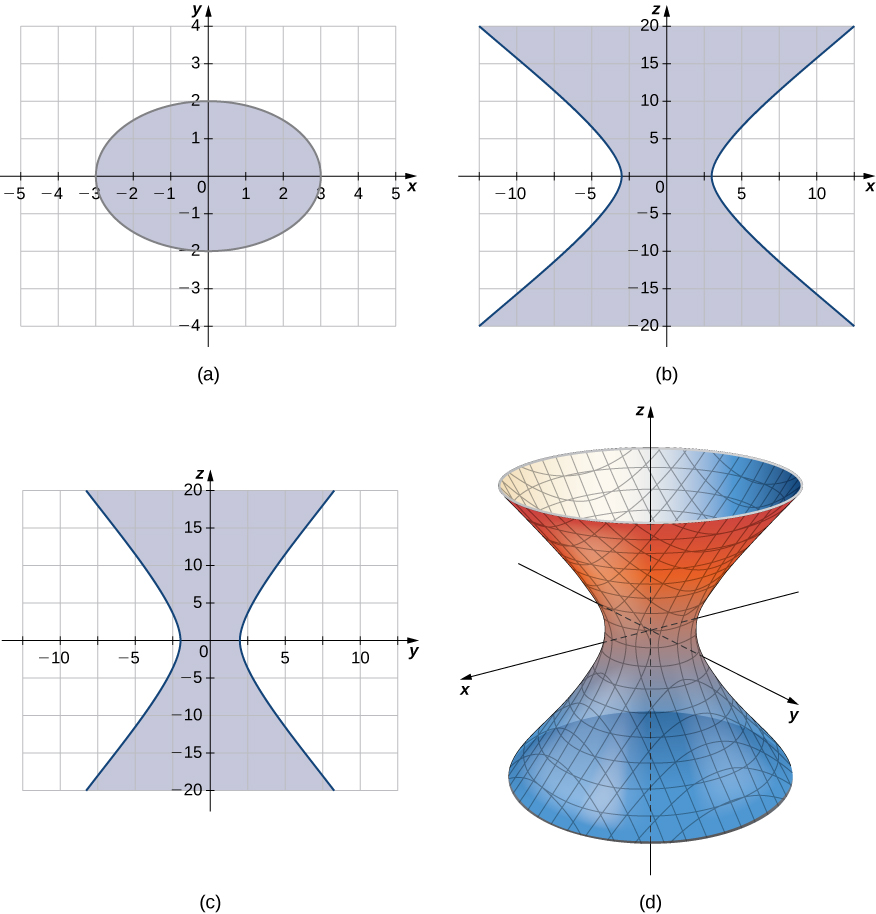
- Mixed signs in squared terms → hyperboloid or hyperbolic paraboloid
Real-World Applications
- Parabolic reflectors: Satellite dishes and solar collectors use elliptic paraboloids because energy hitting the surface concentrates at the focal point
- Hyperboloids: Nuclear cooling towers use hyperboloids of one sheet—they can be built with straight beams, making them strong yet economical