Curvature
An important topic related to arc length is curvature. The concept of curvature provides a way to measure how sharply a smooth curve turns. A circle has constant curvature—the smaller the radius, the greater the curvature.
Think of driving down a road. If the road lies on an arc of a large circle, you would barely need to turn the wheel to stay on the road. If the radius is smaller, you need to turn more sharply. For curves other than circles, we can inscribe a circle to the curve at a given point so that it is tangent to the curve and “hugs” it as closely as possible in a neighborhood of that point (Figure 1). The curvature of the graph at that point is then defined to be the same as the curvature of the inscribed circle.
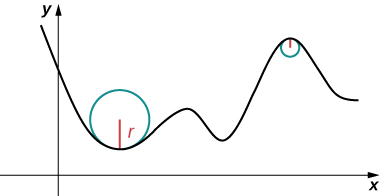
curvature
Let [latex]C[/latex] be a smooth curve in the plane or in space given by [latex]{\bf{r}}(s)[/latex], where [latex]s[/latex] is the arc-length parameter. The curvature [latex]\kappa[/latex] at [latex]s[/latex] is:
[latex]\kappa=\left\Vert\frac{d{\bf{T}}}{ds}\right\Vert=\left\Vert{\bf{T}}'(s)\right\Vert[/latex]
The formula in this definition is not very practical for calculation. Recall that [latex]{\bf{T}}(t)[/latex] represents the unit tangent vector to [latex]{\bf{r}}(t)[/latex], given by [latex]{\bf{T}}(t)=\frac{{\bf{r}}'(t)}{\left\Vert{\bf{r}}'(t)\right\Vert}[/latex]. Using the definition would require expressing [latex]{\bf{r}}(t)[/latex] in terms of the arc-length parameter [latex]s[/latex], finding the unit tangent vector [latex]{\bf{T}}(s)[/latex], then taking the derivative with respect to [latex]s[/latex]—a tedious process. Fortunately, there are more convenient formulas.
alternative formulas for curvature
If [latex]C[/latex] is a smooth curve given by [latex]{\bf{r}}(t)[/latex], then the curvature [latex]\kappa[/latex] of [latex]C[/latex] at [latex]t[/latex] is given by
If [latex]C[/latex] is a three-dimensional curve, then the curvature can be given by the formula
If [latex]C[/latex] is the graph of a function [latex]y=f(x)[/latex] and both [latex]y'[/latex] and [latex]y''[/latex] exist, then the curvature [latex]\kappa[/latex] at point [latex](x,\ y)[/latex] is given by
Proof
The first formula follows directly from the chain rule:
[latex]\large{\frac{d{\bf{T}}}{dt}=\frac{d{\bf{T}}}{ds}\frac{ds}{dt}}[/latex],
where [latex]s[/latex] is the arc length along the curve [latex]C[/latex]. Dividing both sides by [latex]ds/dt[/latex], and taking the magnitude of both sides gives
[latex]\large{\left\Vert\frac{d{\bf{T}}}{dt}\right\Vert=\left\Vert\frac{{\bf{T}}'(t)}{\frac{ds}{dt}}\right\Vert}[/latex].
Since [latex]ds/dt=\left\Vert{\bf{r}}'(t)\right\Vert[/latex], this gives the formula for the curvature [latex]\kappa[/latex] of a curve [latex]C[/latex] in terms of any parameterization of [latex]C[/latex]:
[latex]\large{\kappa=\frac{\left\Vert{\bf{T}}'(t)\right\Vert}{\left\Vert{\bf{r}}'(t)\right\Vert}}[/latex].
In the case of a three-dimensional curve, we start with the formulas [latex]{\bf{T}}(t)=\big({\bf{r}}'(t)\big)/\left\Vert{\bf{r}}'(t)\right\Vert[/latex] and [latex]ds/dt=\left\Vert{\bf{r}}'(t)\right\Vert[/latex]. Therefore, [latex]{\bf{r}}'(t)=(ds/dt){\bf{T}}(t)[/latex]. We can take the derivative of this function using the scalar product formula:
[latex]{\bf{r}}''(t)=\frac{d^{2}s}{dt^{2}}{\bf{T}}(t)+\frac{ds}{dt}{\bf{T}}'(t)[/latex].
Using these last two equations we get
[latex]\begin{array}{ccc}\hfill {{\bf{r}}'(t)\times{\bf{r}}''(t)} & =\hfill & {\frac{ds}{dt}{\bf{T}}(t)\times\big(\frac{d^{2}s}{dt^{2}}{\bf{T}}(t)+\frac{ds}{dt}{\bf{T}}'(t)\big)} \hfill \\ \hfill & =\hfill & {\frac{ds}{dt}\frac{d^{2}s}{dt^{2}}{\bf{T}}(t)\times{\bf{T}}(t)+\big(\frac{ds}{dt}\big)^{2}{\bf{T}}(t)\times{\bf{T}}'(t).}\hfill \\ \hfill \end{array}[/latex]
Since [latex]{\bf{T}}(t)\times{\bf{T}}(t)=0[/latex], this reduces to
[latex]{\bf{r}}'(t)\times{\bf{r}}''(t)=\big(\frac{ds}{dt}\big)^{2}{\bf{T}}(t)\times{\bf{T}}'(t)[/latex].
Since [latex]{\bf{T}}'[/latex] is parallel to [latex]{\bf{N}}[/latex], and [latex]{\bf{T}}[/latex] is orthogonal to [latex]{\bf{N}}[/latex], it follows that [latex]{\bf{T}}[/latex] and [latex]{\bf{T}}'[/latex] are orthogonal. This means that [latex]\left\Vert{\bf{T}}\times{\bf{T}}'\right\Vert=\left\Vert{\bf{T}}\right\Vert\left\Vert{\bf{T}}'\right\Vert\sin{(\pi/2)}=\left\Vert{\bf{T}}'\right\Vert[/latex], so
[latex]\large{\left\Vert{\bf{r}}'(t)\times{\bf{r}}''(t)\right\Vert=\big(\frac{ds}{dt}\big)\left\Vert{\bf{T}}'(t)\right\Vert}[/latex].
Now we solve this equation for [latex]\left\Vert{\bf{T}}'(t)\right\Vert[/latex] and use the fact that [latex]ds/dt=\left\Vert{\bf{r}}'(t)\right\Vert[/latex]:
[latex]\large{\left\Vert{\bf{T}}'(t)\right\Vert=\frac{\left\Vert{\bf{r}}'(t)\times{\bf{r}}''(t)\right\Vert}{\left\Vert{\bf{r}}'(t)\right\Vert^{2}}}[/latex]
Then, we divide both sides by [latex]\left\Vert{\bf{r}}'(t)\right\Vert[/latex]. This gives
[latex]\large{\kappa=\frac{\left\Vert{\bf{T}}'(t)\right\Vert}{\left\Vert{\bf{r}}'(t)\right\Vert}=\frac{\left\Vert{\bf{r}}'(t)\times{\bf{r}}''(t)\right\Vert}{\left\Vert{\bf{r}}'(t)\right\Vert^{3}}}[/latex]
This proves the second equation in our Alternative Formulas for Curvature Theorem. To prove the third equation in our Alternative Formulas for Curvature Theorem, we start with the assumption that curve [latex]C[/latex] is defined by the function [latex][/latex]. Then, we can define [latex][/latex]. Using the previous formula for curvature:
[latex]\begin{array}{ccc}\hfill {{\bf{r}}'(t)} & =\hfill & {{\bf{i}}+f'(x){\bf{j}}}\hfill \\ \hfill {{\bf{r}}''(t)} & =\hfill & {f''(x){\bf{j}}} \hfill \\ \hfill {{\bf{r}}'(t)\times{\bf{r}}''(t)} & =\hfill & {\begin{vmatrix}{\bf{i}} & {\bf{j}} & {\bf{k}}\\1 & f'(x) & 0\\0 & f''(x) & 0\end{vmatrix}=f''(x){\bf{k}}.}\hfill \\ \hfill \end{array}[/latex]
Therefore,
[latex]\large{\kappa=\frac{\left\Vert{\bf{r}}'(t)\times{\bf{r}}''(t)\right\Vert}{\left\Vert{\bf{r}}'(t)\right\Vert^{3}}=\frac{|f''(x)|}{(1+[(f'(x))^{2}])^{3/2}}}[/latex].
[latex]_\blacksquare[/latex]
Choosing the Right Formula
- Use the first formula when you have the unit tangent vector [latex]{\bf{T}}(t)[/latex] already calculated
- Use the cross product formula for space curves—it only requires the first and second derivatives of [latex]{\bf{r}}(t)[/latex]
- Use the [latex]y=f(x)[/latex] formula when working with curves given as functions rather than vector-valued functions
- [latex]{\bf{r}}(t)=4\cos{t{\bf{i}}}+4\sin{t{\bf{j}}}+3t{\bf{k}},\ t=\frac{4\pi}{3}[/latex]
- [latex]f(x)=\sqrt{4x-x^{2}},\ x=2[/latex]

