Cylinders and Surfaces in 3D
We’ve explored vectors, lines, planes, and spheres in three-dimensional space. Now we’ll investigate a broader variety of surfaces that can be graphed in 3D coordinate systems, starting with cylinders.
Identifying Cylinders
When most people hear “cylinder,” they think of a hollow pipe or soda can. But the mathematical definition is much broader—a rectangular heating duct is a cylinder, as is a rolled-up yoga mat with spiral cross-section.
Consider the equation [latex]x^2 + y^2 = 9[/latex]. In 2D, this describes a circle centered at the origin with radius 3. In 3D, this same equation represents a surface. Imagine stacking copies of this circle on top of each other, all centered on the [latex]z[/latex]-axis. This creates a hollow tube extending infinitely in both directions along the [latex]z[/latex]-axis.
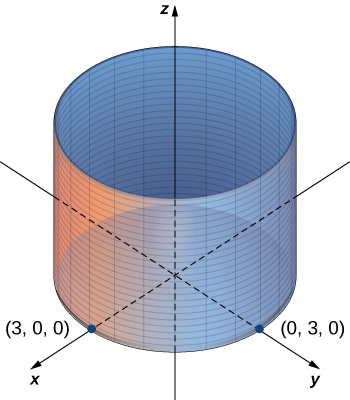
cylindrical surface
A set of parallel lines (called rulings) passing through a given curve forms a cylindrical surface, or cylinder. The rulings can be parallel to any line, and the original curve can have any shape.
This definition shows that cylinders don’t need circular cross-sections. Any curve can form a cylinder, and the parallel lines can point in any direction.
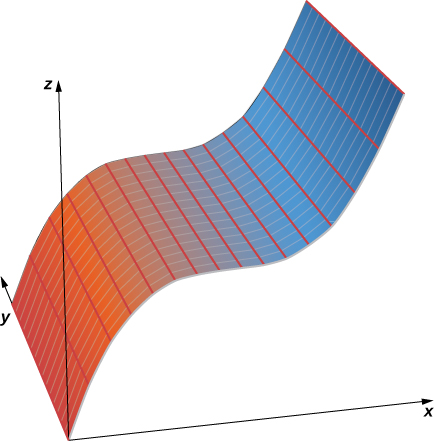
Identifying Cylinders: An equation describes a cylinder if one variable is completely missing. The missing variable corresponds to the direction of the rulings:
- Missing [latex]z[/latex]: rulings parallel to [latex]z[/latex]-axis
- Missing [latex]y[/latex]: rulings parallel to [latex]y[/latex]-axis
- Missing [latex]x[/latex]: rulings parallel to [latex]x[/latex]-axis
Sketch the graphs of the following cylindrical surfaces.
- [latex]x^{2}+z^{2}=25[/latex]
- [latex]z=2x^{2}-y[/latex]
- [latex]y=\sin x[/latex]


Traces: Cross-Sections of Surfaces
When sketching surfaces, it helps to examine where the surface intersects planes parallel to the coordinate planes. These intersections are called traces.
traces
The traces of a surface are the cross-sections created when the surface intersects a plane parallel to one of the coordinate planes ([latex]xy[/latex], [latex]xz[/latex], or [latex]yz[/latex] planes).
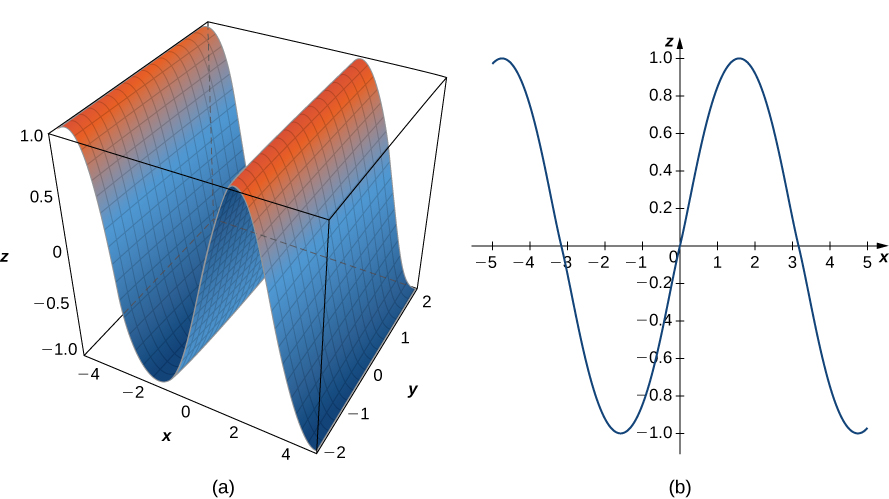
For cylindrical surfaces, only one set of traces provides useful information: The trace perpendicular to the rulings shows the shape of the generating curve. Traces parallel to the rulings just show parallel lines.
For example, with [latex]z = \sin x[/latex]:
- [latex]xz[/latex]-plane trace ([latex]y = 0[/latex]): Shows the sine wave that generates the cylinder
- [latex]xy[/latex]-plane trace ([latex]z = 0[/latex]): Shows parallel lines (not very informative)
- [latex]yz[/latex]-plane trace ([latex]x = 0[/latex]): Shows a single line (also not informative)
Traces become an essential tool as we explore more complex surfaces beyond cylinders, where the geometry isn’t as straightforward as parallel lines through a curve.