Equations for a Plane
Just as a line is uniquely determined by two points, a plane is uniquely determined by three points that don’t all lie on the same line. There are several ways to characterize a plane mathematically.
A plane can be determined by:
- Three non-collinear points (the most basic definition)
- Two distinct, intersecting lines (exactly one plane contains both)
- One line and a point not on the line (the line and point determine the plane)
- A point and a normal vector
The most powerful way to describe a plane uses a normal vector—a vector perpendicular to the plane. Here’s the key insight:
Imagine a vector [latex]\mathbf{n}[/latex] pointing perpendicular to a plane, and a fixed point [latex]P[/latex] on the plane. Any other point [latex]Q[/latex] lies on the same plane if and only if the vector [latex]\overrightarrow{PQ}[/latex] is perpendicular to [latex]\mathbf{n}[/latex].

Since orthogonal vectors have dot product zero, this gives us our plane equation.
plane equations
Given point [latex]P = (x_0, y_0, z_0)[/latex] on the plane and normal vector [latex]\mathbf{n} = \langle a, b, c \rangle[/latex]:
- Vector equation: [latex]\mathbf{n} \cdot \overrightarrow{PQ} = 0[/latex]
- Scalar equation: [latex]a(x - x_0) + b(y - y_0) + c(z - z_0) = 0[/latex]
- General form: [latex]ax + by + cz + d = 0[/latex] where [latex]d = -ax_0 - by_0 - cz_0[/latex]
To see how these forms connect, let’s expand the vector equation. If [latex]Q = (x,y,z)[/latex] is any point on the plane, then [latex]\overrightarrow{PQ} = \langle x-x_0, y-y_0, z-z_0 \rangle[/latex]. The condition that this vector is orthogonal to [latex]\mathbf{n}[/latex] gives us:
[latex]\begin{aligned} \mathbf{n} \cdot \overrightarrow{PQ} &= 0 \ \langle a,b,c \rangle \cdot \langle x-x_0, y-y_0, z-z_0 \rangle &= 0 \ a(x-x_0) + b(y-y_0) + c(z-z_0) &= 0 \end{aligned}[/latex]
Expanding this gives us [latex]ax + by + cz - ax_0 - by_0 - cz_0 = 0[/latex], which we can write as [latex]ax + by + cz + d = 0[/latex] where [latex]d = -ax_0 - by_0 - cz_0[/latex].
When given three points, you need to find a normal vector to write the plane equation. The cross product provides the solution.
Connection to Cross Products: Finding a plane through three points always involves:
- Form two vectors from the three points
- Take their cross product to get a normal vector
- Use the normal vector and any of the three points to write the plane equation
Distance from a Point to a Plane
Once you have a plane equation, you can find the shortest distance from any point to the plane. This distance is always measured along a line perpendicular to the plane.

Just as you find the 2D distance from a point to a line by measuring perpendicular to the line, you find the 3D distance from a point to a plane by measuring perpendicular to the plane.
If [latex]R[/latex] is the closest point on the plane to [latex]P[/latex], then [latex]\overrightarrow{RP}[/latex] must be parallel to the normal vector [latex]\mathbf{n}[/latex]. For any other point [latex]Q[/latex] on the plane, the vector [latex]\overrightarrow{QP}[/latex] can be projected onto [latex]\mathbf{n}[/latex] to find [latex]\overrightarrow{RP}[/latex].
the distance between a plane and a point
For a plane with normal vector [latex]\mathbf{n}[/latex] passing through point [latex]Q[/latex], the distance [latex]d[/latex] from the plane to point [latex]P[/latex] (not on the plane) is:
[latex]d=\left|\left|\text{proj}_{\bf{n}}\overrightarrow{QP}\right|\right|=\left|\text{comp}_{\bf{n}}\overrightarrow{QP}\right|=\frac{|\overrightarrow{QP}\cdot{\bf{n}}|}{||{\bf{n}}||}[/latex].
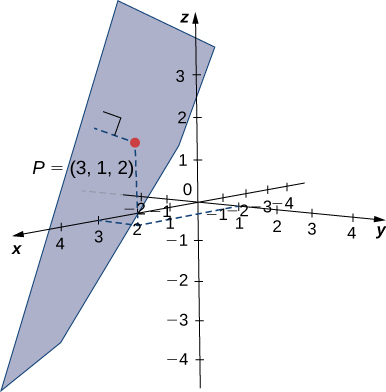
Find the distance between point [latex]P=(3, 1, 2)[/latex] and the plane given by [latex]x-2y+z=5[/latex] (see the following figure).