Distance between a Point and a Line
You already know how to calculate the distance between two points in space. Now we expand this to find the distance between a point and an entire line. This calculation has many practical applications. Builders must consider “setback” requirements to ensure structures maintain proper distance from property lines. Airlines need to calculate distances between populated areas and proposed flight paths.
The distance from a point to a line is defined as the length of the shortest possible segment connecting the point to the line. This shortest segment is always perpendicular to the line.
Let [latex]L[/latex] be a line and [latex]M[/latex] be any point not on the line. The distance [latex]d[/latex] from [latex]M[/latex] to [latex]L[/latex] is the length of line segment [latex]\overline{MP}[/latex], where [latex]P[/latex] is the point on [latex]L[/latex] such that [latex]\overline{MP}[/latex] is perpendicular to [latex]L[/latex].

In three dimensions, there’s no obvious way to identify which point on the line creates the perpendicular segment. We solve this by selecting an arbitrary point on the line and using vector properties.
Let [latex]P[/latex] be any point on line [latex]L[/latex] and let [latex]\textbf{v}[/latex] be a direction vector for [latex]L[/latex]. For any point [latex]M[/latex] not on the line, consider the vectors [latex]\overrightarrow{PM}[/latex] and [latex]\textbf{v}[/latex].
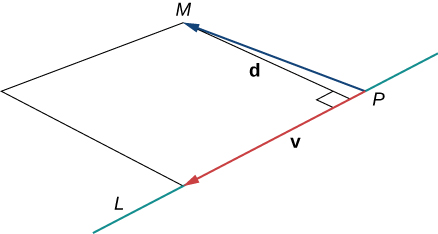
These vectors form two sides of a parallelogram. From the properties of cross products and geometry:
- The area of this parallelogram equals [latex]||\overrightarrow{PM} \times \textbf{v}||[/latex]
- The area also equals base × height = [latex]||\textbf{v}|| \cdot d[/latex]
Setting these equal gives us:
[latex]||\overrightarrow{PM} \times \textbf{v}|| = ||\textbf{v}|| \cdot d[/latex]
We can use this formula to find a general formula for the distance between a line in space and any point not on the line.
distance from a point to a line
Let [latex]L[/latex] be a line in space passing through point [latex]P[/latex] with direction vector [latex]\textbf v[/latex]. If [latex]M[/latex] is any point not on [latex]L[/latex], then the distance from [latex]M[/latex] to [latex]L[/latex] is
[latex]d=\frac{||\overrightarrow{PM}\times{\bf{v}}||}{||{\bf{v}}||}[/latex].
