Now that you can represent points in space and calculate distances between them, you can learn to write equations for geometric objects like lines, planes, and curved surfaces in three-dimensional space.
The same equation can represent completely different geometric objects depending on the dimensional space you’re working in. Consider the simple equation [latex]x = 0[/latex]:
In [latex]\mathbb{R}[/latex] (1D): Describes a single point
In [latex]\mathbb{R}^2[/latex] (2D): Describes a line (the [latex]y[/latex]-axis)
In [latex]\mathbb{R}^3[/latex] (3D): Describes a plane (the [latex]yz[/latex]-plane)
Figure 1. (a) In [latex]ℝ[/latex], the equation [latex]x=0[/latex] describes a single point. (b) In [latex]ℝ^2[/latex], the equation [latex]x=0[/latex] describes a line, the [latex]y[/latex]-axis. (c) In [latex]ℝ^3[/latex], the equation [latex]x=0[/latex] describes a plane, the [latex]yz[/latex]-plane.
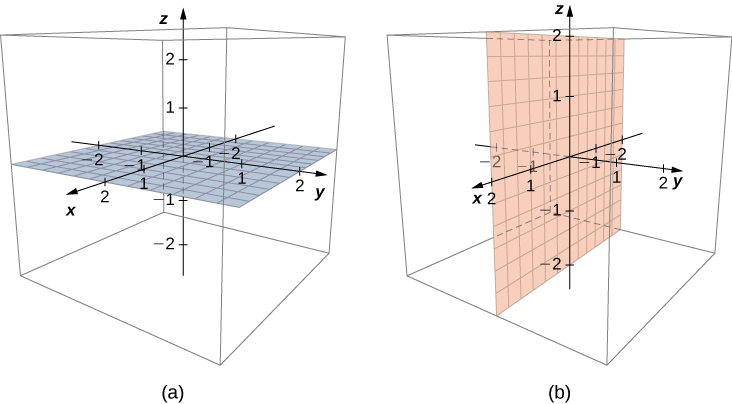
In 3D space, each coordinate plane has a simple equation:
[latex]yz[/latex]-plane: [latex]x = 0[/latex] (contains all points [latex](0, y, z)[/latex])
[latex]xy[/latex]-plane: [latex]z = 0[/latex] (contains all points [latex](x, y, 0)[/latex])
[latex]xz[/latex]-plane: [latex]y = 0[/latex] (contains all points [latex](x, 0, z)[/latex])
Figure 2 (a) In space, the equation [latex]z=0[/latex] describes the [latex]xy[/latex]-plane. (b) All points in the [latex]xz[/latex]-plane satisfy the equation [latex]y=0[/latex].
Once you understand coordinate plane equations, you can write equations for any plane parallel to a coordinate plane. The key insight: when a plane is parallel to a coordinate plane, one coordinate remains constant for all points in that plane.
For example, if a plane is parallel to the [latex]xy[/latex]-plane, every point in that plane has the same [latex]z[/latex]-coordinate. Only the [latex]x[/latex]– and [latex]y[/latex]-coordinates vary from point to point.
equations of planes parallel to coordinate planes
Parallel to [latex]xy[/latex]-plane: [latex]z = c[/latex] (contains point [latex](a, b, c)[/latex])
Parallel to [latex]xz[/latex]-plane: [latex]y = b[/latex] (contains point [latex](a, b, c)[/latex])
Parallel to [latex]yz[/latex]-plane: [latex]x = a[/latex] (contains point [latex](a, b, c)[/latex])
The constant value ([latex]a[/latex], [latex]b[/latex], or [latex]c[/latex]) determines how far the plane is from the corresponding coordinate plane.
The coordinate that equals a constant tells you which coordinate plane your plane is parallel to. If [latex]z = 5[/latex], the plane is parallel to the [latex]xy[/latex]-plane and located [latex]5[/latex] units above it.
Write an equation of the plane passing through point [latex](3, 11, 7)[/latex] that is parallel to the [latex]yz[/latex]-plane.
Find an equation of the plane passing through points [latex](6, -2, 9)[/latex], [latex](0, -2, 4)[/latex], and [latex](1, -2, -3)[/latex].
When a plane is parallel to the [latex]yz[/latex]-plane, only the [latex]y[/latex]– and [latex]z[/latex]-coordinates may vary. The [latex]x[/latex]-coordinate has the same constant value for all points in this plane, so this plane can be represented by the equation [latex]x=3[/latex].
Each of the points [latex](6, -2, 9)[/latex], [latex](0, -2, 4)[/latex], and [latex](1, -2, -3)[/latex] has the same y-coordinate. This plane can be represented by the equation [latex]y=-2[/latex].
Spheres
Just as a circle consists of all points in a plane equidistant from a center point, a sphere consists of all points in 3D space equidistant from a center point. The distance from the center to any point on the sphere is the radius.
Figure 3. Each point [latex](x,y,z)[/latex] on the surface of a sphere is [latex]r[/latex] units away from the center [latex](a,b,c)[/latex].
The equation of a circle is derived using the distance formula in two dimensions. In the same way, the equation of a sphere is based on the three-dimensional formula for distance.
equation of a sphere
The sphere with center [latex](a, b, c)[/latex] and radius [latex]r[/latex] can be represented by the equation
[latex](x - a)^2 +(y - b)^2+ (z - c)^2 =r^2[/latex]
.
This equation is known as the standard equation of a sphere.
Compare the 2D circle equation [latex](x-a)^2 + (y-b)^2 = r^2[/latex] to the 3D sphere equation. The sphere equation simply adds the [latex](z-c)^2[/latex] term for the third dimension.
Find the standard equation of the sphere with center [latex](10, 7, 4)[/latex] and point [latex](-1, 3, -2)[/latex] as shown in Figure 4.
Figure 4. The sphere centered at [latex](10,7,4)[/latex] containing point [latex](−1,3,−2)[/latex].
Use the distance formula to find the radius [latex]r[/latex] of the sphere:
Let [latex]P=(-5, 2, 3)[/latex] and [latex]Q=(3, 4, -1)[/latex], and suppose line segment [latex]PQ[/latex] forms the diameter of a sphere (Figure 5). Find the equation of the sphere.
Figure 5. Line segment [latex]PQ[/latex].
Since [latex]PQ[/latex] is a diameter of the sphere, we know the center of the sphere is the midpoint of [latex]PQ[/latex]. Then,
Then, the equation of the sphere is [latex](x+1)^2 + (y-3)^2 + (z-1)^2 = 21[/latex].
Describe the set of points that satisfies [latex](x-4)(z-2)=0[/latex], and graph the set.
We must have either [latex]x-4=0[/latex] or [latex]z-2=0[/latex], so the set of points forms the two planes [latex]x=4[/latex] and [latex]z=2[/latex] (Figure 6).
Figure 6. The set of points satisfying [latex](x−4)(z−2)=0[/latex] forms the two planes [latex]x=4[/latex] and [latex]z=2[/latex].
Describe the set of points in three-dimensional space that satisfies [latex](x+2)^{2}+(y-1)^{2}=4[/latex], and graph the set.
The [latex]x[/latex]– and [latex]y[/latex]-coordinates form a circle in the [latex]xy[/latex]-plane of radius 2, centered at [latex](2, 1)[/latex]. Since there is no restriction on the [latex]z[/latex]-coordinate, the three-dimensional result is a circular cylinder of radius 2 centered on the line with [latex]x=2[/latex] and [latex]x=1[/latex]. The cylinder extends indefinitely in the [latex]z[/latex]-direction (Figure 8).
Figure 8. The set of points satisfying [latex](x−2)^2+(y−1)^2=4[/latex]. This is a cylinder of radius [latex]2[/latex] centered on the line with [latex]x=2[/latex] and [latex]y=1[/latex].