-
Solve quadratic equations using factoring, the quadratic formula, and completing the square.
Solving Quadratic Equations by Factoring
Often the easiest method of solving a quadratic equation is factoring. Factoring a quadratic equation involves expressing it as a product of simpler polynomials, typically two binomials.
If a quadratic equation can be factored, it is written as a product of linear terms. Solving by factoring depends on the zero-product property which states that if [latex]a\cdot b=0[/latex], then [latex]a=0[/latex] or [latex]b=0[/latex], where [latex]a[/latex] and [latex]b[/latex] are real numbers or algebraic expressions. In other words, if the product of two numbers or two expressions equals zero, then one of the numbers or one of the expressions must equal zero because zero multiplied by anything equals zero.
The process of factoring a quadratic equation depends on the leading coefficient, whether it is [latex]1[/latex] or another integer.
- Find two numbers whose product equals c and whose sum equals [latex]b[/latex].
- Use those numbers to write two factors of the form [latex]\left(x+k\right)\text{ or }\left(x-k\right)[/latex], where [latex]k[/latex] is one of the numbers found in step 1. Use the numbers exactly as they are. In other words, if the two numbers are [latex]1[/latex] and [latex]-2[/latex], the factors are [latex]\left(x+1\right)\left(x - 2\right)[/latex].
- Solve using the zero-product property by setting each factor equal to zero and solving for the variable.
- Factor the quadratic expression.
[latex]x^2+x - 6 = (x+2)(x-3)[/latex]
- Apply the Zero-Product Property to find [latex]x[/latex].[latex]\begin{align*} \text{Equation:} && x^2 + x - 6 &= 0 \\ \text{Factored form:} && (x - 2)(x + 3) &= 0 \\ \text{Apply zero product property:} && x - 2 &= 0 \quad \text{or} \quad x + 3 = 0 \\ \text{Solution:} && x &= 2 \quad \text{or} \quad x = -3 \end{align*}[/latex]
When the leading coefficient is not [latex]1[/latex], we factor a quadratic equation using the method called grouping, which requires four terms.
- With the quadratic in standard form, [latex]ax^2 + bx + c = 0[/latex], multiply [latex]a \cdot c[/latex].
- Find two numbers whose product equals [latex]a \cdot c[/latex] and whose sum equals [latex]b[/latex].
- Rewrite the equation replacing the [latex]bx[/latex] term with two terms using the numbers found in step 2 as coefficients of [latex]x[/latex].
- Factor the first two terms and then factor the last two terms. The expressions in parentheses must be exactly the same to use grouping.
- Factor out the expression in parentheses.
- Set the expressions equal to zero and solve for the variable.
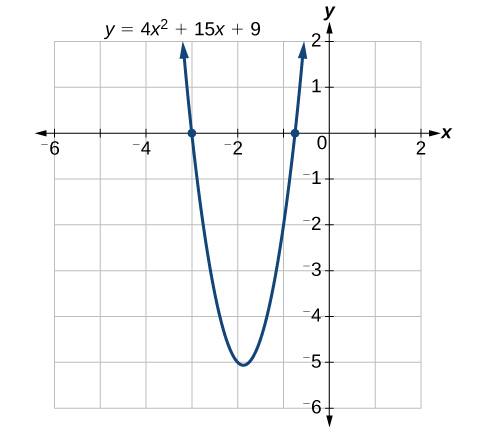
Using the Square Root Property
When there is no linear term in the equation, another method of solving a quadratic equation is by using the square root property, in which we isolate the [latex]{x}^{2}[/latex] term and take the square root of the number on the other side of the equal sign. Keep in mind that sometimes we may have to manipulate the equation to isolate the [latex]{x}^{2}[/latex] term so that the square root property can be used.
square root property
With the [latex]{x}^{2}[/latex] term isolated, the square root property states that:
where [latex]k[/latex] is a non-negative real number.
- Isolate the [latex]{x}^{2}[/latex] term on one side of the equal sign.
- Take the square root of both sides of the equation, putting a [latex]\pm[/latex] sign before the expression on the side opposite the squared term.
- Simplify the numbers on the side with the [latex]\pm[/latex] sign.
[latex]\begin{align*} \text{Given equation:} & \quad x^2 = 8 \\ \text{Apply the square root property:} & \quad x = \pm \sqrt{8} \\ \text{Simplify the square root:} & \quad \sqrt{8} = \sqrt{4 \times 2} = 2\sqrt{2} \\ \text{Thus, the solution is:} & \quad x = \pm 2\sqrt{2} \end{align*}[/latex]
Completing the Square
Not all quadratic equations can be factored or can be solved in their original form using the square root property. In these cases, we may use other methods for solving a quadratic equation. One method of solving quadratic equation is known as completing the square.
Using this process, we add or subtract terms to both sides of the equation until we have a perfect square trinomial on one side of the equal sign. We then apply the square root property. To complete the square, the leading coefficient, [latex]a[/latex], must equal [latex]1[/latex]. If it does not, then divide the entire equation by [latex]a[/latex]. Then, we can use the following procedures to solve a quadratic equation by completing the square.
completing the square
The goal of completing the square is to transform a quadratic equation of the form [latex]ax^2+bx+c = 0[/latex] into a perfect square trinomial:
[latex](x-h)^2 = k[/latex],
which can easily be solved by taking square roots.
- Rearrange your equation so that it is in standard form: [latex]ax^2 + bx + c = 0[/latex]. Divide by [latex]a[/latex] if [latex]a \neq 1[/latex].
- Isolate the constant term by moving it to the right side of the equation.
- Add [latex](\frac{b}{2})^2[/latex] on both sides of the equation.
- Form the perfect square trinomial.
- Solve for [latex]x[/latex] using the square root property.
Quadratic Formula
The fourth method of solving a quadratic equation is by using the quadratic formula, a formula that will solve all quadratic equations. Although the quadratic formula works on any quadratic equation in standard form, it is easy to make errors in substituting the values into the formula. Pay close attention when substituting, and use parentheses when inserting a negative number.
quadratic formula
Written in standard form, [latex]a{x}^{2}+bx+c=0[/latex], any quadratic equation can be solved using the quadratic formula:
where [latex]a, b,[/latex] and [latex]c[/latex] are real numbers and [latex]a\ne 0[/latex].
- Make sure the equation is in standard form: [latex]a{x}^{2}+bx+c=0[/latex].
- Make note of the values of the coefficients and constant term, [latex]a,b[/latex], and [latex]c[/latex].
- Carefully substitute the values noted in step 2 into the equation. To avoid needless errors, use parentheses around each number input into the formula.
- Calculate and solve.