- Understand and find parametric representations of surfaces
- Calculate surface integrals of scalar functions
- Calculate surface integrals of vector fields
- Use surface integrals to solve real-world problems
Parametric Surfaces
We have seen that a line integral is an integral over a path in a plane or in space. However, if we wish to integrate over a surface (a two-dimensional object) rather than a path (a one-dimensional object) in space, then we need a new kind of integral that can handle integration over objects in higher dimensions. We can extend the concept of a line integral to a surface integral to allow us to perform this integration.
Just as with line integrals, there are two kinds of surface integrals: surface integrals of scalar-valued functions and surface integrals of vector fields. Before we can integrate over a surface, we need to understand how to describe surfaces mathematically using parameterizations.
Parameterizing Curves
To calculate a line integral over curve [latex]C[/latex], we first parameterize [latex]C[/latex]. A parametric curve uses one parameter [latex]t[/latex] to trace out a one-dimensional path.
To calculate a surface integral over surface [latex]S[/latex], we need to parameterize [latex]S[/latex]. A parametric surface uses two parameters because a surface is two-dimensional.
A parametric surface is given by:
[latex]\mathbf{r}(u,v) = \langle x(u,v), y(u,v), z(u,v) \rangle[/latex]
The parameters [latex]u[/latex] and [latex]v[/latex] vary over a region called the parameter domain (or parameter space)—the set of points in the [latex]uv[/latex]-plane that can be substituted into [latex]\mathbf{r}[/latex]. Each choice of [latex]u[/latex] and [latex]v[/latex] in the parameter domain gives a point on the surface, just as each choice of parameter [latex]t[/latex] gives a point on a parameterized curve. The entire surface is created by making all possible choices of [latex]u[/latex] and [latex]v[/latex] over the parameter domain.
parameter domain
Given a parameterization of surface [latex]{\bf{r}}(u,v)=\langle{x}(u,v),y(u,v),z(u,v)\rangle[/latex], the parameter domain of the parameterization is the set of points in the [latex]uv[/latex]-plane that can be substituted into [latex]{\bf{r}}[/latex].
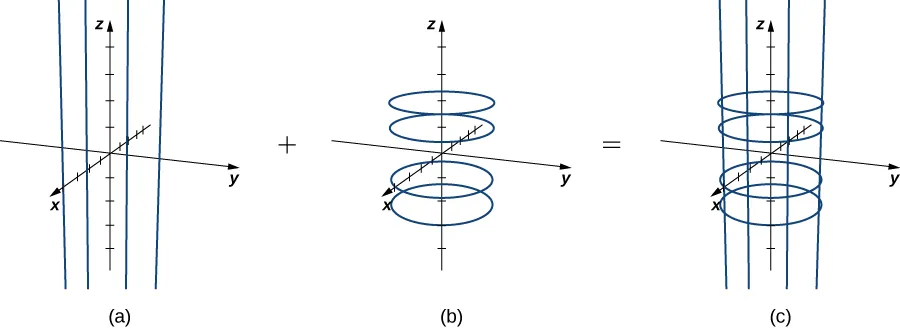
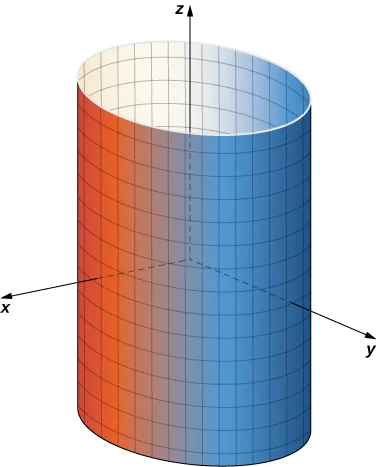
Describe the surface [latex]S[/latex] parameterized by
[latex]\mathbf{r}(u,v) = \langle \cos u, \sin u, v \rangle, -\infty < u < \infty, -\infty < v < \infty[/latex]
Parameterizing Cylinders
It follows from the example that we can parameterize all cylinders of the form [latex]x^2 + y^2 = R^2[/latex]. If [latex]S[/latex] is a cylinder given by equation [latex]x^2 + y^2 = R^2[/latex], then a parameterization of [latex]S[/latex] is:
[latex]\mathbf{r}(u,v) = \langle R\cos u, R\sin u, v \rangle, \quad 0 \leq u \leq 2\pi, \quad -\infty < v < \infty[/latex]
We can also find different types of surfaces given their parameterization, or we can find a parameterization when we are given a surface.
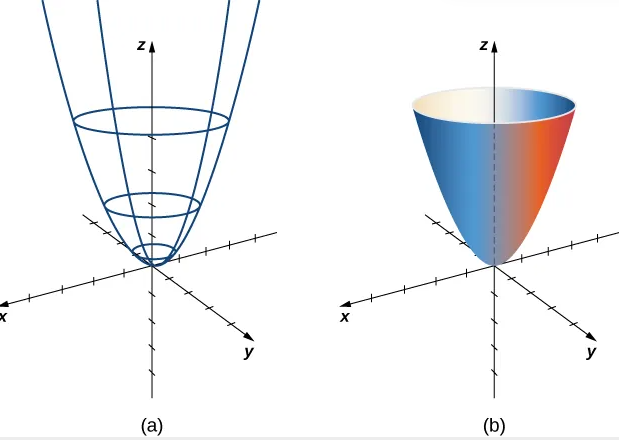
Describe the surface [latex]S[/latex] parameterized by [latex]{\bf{r}}(u,v)=\langle{u}\cos{v},u\sin{v},u^2\rangle,0\le{u}\le\infty,0\le{v}<2\pi[/latex].
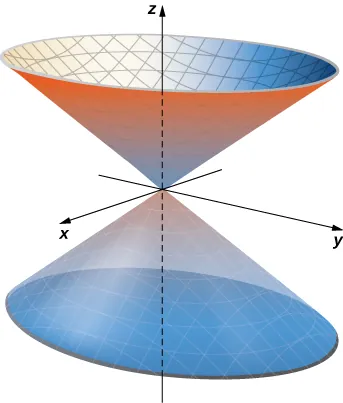
We have discussed parameterizations of various surfaces, but two important types of surfaces need a separate discussion: spheres and graphs of two-variable functions.
Parameterizing Spheres
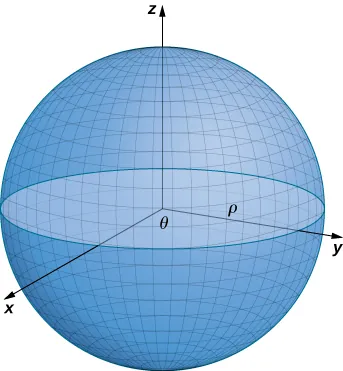
To parameterize a sphere, it’s easiest to use spherical coordinates. The sphere of radius [latex]\rho[/latex] centered at the origin is given by:
[latex]\mathbf{r}(\phi,\theta) = \langle \rho\cos\theta\sin\phi, \rho\sin\theta\sin\phi, \rho\cos\phi \rangle, \quad 0 \leq \theta \leq 2\pi, \quad 0 \leq \phi \leq \pi[/latex]
The idea is that as [latex]\phi[/latex] sweeps downward from the positive [latex]z[/latex]-axis, a circle of radius [latex]\rho\sin\phi[/latex] is traced out by letting [latex]\theta[/latex] run from [latex]0[/latex] to [latex]2\pi[/latex]. To see this, let [latex]\phi[/latex] be fixed. Then:
[latex]\begin{aligned} x^2 + y^2 &= (\rho\cos\theta\sin\phi)^2 + (\rho\sin\theta\sin\phi)^2 \\ &= \rho^2\sin^2\phi(\cos^2\theta + \sin^2\theta) \\ &= \rho^2\sin^2\phi \ &= (\rho\sin\phi)^2 \end{aligned}[/latex]
This gives the desired circle (Figure 5).
Parameterizing Graphs of Functions
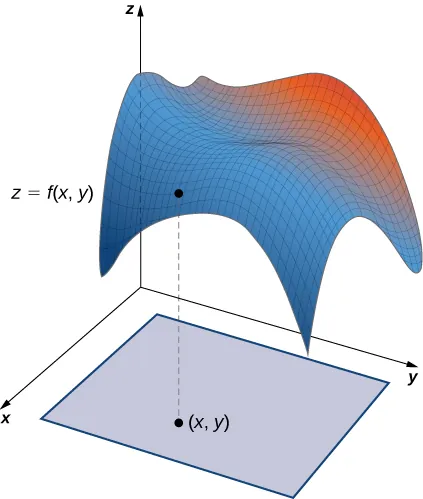
To parameterize the graph of a two-variable function, let [latex]z = f(x,y)[/latex] be a function of two variables. The simplest parameterization of the graph of [latex]f[/latex] is:
[latex]\mathbf{r}(x,y) = \langle x, y, f(x,y) \rangle[/latex]
where [latex]x[/latex] and [latex]y[/latex] vary over the domain of [latex]f[/latex] (Figure 6).
For example, the graph of [latex]f(x,y) = x^2y[/latex] can be parameterized by [latex]\mathbf{r}(x,y) = \langle x, y, x^2y \rangle[/latex], where the parameters [latex]x[/latex] and [latex]y[/latex] vary over the domain of [latex]f[/latex].
If you only care about a piece of the graph of [latex]f[/latex]—say, the piece over rectangle [latex][1,3] \times [2,5][/latex]—then you can restrict the parameter domain:
[latex]\mathbf{r}(x,y) = \langle x, y, x^2y \rangle, \quad 1 \leq x \leq 3, \quad 2 \leq y \leq 5[/latex]
Similarly, if [latex]S[/latex] is a surface given by [latex]x = g(y,z)[/latex] or [latex]y = h(x,z)[/latex], then a parameterization of [latex]S[/latex] is:
[latex]\mathbf{r}(y,z) = \langle g(y,z), y, z \rangle[/latex] or [latex]\mathbf{r}(x,z) = \langle x, h(x,z), z \rangle[/latex]
For example, the graph of paraboloid [latex]2y = x^2 + z^2[/latex] can be parameterized by:
[latex]\mathbf{r}(x,z) = \left\langle x, \frac{x^2 + z^2}{2}, z \right\rangle, \quad 0 \leq x \leq \infty, \quad 0 \leq z \leq \infty[/latex]
Notice that we don’t need to vary over the entire domain of [latex]y[/latex] because [latex]x[/latex] and [latex]z[/latex] are squared.
Smooth and Regular Parameterizations
Let’s generalize the notions of smoothness and regularity from curves to parametric surfaces.
Regular Parameterizations of Curves
Curve parameterization [latex]\mathbf{r}(t)[/latex], [latex]a \leq t \leq b[/latex], is regular if [latex]\mathbf{r}'(t) \neq \mathbf{0}[/latex] for all [latex]t[/latex] in [latex][a,b][/latex]. This condition ensures the image of [latex]\mathbf{r}[/latex] is actually a curve, not just a point.
For example, [latex]\mathbf{r}(t) = \langle 1, 2 \rangle[/latex], [latex]0 \leq t \leq 5[/latex], is not regular because its image is just the point [latex](1, 2)[/latex] and [latex]\mathbf{r}'(t) = \mathbf{0}[/latex].
We need a similar notion of regularity for surfaces to ensure a surface parameterization traces out an actual surface. Consider the parameterization:
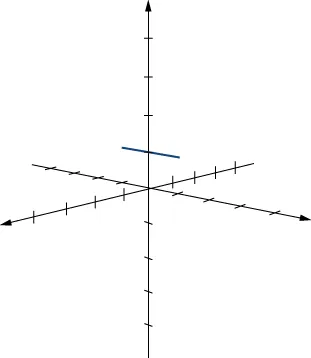
[latex]\mathbf{r}(u,v) = \langle 0, \cos v, 1 \rangle, \quad 0 \leq u \leq 1, \quad 0 \leq v \leq \pi[/latex]
Although this appears to parameterize a surface, its image is actually just a line (Figure 7). Notice that [latex]\mathbf{r}_u = \langle 0, 0, 0 \rangle[/latex] and [latex]\mathbf{r}_v = \langle 0, -\sin v, 0 \rangle[/latex], so the cross product [latex]\mathbf{r}_u \times \mathbf{r}_v = \mathbf{0}[/latex].
The analog of the condition [latex]\mathbf{r}'(t) \neq \mathbf{0}[/latex] for curves is that [latex]\mathbf{r}_u \times \mathbf{r}_v \neq \mathbf{0}[/latex] for surfaces.
regular parameterization
Parameterization [latex]{\bf{r}}(u,v)=\langle(x(u,v),y(u,v),z(u,v)\rangle[/latex] is a regular parameterization if [latex]{\bf{r}}_u\times{\bf{r}}_v[/latex] is not zero for point [latex](u, v)[/latex] in the parameter domain.
If parameterization [latex]\mathbf{r}[/latex] is regular, then the image of [latex]\mathbf{r}[/latex] is a two-dimensional object, as a surface should be. Throughout this module, we assume all parameterizations [latex]\mathbf{r}(u,v) = \langle x(u,v), y(u,v), z(u,v) \rangle[/latex] are regular.
Smooth Parameterizations of Curves
Curve parameterization [latex]\mathbf{r}(t)[/latex], [latex]a \leq t \leq b[/latex], is smooth if [latex]\mathbf{r}'(t)[/latex] is continuous and [latex]\mathbf{r}'(t) \neq \mathbf{0}[/latex] for all [latex]t[/latex] in [latex][a,b][/latex]. Informally, a curve parameterization is smooth if the resulting curve has no sharp corners.
The definition of a smooth surface parameterization is similar. Informally, a surface parameterization is smooth if the resulting surface has no sharp corners.
smooth parameterization
A surface parameterization [latex]{\bf{r}}(u,v)=\langle(x(u,v),y(u,v),z(u,v)\rangle[/latex] is smooth if vector [latex]{\bf{r}}_u\times{\bf{r}}_v[/latex] is not zero for any choice of [latex]u[/latex] and [latex]v[/latex] in the parameter domain.
A surface may also be piecewise smooth if it has smooth faces but also has locations where the directional derivatives do not exist.