- Calculate the cross product of two vectors and understand what it tells us
The Cross Product
The cross product multiplies two vectors in [latex]\mathbb{R}^3[/latex] to produce a third vector that is orthogonal to both original vectors. This operation is essential for finding perpendicular directions, calculating torque, and determining areas and volumes.
cross product
For vectors [latex]\mathbf{u} = \langle u_1, u_2, u_3 \rangle[/latex] and [latex]\mathbf{v} = \langle v_1, v_2, v_3 \rangle[/latex]:
Component Form:
[latex]\mathbf{u} \times \mathbf{v} = \langle u_2v_3 - u_3v_2, u_3v_1 - u_1v_3, u_1v_2 - u_2v_1 \rangle[/latex]
Standard Unit Vector Form:
[latex]\mathbf{u} \times \mathbf{v} = (u_2v_3 - u_3v_2)\mathbf{i} - (u_1v_3 - u_3v_1)\mathbf{j} + (u_1v_2 - u_2v_1)\mathbf{k}[/latex]
Direction: The Right-Hand Rule
The cross product formula tells us the components of [latex]\mathbf{u} \times \mathbf{v}[/latex], but how do we determine its direction? The right-hand rule provides the answer.
Right-Hand Rule Steps:
- Point your right hand fingers in the direction of the first vector [latex]\mathbf{u}[/latex]
- Curl your fingers toward the second vector [latex]\mathbf{v}[/latex]
- Your thumb points in the direction of [latex]\mathbf{u} \times \mathbf{v}[/latex]
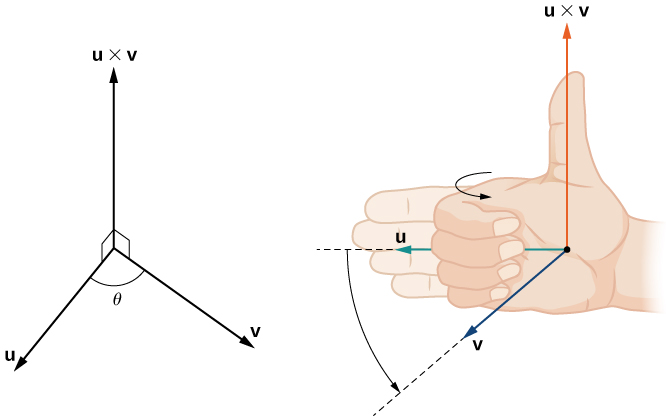
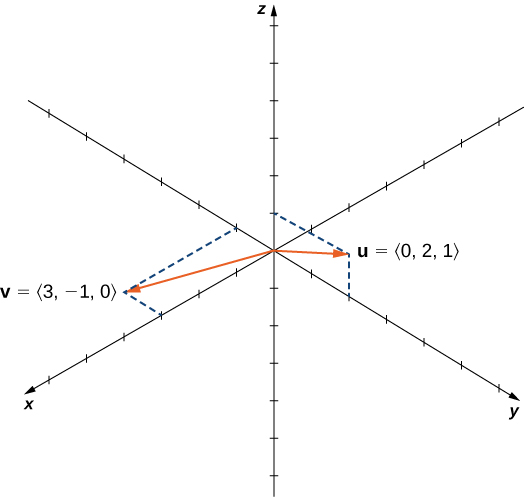

Cross Products of Standard Unit Vectors
unit vector cross products
Positive Results (right-hand rule gives positive direction):
- [latex]\mathbf{i} \times \mathbf{j} = \mathbf{k}[/latex]
- [latex]\mathbf{j} \times \mathbf{k} = \mathbf{i}[/latex]
- [latex]\mathbf{k} \times \mathbf{i} = \mathbf{j}[/latex]
Negative Results (opposite order gives negative direction):
- [latex]\mathbf{j} \times \mathbf{i} = -\mathbf{k}[/latex]
- [latex]\mathbf{k} \times \mathbf{j} = -\mathbf{i}[/latex]
- [latex]\mathbf{i} \times \mathbf{k} = -\mathbf{j}[/latex]
Properties of the Cross Product
The dot product and cross product are both forms of vector multiplication, but they have very different properties and applications. The dot product is called the scalar product because it produces a scalar, while the cross product is called the vector product because it produces a vector.
properties of the cross product:
Let [latex]\mathbf{u}[/latex], [latex]\mathbf{v}[/latex], and [latex]\mathbf{w}[/latex] be vectors, and let [latex]c[/latex] be a scalar.
- Anticommutative: [latex]\mathbf{u} \times \mathbf{v} = -(\mathbf{v} \times \mathbf{u})[/latex]
- Distributive: [latex]\mathbf{u} \times (\mathbf{v} + \mathbf{w}) = \mathbf{u} \times \mathbf{v} + \mathbf{u} \times \mathbf{w}[/latex]
- Scalar multiplication: [latex]c(\mathbf{u} \times \mathbf{v}) = (c\mathbf{u}) \times \mathbf{v} = \mathbf{u} \times (c\mathbf{v})[/latex]
- Zero vector: [latex]\mathbf{u} \times \mathbf{0} = \mathbf{0} \times \mathbf{u} = \mathbf{0}[/latex]
- Self cross product: [latex]\mathbf{v} \times \mathbf{v} = \mathbf{0}[/latex]
- Scalar triple product: [latex]\mathbf{u} \times (\mathbf{v} \times \mathbf{w}) \neq (\mathbf{u} \times \mathbf{v}) \times \mathbf{w}[/latex] (in general)
Magnitude of the Cross Product
We’ve focused on the direction of [latex]\mathbf{u} \times \mathbf{v}[/latex], but what about its magnitude? It turns out there is a simple expression for the magnitude of [latex]\mathbf{u} \times \mathbf{v}[/latex] involving the magnitudes of [latex]\mathbf u[/latex] and [latex]\mathbf v[/latex], and the sine of the angle between them.
magnitude of the cross product
For vectors [latex]\mathbf{u}[/latex] and [latex]\mathbf{v}[/latex] with angle [latex]\theta[/latex] between them:
[latex]||\mathbf{u} \times \mathbf{v}|| = ||\mathbf{u}|| \cdot ||\mathbf{v}|| \cdot \sin \theta[/latex]
The cross product only works in three dimensions. In 2D, there’s no direction simultaneously perpendicular to two nonparallel vectors—you’d need to point “out of the plane,” which requires a third dimension. This geometric requirement explains why cross products are fundamental in 3D applications like torque, rotation, and magnetic fields, but don’t exist in 2D vector algebra.