- Use a double integral to calculate the area of a region, volume under a surface, or average value of a function over a plane region
- Use double integrals to calculate the volume of a region between two surfaces or the area of a plane region
- Solve problems involving improper double integrals
Applications of Double Integrals
The Main Idea
Double integrals do more than just find volumes—they’re versatile tools for calculating areas, average values, and analyzing real-world data over regions. Understanding these applications helps you see why double integrals matter beyond abstract computation.
Finding Area
To find the area of a region [latex]R[/latex], integrate the constant function [latex]f(x,y) = 1[/latex]:
[latex]A(R) = \underset{R}{\displaystyle\iint}1\,dA[/latex]
This works because you’re essentially “summing up” tiny area elements [latex]dA[/latex] across the entire region. For a rectangle, this reduces to length times width.
Finding Volume
When [latex]f(x,y) \geq 0[/latex] over region [latex]R[/latex], the double integral gives the volume of the solid under the surface [latex]z = f(x,y)[/latex] and above [latex]R[/latex]:
[latex]V = \underset{R}{\displaystyle\iint}f(x,y)\,dA[/latex]
The function value [latex]f(x,y)[/latex] represents the height at each point, and [latex]dA[/latex] is the base area element.
Average Value
The average value of a function over region [latex]R[/latex] is the total integral divided by the region’s area:
[latex]f_{\text{ave}} = \dfrac{1}{\text{Area }R}\underset{R}{\displaystyle\iint}f(x,y)\,dA[/latex]
This extends the single-variable concept where you divided by interval length. Now you divide by area instead.
A contour map is shown for a function [latex]f(x,y)[/latex] on the rectangle [latex]{R} = {[-3,6]} {\times} {[-1,4]}[/latex].
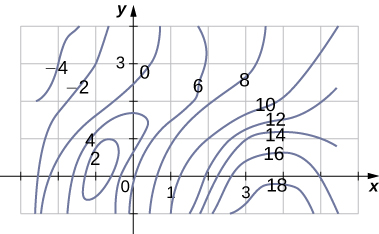
- Use the midpoint rule with [latex]m = 3[/latex] and [latex]n = 2[/latex] to estimate the value of [latex]\underset{R}{\displaystyle\iint}{f(x,y)dA}[/latex].
- Estimate the average value of the function [latex]f(x,y)[/latex].
Calculating Volumes, Areas, and Average Values
The Main Idea
Now that you can integrate over non-rectangular regions, you can tackle practical problems involving irregular shapes. The same setup works for different calculations—just change what you’re integrating.
Volume Under a Surface
For a solid bounded by coordinate planes and a tilted plane (like a tetrahedron), identify the region [latex]D[/latex] where the base sits, then integrate the height function. A plane like [latex]2x + 3y + z = 6[/latex] gives height [latex]z = 6 - 2x - 3y[/latex]. The volume is then [latex]\underset{D}{\displaystyle\iint}(6 - 2x - 3y)\,dA[/latex].
Area of Curved Regions
For regions bounded by curves like [latex]y = x^2[/latex] and [latex]y = 2x[/latex], double integrals provide an alternative to single-variable methods. Set up [latex]\underset{D}{\displaystyle\iint}1\,dA[/latex] using the curves as your limits. This approach shines when the region is easier to describe with two variables than with a single integral.
Computing Average Values
Finding an average requires two steps: calculate the total integral of your function, then divide by the region’s area. For [latex]f(x,y) = 7xy^2[/latex] over a curved region, you need both [latex]\underset{D}{\displaystyle\iint}7xy^2\,dA[/latex] and [latex]A(D) = \underset{D}{\displaystyle\iint}1\,dA[/latex]. The average is their ratio.
Problem-Solving Strategy
- Sketch the region: Identify all boundary curves and intersection points
- Choose region type: Decide whether Type I or Type II gives simpler limits
- Set up bounds: Determine constant limits (outer integral) and function limits (inner integral)
- Choose your integrand: Use [latex]f(x,y)[/latex] for volume, 1 for area
- Integrate: Work inside out, treating the outer variable as constant in the inner integral
- For average value: Compute both [latex]\iint f,dA[/latex] and [latex]\iint 1,dA[/latex], then divide
Strategic Choices
When a region can be described both ways, try the simpler one first. For a tetrahedron base that’s a right triangle, you might find [latex]0 \leq x \leq 3[/latex], [latex]0 \leq y \leq 2 - \frac{2x}{3}[/latex] easier than the reversed bounds. The algebra often guides your choice—whichever avoids messy fractions or complicated limits usually works better.
Improper Double Integrals
The Main Idea
Just as in single-variable calculus, double integrals can be “improper” when either the region is unbounded or the function has discontinuities. These integrals require limits to evaluate properly, but many converge to finite values.
Two Types of Improper Double Integrals
An improper double integral occurs when:
- The region [latex]D[/latex] is unbounded (extends to infinity in some direction)
- The function [latex]f[/latex] is unbounded (has discontinuities or vertical asymptotes within [latex]D[/latex])
Fubini’s Theorem Still Applies
For nonnegative functions with finitely many discontinuities in the interior, you can still convert double integrals to iterated integrals. The key restriction: the function must be nonnegative over [latex]D[/latex].
Handling Unbounded Regions
When integrating over an unbounded region like the first quadrant [latex](x \geq 0, y \geq 0)[/latex], use limits:
[latex]\underset{R}{\displaystyle\iint}f(x,y)dA = \displaystyle\lim_{(b,d)\to(\infty,\infty)}\displaystyle\int_a^b\displaystyle\int_c^d f(x,y)dy\,dx[/latex]
Evaluate the integral with finite bounds first, then take the limit as those bounds approach infinity.
When Functions Have Discontinuities
If [latex]f[/latex] has a discontinuity at a point inside [latex]D[/latex] (like [latex](0,0)[/latex]), you may still be able to evaluate the integral by switching the order of integration to avoid the problematic point in a specific limit.
Probability Applications
Joint density functions in probability often lead to improper integrals. For independent random variables [latex]X[/latex] and [latex]Y[/latex], the joint density is [latex]f(x,y) = f_1(x)f_2(y)[/latex]. Probabilities are computed as:
[latex]P((X,Y) \in D) = \underset{D}{\displaystyle\iint}f(x,y)dA[/latex]
Expected values require integrating over the entire sample space (often unbounded):
[latex]E(X) = \underset{S}{\displaystyle\iint}xf(x,y)dA[/latex]
These improper integrals often converge because exponential density functions decay rapidly.
The joint density function for two random variables [latex]X[/latex] and [latex]Y[/latex] is given by
[latex]\hspace{6cm}f(x,y) = \begin{align} &\frac1{16,250}(x^2+y^2) &\,&\text{ if } 0 \leq x \leq 15,0 \leq y \leq 10 \\ &0 &\,&\text{otherwise} \end{align}[/latex]
Find the probability that [latex]X[/latex] is at most 10 and [latex]Y[/latex] is at least 5.