- Use a double integral to calculate the area of a region, volume under a surface, or average value of a function over a plane region
- Use double integrals to calculate the volume of a region between two surfaces or the area of a plane region
- Solve problems involving improper double integrals
Applications of Double Integrals
Double integrals are very useful for finding the area of a region bounded by curves of functions. We describe this situation in more detail in the next section. However, if the region is a rectangular shape, we can find its area by integrating the constant function [latex]f(x,y) = 1[/latex] over the region [latex]R[/latex].
area of the region
The area of the region [latex]R[/latex] is given by:
[latex]A(R) = \underset{R}{\displaystyle\iint}1dA[/latex].
This definition makes sense because using [latex]f(x,y) = 1[/latex] and evaluating the integral make it a product of length and width. Let’s check this formula with an example and see how this works.
We have already seen how double integrals can be used to find the volume of a solid bounded above by a function [latex]f(x,y)[/latex] over a region [latex]R[/latex] provided [latex]f(x,y)\geq 0[/latex] for all [latex](x,y)[/latex] in [latex]R[/latex]. Here is another example to illustrate this concept.

Similarly, we can define the average value of a function of two variables over a region [latex]R[/latex]. The main difference is that we divide by an area instead of the width of an interval.
[latex]{f_{\text{ave}}} = {\dfrac{1}{b-a}}\displaystyle\int_a^b{f(x)dx}[/latex].
average value of a function of two variables
The average value of a function of two variables over a region [latex]R[/latex] is:
[latex]{f_{\text{ave}}} = {\dfrac{1}{\text{Area }R}} \underset{R}{\displaystyle\iint}{f(x,y)dA}[/latex]
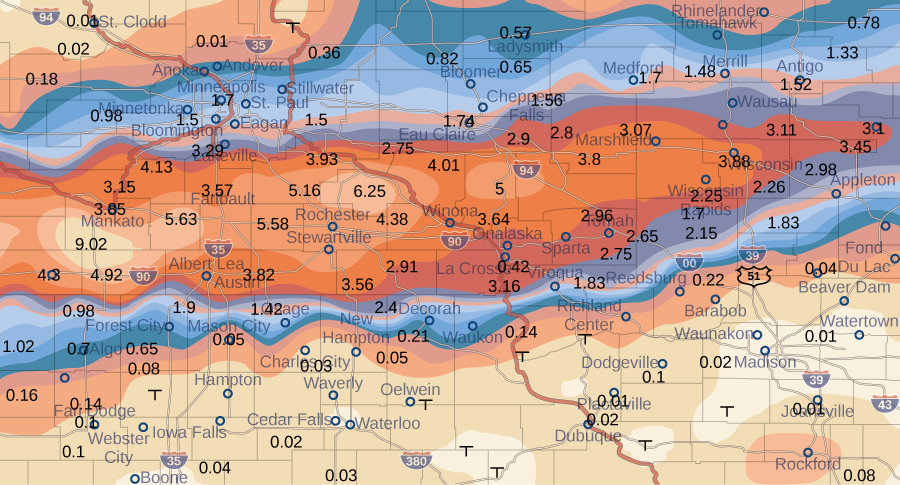
In the next example we find the average value of a function over a rectangular region. This is a good example of obtaining useful information for an integration by making individual measurements over a grid, instead of trying to find an algebraic expression for a function.
The weather map in Figure 2 shows an unusually moist storm system associated with the remnants of Hurricane Karl, which dumped 4–8 inches (100–200 mm) of rain in some parts of the Midwest on September 22–23, 2010. The area of rainfall measured 300 miles east to west and 250 miles north to south. Estimate the average rainfall over the entire area in those two days.