Double Integration and Applications: Background You’ll Need 3
Recognize indeterminate forms and apply L’Hôpital’s rule for quotients, products, subtractions, and powers
L’Hôpital’s Rule
L’Hôpital’s Rule uses derivatives to evaluate limits that produce indeterminate forms [latex]\frac{0}{0}[/latex] or [latex]\frac{\infty}{\infty}[/latex].
L’Hôpital’s rule
Suppose [latex]f[/latex] and [latex]g[/latex] are differentiable near [latex]a[/latex]. If [latex]\underset{x\to a}{\lim}\dfrac{f(x)}{g(x)}[/latex] produces [latex]\frac{0}{0}[/latex] or [latex]\frac{\infty}{\infty}[/latex], then:
Since the numerator [latex]1- \cos x\to 0[/latex] and the denominator [latex]x\to 0[/latex], we can apply L’Hôpital’s rule to evaluate this limit. We have
As [latex]x\to 1[/latex], the numerator [latex]\sin (\pi x)\to 0[/latex] and the denominator [latex]\ln x \to 0[/latex]. Therefore, we can apply L’Hôpital’s rule. We obtain
As [latex]x\to \infty[/latex], the numerator [latex]e^{1/x}-1\to 0[/latex] and the denominator [latex](\frac{1}{x})\to 0[/latex]. Therefore, we can apply L’Hôpital’s rule. We obtain
Since the numerator and denominator of this new quotient both approach zero as [latex]x\to 0[/latex], we apply L’Hôpital’s rule again. In doing so, we see that
Watch the following video to see the worked solution to this example.
For closed captioning, open the video on its original page by clicking the Youtube logo in the lower right-hand corner of the video display. In YouTube, the video will begin at the same starting point as this clip, but will continue playing until the very end.
Since [latex]3x+5[/latex] and [latex]2x+1[/latex] are first-degree polynomials with positive leading coefficients, [latex]\underset{x\to \infty }{\lim}(3x+5)=\infty[/latex] and [latex]\underset{x\to \infty }{\lim}(2x+1)=\infty[/latex]. Therefore, we apply L’Hôpital’s rule and obtain
Note that this limit can also be calculated without invoking L’Hôpital’s rule. Earlier in the module we showed how to evaluate such a limit by dividing the numerator and denominator by the highest power of [latex]x[/latex] in the denominator. In doing so, we saw that
L’Hôpital’s rule provides us with an alternative means of evaluating this type of limit.
Here, [latex]\underset{x\to 0^+}{\lim} \ln x=−\infty[/latex] and [latex]\underset{x\to 0^+}{\lim} \cot x=\infty[/latex]. Therefore, we can apply L’Hôpital’s rule and obtain
Now as [latex]x\to 0^+[/latex], [latex]\csc^2 x\to \infty[/latex]. Therefore, the first term in the denominator is approaching zero and the second term is getting really large. In such a case, anything can happen with the product. Therefore, we cannot make any conclusion yet. To evaluate the limit, we use the definition of [latex]\csc x[/latex] to write
When [latex]\underset{x\to a}{\lim}f(x) = 0[/latex] and [latex]\underset{x\to a}{\lim}g(x) = \infty[/latex], the product [latex]f(x)g(x)[/latex] produces the indeterminate form [latex]0 \cdot \infty[/latex]. To apply L’Hôpital’s Rule, rewrite the product as a quotient:
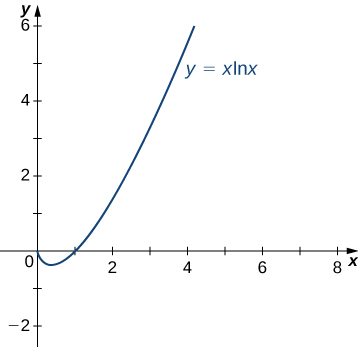
First, rewrite the function [latex]x \ln x[/latex] as a quotient to apply L’Hôpital’s rule. If we write
[latex]x \ln x=\frac{\ln x}{1/x}[/latex],
we see that [latex]\ln x\to −\infty[/latex] as [latex]x\to 0^+[/latex] and [latex]\frac{1}{x}\to \infty[/latex] as [latex]x\to 0^+[/latex]. Therefore, we can apply L’Hôpital’s rule and obtain
Figure 2. Finding the limit at [latex]x=0[/latex] of the function [latex]f(x)=x \ln x[/latex].
Indeterminate Form [latex]\infty - \infty[/latex]
When both [latex]f(x) \to \infty[/latex] and [latex]g(x) \to \infty[/latex] as [latex]x \to a[/latex], the difference [latex]f(x) - g(x)[/latex] produces [latex]\infty - \infty[/latex]. To use L’Hôpital’s Rule, combine the terms into a single quotient, typically by finding a common denominator.
As [latex]x\to 0^+[/latex], the numerator [latex]\tan x-x^2 \to 0[/latex] and the denominator [latex]x^2 \tan x \to 0[/latex]. Therefore, we can apply L’Hôpital’s rule. Taking the derivatives of the numerator and the denominator, we have
As [latex]x\to 0^+[/latex], [latex](\sec^2 x)-2x \to 1[/latex] and [latex]x^2 \sec^2 x+2x \tan x \to 0[/latex]. Since the denominator is positive as [latex]x[/latex] approaches zero from the right, we conclude that
[latex]\underset{x\to 0^+}{\lim}(\frac{1}{x^2}-\frac{1}{ tan x})=\infty[/latex]
Indeterminate Forms Involving Exponents
The forms [latex]0^0[/latex], [latex]\infty^0[/latex], and [latex]1^\infty[/latex] are indeterminate when they arise in limits. To handle limits of the form [latex]\underset{x\to a}{\lim}f(x)^{g(x)}[/latex], use logarithms.
Strategy for Exponential Indeterminate Forms
Let [latex]y = f(x)^{g(x)}[/latex]
Take the natural logarithm: [latex]\ln y = g(x) \ln(f(x))[/latex]
Evaluate [latex]L = \underset{x\to a}{\lim}g(x)\ln(f(x))[/latex] using techniques for [latex]0 \cdot \infty[/latex]
Then [latex]\underset{x\to a}{\lim}f(x)^{g(x)} = e^L[/latex]
Watch the following video to see the worked solution to this example.
For closed captioning, open the video on its original page by clicking the Youtube logo in the lower right-hand corner of the video display. In YouTube, the video will begin at the same starting point as this clip, but will continue playing until the very end.