Optimization and Applications: Background You’ll Need 2
Apply the second derivative to determine concavity and locate inflection points
Concavity and the Second Derivative
The second derivative tells you about the concavity of a function—whether the graph curves upward or downward.
When [latex]f[/latex] is concave up, the slope [latex]f'[/latex] is increasing, so [latex]f''(x) > 0[/latex]
When [latex]f[/latex] is concave down, the slope [latex]f'[/latex] is decreasing, so [latex]f''(x) < 0[/latex]
test for concavity
Let [latex]f[/latex] be twice differentiable over an interval [latex]I[/latex]:
If [latex]f''(x) > 0[/latex] for all [latex]x \in I[/latex], then [latex]f[/latex] is concave up on [latex]I[/latex]
If [latex]f''(x) < 0[/latex] for all [latex]x \in I[/latex], then [latex]f[/latex] is concave down on [latex]I[/latex]
A function can switch concavity, but only at points where [latex]f''(x) = 0[/latex] or [latex]f''(x)[/latex] is undefined. When [latex]f[/latex] is continuous at such a point and actually changes concavity there, we call it an inflection point.
inflection point
If [latex]f[/latex] is continuous at [latex]a[/latex] and [latex]f[/latex] changes concavity at [latex]a[/latex], then the point [latex](a, f(a))[/latex] is an inflection point of [latex]f[/latex].
Quick Reference: What Derivatives Tell You
Sign of [latex]f^{\prime}[/latex]
Sign of [latex]f^{\prime \prime}[/latex]
Is [latex]f[/latex] increasing or decreasing?
Concavity
Positive
Positive
Increasing
Concave up
Positive
Negative
Increasing
Concave down
Negative
Positive
Decreasing
Concave up
Negative
Negative
Decreasing
Concave down
The Second Derivative Test
The second derivative provides an alternative method for classifying critical points. At a critical point [latex]c[/latex] where [latex]f'(c) = 0[/latex], the concavity tells you whether you have a maximum or minimum.
second derivative test
Suppose [latex]f'(c) = 0[/latex] and [latex]f''[/latex] is continuous near [latex]c[/latex]:
If [latex]f''(c) > 0[/latex], then [latex]f[/latex] has a local minimum at [latex]c[/latex]
If [latex]f''(c) < 0[/latex], then [latex]f[/latex] has a local maximum at [latex]c[/latex]
If [latex]f''(c) = 0[/latex], the test is inconclusive (use the first derivative test instead)
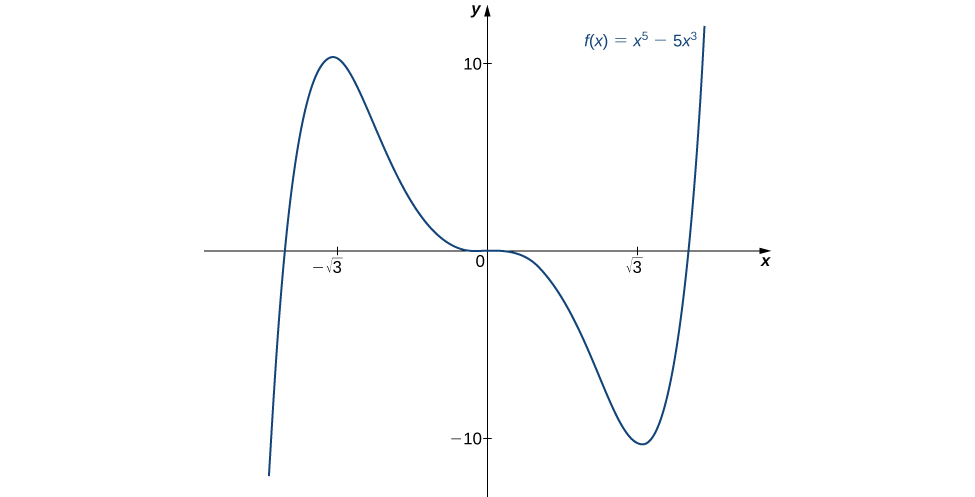
Use the second derivative to find the location of all local extrema for [latex]f(x)=x^5-5x^3[/latex].
To apply the second derivative test, we first need to find critical points [latex]c[/latex] where [latex]f^{\prime}(c)=0[/latex].
The derivative is [latex]f^{\prime}(x)=5x^4-15x^2[/latex]. Therefore, [latex]f^{\prime}(x)=5x^4-15x^2=5x^2(x^2-3)=0[/latex] when [latex]x=0,\pm \sqrt{3}[/latex].
To determine whether [latex]f[/latex] has a local extrema at any of these points, we need to evaluate the sign of [latex]f^{\prime \prime}[/latex] at these points. The second derivative is
In the following table, we evaluate the second derivative at each of the critical points and use the second derivative test to determine whether [latex]f[/latex] has a local maximum or local minimum at any of these points.
[latex]x[/latex]
[latex]f^{\prime \prime}(x)[/latex]
Conclusion
[latex]−\sqrt{3}[/latex]
[latex]-30\sqrt{3}[/latex]
Local maximum
[latex]0[/latex]
[latex]0[/latex]
Second derivative test is inconclusive
[latex]\sqrt{3}[/latex]
[latex]30\sqrt{3}[/latex]
Local minimum
By the second derivative test, we conclude that [latex]f[/latex] has a local maximum at [latex]x=−\sqrt{3}[/latex] and [latex]f[/latex] has a local minimum at [latex]x=\sqrt{3}[/latex]. The second derivative test is inconclusive at [latex]x=0[/latex].
To determine whether [latex]f[/latex] has a local extrema at [latex]x=0[/latex], we apply the first derivative test.
To evaluate the sign of [latex]f^{\prime}(x)=5x^2(x^2-3)[/latex] for [latex]x \in (−\sqrt{3},0)[/latex] and [latex]x \in (0,\sqrt{3})[/latex], let [latex]x=-1[/latex] and [latex]x=1[/latex] be the two test points. Since [latex]f^{\prime}(-1)<0[/latex] and [latex]f^{\prime}(1)<0[/latex], we conclude that [latex]f[/latex] is decreasing on both intervals and, therefore, [latex]f[/latex] does not have a local extrema at [latex]x=0[/latex] as shown in the following graph.
Figure 10. The function [latex]f[/latex] has a local maximum at [latex]x=−\sqrt{3}[/latex] and a local minimum at [latex]x=\sqrt{3}[/latex]
Watch the following video to see the worked solution to this example.
For closed captioning, open the video on its original page by clicking the Youtube logo in the lower right-hand corner of the video display. In YouTube, the video will begin at the same starting point as this clip, but will continue playing until the very end.