- Use the first derivative to determine where a function is increasing or decreasing and identify local extrema
The First Derivative and Function Behavior
The first derivative tells you whether a function is increasing or decreasing. This comes directly from the Mean Value Theorem:
- If [latex]f'(x) > 0[/latex] on an interval [latex]I[/latex], then [latex]f[/latex] is increasing on [latex]I[/latex]
- If [latex]f'(x) < 0[/latex] on an interval [latex]I[/latex], then [latex]f[/latex] is decreasing on [latex]I[/latex]
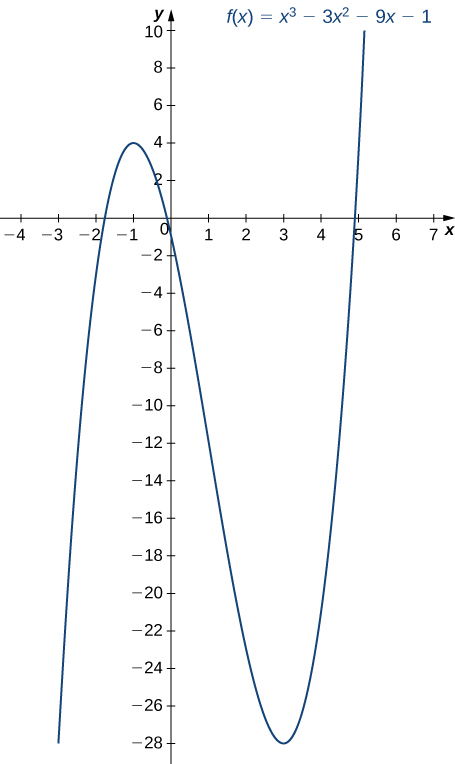
A continuous function [latex]f[/latex] has a local maximum at [latex]c[/latex] when [latex]f[/latex] switches from increasing to decreasing at that point. Similarly, [latex]f[/latex] has a local minimum at [latex]c[/latex] when it switches from decreasing to increasing.
For a continuous function [latex]f[/latex] to switch from increasing to decreasing (or vice versa) at point [latex]c[/latex], the derivative must change sign. This can only happen when [latex]f'(c) = 0[/latex] or [latex]f'(c)[/latex] is undefined—these are your critical points.
first derivative test
Let [latex]f[/latex] be continuous over an interval [latex]I[/latex] containing a critical point [latex]c[/latex]:
- If [latex]f'[/latex] changes from positive to negative at [latex]c[/latex], then [latex]f(c)[/latex] is a local maximum
- If [latex]f'[/latex] changes from negative to positive at [latex]c[/latex], then [latex]f(c)[/latex] is a local minimum
- If [latex]f'[/latex] does not change sign at [latex]c[/latex], then [latex]f(c)[/latex] is neither a maximum nor minimum
- Find all critical points of [latex]f(x)[/latex] on the interval (where [latex]f'(x) = 0[/latex] or [latex]f'(x)[/latex] is undefined)
- Divide the interval into subintervals using the critical points as boundaries
- Test the sign of [latex]f'(x)[/latex] in each subinterval by choosing a test point
- Determine extrema by checking if [latex]f'[/latex] changes sign at each critical point