Vector-Valued Functions and Motion: Background You’ll Need 2
Use basic rules to differentiate functions that involve adding, subtracting, scaling, and raising to powers
The Basic Rules
The Constant Rule
The derivative of any constant is zero:
[latex]\dfrac{d}{dx}(c) = 0[/latex]
Why? A constant function [latex]f(x) = c[/latex] is a horizontal line with slope [latex]0[/latex]. Since the derivative measures rate of change, and a constant never changes, its derivative is [latex]0[/latex].
the constant rule
Let [latex]c[/latex] be a constant.
If [latex]f(x)=c[/latex], then [latex]f^{\prime}(c)=0[/latex]
Alternatively, we may express this rule as
[latex]\dfrac{d}{dx}(c)=0[/latex]
Find the derivative of [latex]f(x)=8[/latex].
This is just a one-step application of the rule:
[latex]f^{\prime}(8)=0[/latex].
The Power Rule
From Calculus 1, you know that differentiation follows predictable patterns for power functions. For example:
[latex]\dfrac{d}{dx}\left(x^2\right) = 2x[/latex] and [latex]\dfrac{d}{dx}\left(x^{\frac{1}{2}}\right) = \dfrac{1}{2}x^{-\frac{1}{2}}[/latex]
Notice the pattern: the exponent becomes the coefficient, and the new exponent decreases by [latex]1[/latex].
the power rule
For any real number [latex]n[/latex]:
[latex]\dfrac{d}{dx}(x^n) = nx^{n-1}[/latex]
This applies to all powers—positive, negative, and fractional.
Find the derivative of the function [latex]f(x)=x^{10}[/latex] by applying the power rule.
Using the power rule with [latex]n=10[/latex], we obtain
[latex]f^{\prime}(x)=10x^{10-1}=10x^9[/latex].
The Sum, Difference, and Constant Multiple Rules
We find our next differentiation rules by looking at derivatives of sums, differences, and constant multiples of functions. Just as when we work with functions, there are rules that make it easier to find derivatives of functions that we add, subtract, or multiply by a constant.
sum, difference, and constant multiple rules
Let [latex]f(x)[/latex] and [latex]g(x)[/latex] be differentiable functions and [latex]k[/latex] be a constant. Then each of the following equations holds.
Sum Rule: The derivative of the sum of a function [latex]f[/latex] and a function [latex]g[/latex] is the same as the sum of the derivative of [latex]f[/latex] and the derivative of [latex]g[/latex].
for [latex]j(x)=f(x)+g(x), \, j^{\prime}(x)=f^{\prime}(x)+g^{\prime}(x)[/latex]
Difference Rule: The derivative of the difference of a function [latex]f[/latex] and a function [latex]g[/latex] is the same as the difference of the derivative of [latex]f[/latex] and the derivative of [latex]g[/latex].
for [latex]j(x)=f(x)-g(x), \, j^{\prime}(x)=f^{\prime}(x)-g^{\prime}(x)[/latex]
Constant Multiple Rule: The derivative of a constant [latex]k[/latex] multiplied by a function [latex]f[/latex] is the same as the constant multiplied by the derivative:
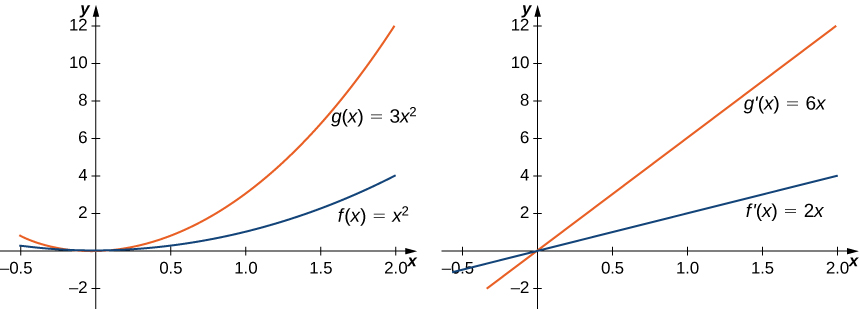
Since [latex]f(x)=x^2[/latex] has derivative [latex]f^{\prime}(x)=2x[/latex], we see that the derivative of [latex]g(x)[/latex] is [latex]3[/latex] times the derivative of [latex]f(x)[/latex]. This relationship is illustrated in the graphs below.
Figure 1. The derivative of [latex]g(x)[/latex] is 3 times the derivative of [latex]f(x)[/latex].
Find the derivative of [latex]f(x)=2x^5+7[/latex].
We begin by applying the rule for differentiating the sum of two functions, followed by the rules for differentiating constant multiples of functions and the rule for differentiating powers. To better understand the sequence in which the differentiation rules are applied, we use Leibniz notation throughout the solution:
[latex]\begin{array}{lllll}f^{\prime}(x) & =\frac{d}{dx}(2x^5+7) & & & \\ & =\frac{d}{dx}(2x^5)+\frac{d}{dx}(7) & & & \text{Apply the sum rule.} \\ & =2\frac{d}{dx}(x^5)+\frac{d}{dx}(7) & & & \text{Apply the constant multiple rule.} \\ & =2(5x^4)+0 & & & \text{Apply the power rule and the constant rule.} \\ & =10x^4. & & & \text{Simplify.} \end{array}[/latex]
Find the equation of the line tangent to the graph of [latex]f(x)=x^2-4x+6[/latex] at [latex]x=1[/latex].
To find the equation of the tangent line, we need a point and a slope. To find the point, compute
[latex]f(1)=1^2-4(1)+6=3[/latex].
This gives us the point [latex](1,3)[/latex]. Since the slope of the tangent line at [latex]1[/latex] is [latex]f^{\prime}(1)[/latex], we must first find [latex]f^{\prime}(x)[/latex]. Using the definition of a derivative, we have
[latex]f^{\prime}(x)=2x-4[/latex]
so the slope of the tangent line is [latex]f^{\prime}(1)=-2[/latex]. Using the point-slope formula, we see that the equation of the tangent line is
[latex]y-3=-2(x-1)[/latex].
Putting the equation of the line in slope-intercept form, we obtain
[latex]y=-2x+5[/latex].
Watch the following video to see the worked solution to this example.
For closed captioning, open the video on its original page by clicking the Youtube logo in the lower right-hand corner of the video display. In YouTube, the video will begin at the same starting point as this clip, but will continue playing until the very end.