- Describe three-dimensional space mathematically
- Find and graph points in 3D space using their [latex](x, y, z)[/latex] coordinates
- Write the distance formula in three dimensions
- Write the equations for simple planes and spheres
- Perform vector operations in ℝ3
Three-Dimensional Coordinate Systems
The Main Idea
Real-world problems happen in three dimensions—flight paths, terrain navigation, molecular structures. To handle these, we extend the 2D coordinate system by adding a third axis perpendicular to the other two.
The three-dimensional rectangular coordinate system ([latex]\mathbb{R}^3[/latex]) consists of three mutually perpendicular axes: [latex]x[/latex], [latex]y[/latex], and [latex]z[/latex]. Their arrangement follows the right-hand rule:
- Point your right hand’s fingers along the positive [latex]x[/latex]-axis
- Curl them toward the positive [latex]y[/latex]-axis
- Your thumb points in the direction of the positive [latex]z[/latex]-axis
Plotting Points in 3D
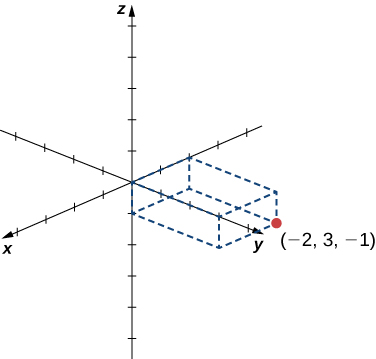
A point in 3D space is written as [latex](x, y, z)[/latex]. To plot it: move [latex]x[/latex] units along the [latex]x[/latex]-axis, then [latex]y[/latex] units in the [latex]y[/latex]-direction, then [latex]z[/latex] units in the [latex]z[/latex]-direction. Imagine constructing a rectangular box with the origin and your point as opposite corners.
Tip: 3D visualization on paper is tricky—use physical objects or online 3D graphing tools to build intuition.
Coordinate Planes and Octants
Three axes create three coordinate planes, each defined by setting one coordinate to zero:
- [latex]xy[/latex]-plane: [latex]z = 0[/latex] (the “floor”)
- [latex]xz[/latex]-plane: [latex]y = 0[/latex] (one “wall”)
- [latex]yz[/latex]-plane: [latex]x = 0[/latex] (other “wall”)
These three planes divide space into eight regions called octants (like quadrants, but in 3D).
Distance Formula in 3D
The distance between points [latex](x_1, y_1, z_1)[/latex] and [latex](x_2, y_2, z_2)[/latex] extends the 2D formula by adding the third coordinate:
[latex]d = \sqrt{(x_2 - x_1)^2 + (y_2 - y_1)^2 + (z_2 - z_1)^2}[/latex]
This measures the diagonal of a rectangular box with the two points as opposite corners.
3D vs 2D: New Possibilities
Three dimensions allow geometric relationships impossible in 2D:
- Skew lines: Lines that don’t intersect and aren’t parallel (impossible in 2D)
- Interconnected circles: Circles linked like chain links without sharing any points (impossible in 2D)
Writing Equations in [latex]\mathbb{R}^3[/latex]
The Main Idea
The same equation describes different objects depending on dimension. For example, [latex]x = 0[/latex] is a point in 1D, a line in 2D, and a plane in 3D.
Planes Parallel to Coordinate Planes
In 3D, setting one coordinate equal to a constant creates a plane:
- [latex]x = a[/latex]: Plane parallel to [latex]yz[/latex]-plane
- [latex]y = b[/latex]: Plane parallel to [latex]xz[/latex]-plane
- [latex]z = c[/latex]: Plane parallel to [latex]xy[/latex]-plane
The constant value tells you how far the plane is from the origin. For example, [latex]z = 5[/latex] is a horizontal plane [latex]5[/latex] units above the [latex]xy[/latex]-plane.
Spheres in 3D
A sphere with center [latex](a, b, c)[/latex] and radius [latex]r[/latex]:
[latex](x - a)^2 + (y - b)^2 + (z - c)^2 = r^2[/latex]
This extends the 2D circle equation by adding [latex](z - c)^2[/latex]. To find [latex]r[/latex], use the 3D distance formula from the center to any point on the sphere.
Cylinders and Surfaces
When an equation uses only two coordinates (like [latex](x - a)^2 + (y - b)^2 = r^2[/latex]), the missing coordinate is unrestricted. This creates a cylinder extending infinitely in that direction.
Multiple Objects from One Equation
Equations like [latex](x - 4)(z - 2) = 0[/latex] factor into [latex]x = 4[/latex] or [latex]z = 2[/latex], describing two intersecting planes.


Working with Vectors in Three Dimensions
The Main Idea
Three-dimensional vectors work exactly like 2D vectors—they have magnitude and direction. The only difference? They point in 3D space and have three components instead of two.
Component Form in 3D
A vector [latex]\mathbf{v} = \langle x, y, z \rangle[/latex] starts at the origin [latex](0, 0, 0)[/latex] and ends at [latex](x, y, z)[/latex]. The zero vector is [latex]\mathbf{0} = \langle 0, 0, 0 \rangle[/latex].
Vector Operations: Add the Third Component
For [latex]\mathbf{v} = \langle x_1, y_1, z_1 \rangle[/latex] and [latex]\mathbf{w} = \langle x_2, y_2, z_2 \rangle[/latex]:
- Addition: [latex]\mathbf{v} + \mathbf{w} = \langle x_1 + x_2, y_1 + y_2, z_1 + z_2 \rangle[/latex]
- Scalar multiplication: [latex]k\mathbf{v} = \langle kx_1, ky_1, kz_1 \rangle[/latex]
- Magnitude: [latex]||\mathbf{v}|| = \sqrt{x_1^2 + y_1^2 + z_1^2}[/latex]
- Unit vector: [latex]\frac{1}{||\mathbf{v}||}\mathbf{v}[/latex] (normalize by dividing by magnitude)
Standard Unit Vectors: Meet [latex]\mathbf{k}[/latex]
The 2D unit vectors [latex]\mathbf{i}[/latex] and [latex]\mathbf{j}[/latex] get a third companion:
- [latex]\mathbf{i} = \langle 1, 0, 0 \rangle[/latex] (along [latex]x[/latex]-axis)
- [latex]\mathbf{j} = \langle 0, 1, 0 \rangle[/latex] (along [latex]y[/latex]-axis)
- [latex]\mathbf{k} = \langle 0, 0, 1 \rangle[/latex] (along [latex]z[/latex]-axis)
Any vector can be written: [latex]\mathbf{v} = x\mathbf{i} + y\mathbf{j} + z\mathbf{k}[/latex]
Converting from Points
For a vector from [latex]P = (x_1, y_1, z_1)[/latex] to [latex]Q = (x_2, y_2, z_2)[/latex]:
[latex]\overrightarrow{PQ} = \langle x_2 - x_1, y_2 - y_1, z_2 - z_1 \rangle[/latex]
All 2D vector properties (commutative, associative, distributive) apply in 3D. Geometric methods (parallelogram rule, triangle method) work the same way too.