Double Integration and Applications: Background You’ll Need 4
Find the volume of a solid by using the disk method
The Disk Method
The disk method is a technique for finding volumes of solids of revolution. When you revolve a region around an axis, the cross-sections perpendicular to that axis are circular disks. This method uses integration to sum the volumes of these infinitely thin disks.
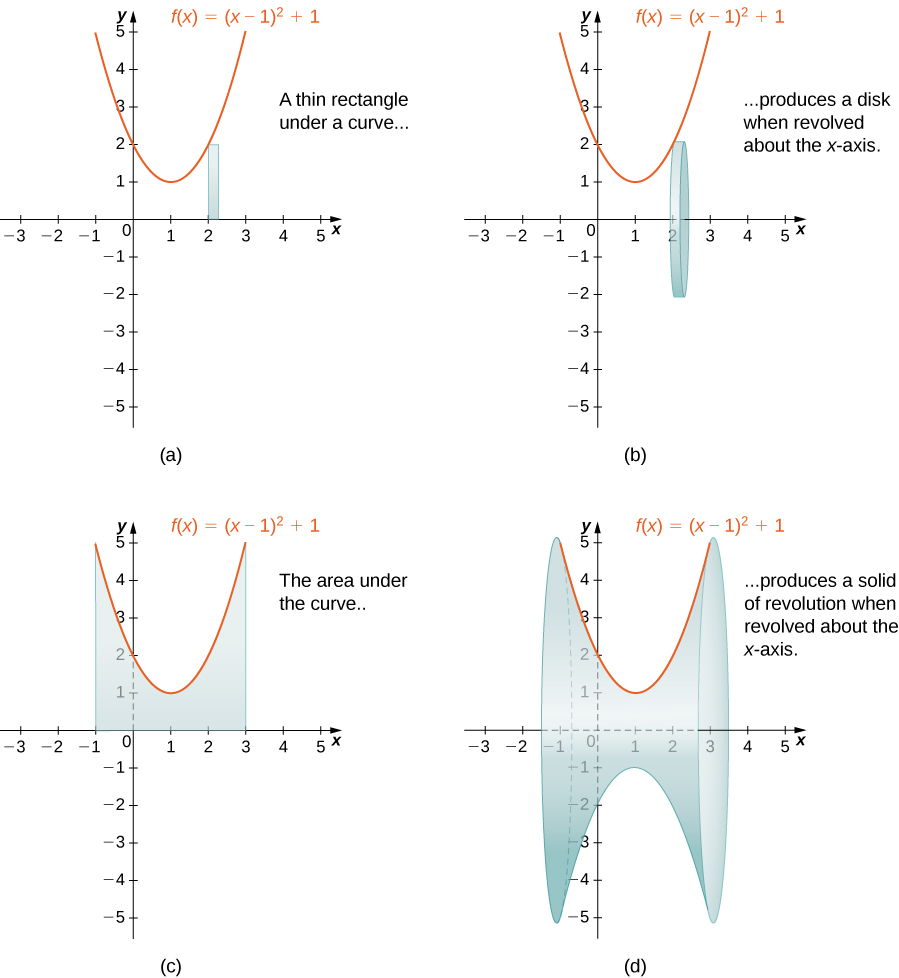
Consider revolving the region between the graph of [latex]f(x)={(x-1)}^{2}+1[/latex] and the [latex]x[/latex]-axis over the interval [latex][-1,3][/latex] around the [latex]x[/latex]-axis. The process creates a three-dimensional solid, and each cross-section perpendicular to the [latex]x[/latex]-axis is a circular disk.
Figure 9. (a) A thin rectangle for approximating the area under a curve. (b) A representative disk formed by revolving the rectangle about the [latex]x\text{-axis}\text{.}[/latex] (c) The region under the curve is revolved about the [latex]x\text{-axis},[/latex] resulting in (d) the solid of revolution.
The disk method builds on the general slicing method for volumes. You already know that volume can be found using:
[latex]V=\int_{a}^{b}A(x)dx[/latex]
The key difference with the disk method is that the cross-sectional area [latex]A(x)[/latex] is always the area of a circle: [latex]A(x)=\pi[r(x)]^{2}[/latex], where [latex]r(x)[/latex] is the radius of the disk at position [latex]x[/latex].
the disk method
Let [latex]f(x)[/latex] be continuous and nonnegative.
Define [latex]R[/latex] as the region bounded above by the graph of [latex]f(x),[/latex] below by the [latex]x\text{-axis,}[/latex] on the left by the line [latex]x=a,[/latex] and on the right by the line [latex]x=b.[/latex]
Then, the volume of the solid of revolution formed by revolving [latex]R[/latex] around the [latex]x\text{-axis}[/latex] is given by:
Use the disk method to find the volume of the solid of revolution generated by rotating the region between the graph of [latex]f(x)=\sqrt{x}[/latex] and the [latex]x\text{-axis}[/latex] over the interval [latex]\left[1,4\right][/latex] around the [latex]x\text{-axis}\text{.}[/latex]
The graphs of the function and the solid of revolution are shown in the following figure.
Figure 10. (a) The function [latex]f(x)=\sqrt{x}[/latex] over the interval [latex]\left[1,4\right].[/latex] (b) The solid of revolution obtained by revolving the region under the graph of [latex]f(x)[/latex] about the [latex]x\text{-axis}.[/latex]
The volume is [latex]\frac{(15\pi )}{2}[/latex] units3.
Revolving Around the [latex]y[/latex]-axis
You can revolve a region around any horizontal or vertical line. When revolving around the [latex]y[/latex]-axis, the mechanics are similar, but you express the function in terms of [latex]y[/latex] and integrate with respect to [latex]y[/latex].
the disk method for solids of revolution around the [latex]y[/latex]-axis
Let [latex]g(y)[/latex] be continuous and nonnegative. Define [latex]Q[/latex] as the region bounded on the right by the graph of [latex]g(y),[/latex] on the left by the [latex]y\text{-axis,}[/latex] below by the line [latex]y=c,[/latex] and above by the line [latex]y=d.[/latex]
Then, the volume of the solid of revolution formed by revolving [latex]Q[/latex] around the [latex]y\text{-axis}[/latex] is given by:
Let [latex]R[/latex] be the region bounded by the graph of [latex]g(y)=\sqrt{4-y}[/latex] and the [latex]y\text{-axis}[/latex] over the [latex]y\text{-axis}[/latex] interval [latex]\left[0,4\right].[/latex] Use the disk method to find the volume of the solid of revolution generated by rotating [latex]R[/latex] around the [latex]y\text{-axis}\text{.}[/latex]
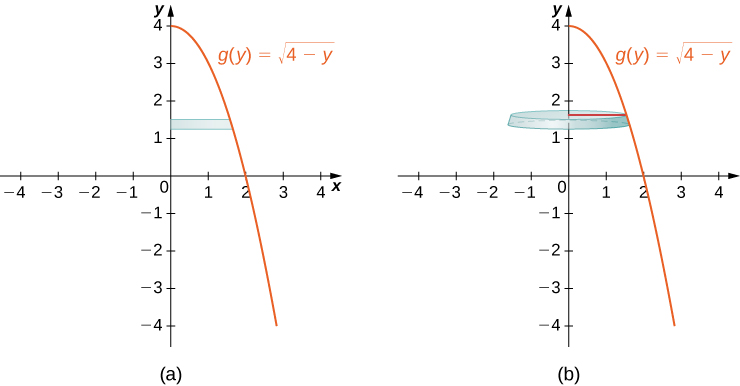
Figure 11 shows the function and a representative disk that can be used to estimate the volume. Notice that since we are revolving the function around the [latex]y\text{-axis,}[/latex] the disks are horizontal, rather than vertical.
Figure 11. (a) Shown is a thin rectangle between the curve of the function [latex]g(y)=\sqrt{4-y}[/latex] and the [latex]y\text{-axis}\text{.}[/latex] (b) The rectangle forms a representative disk after revolution around the [latex]y\text{-axis}\text{.}[/latex]
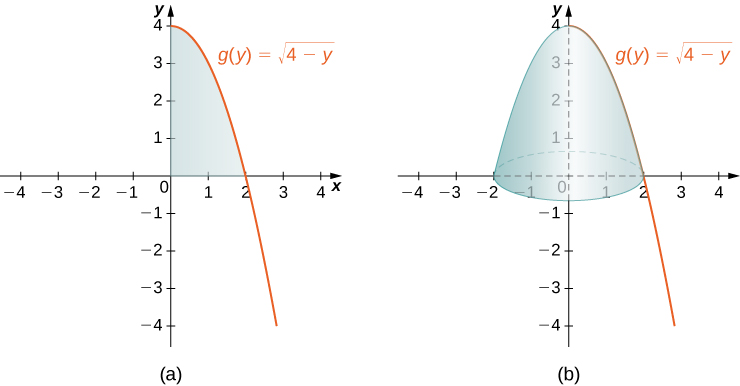
The region to be revolved and the full solid of revolution are depicted in the following figure.
Figure 12. (a) The region to the left of the function [latex]g(y)=\sqrt{4-y}[/latex] over the [latex]y\text{-axis}[/latex] interval [latex]\left[0,4\right].[/latex] (b) The solid of revolution formed by revolving the region about the [latex]y\text{-axis}\text{.}[/latex]
To find the volume, we integrate with respect to [latex]y.[/latex] We obtain