Stokes’ theorem translates between the flux integral of surface [latex]S[/latex] to a line integral around the boundary of [latex]S[/latex]. Therefore, the theorem allows us to compute surface integrals or line integrals that would ordinarily be quite difficult by translating the line integral into a surface integral or vice versa.
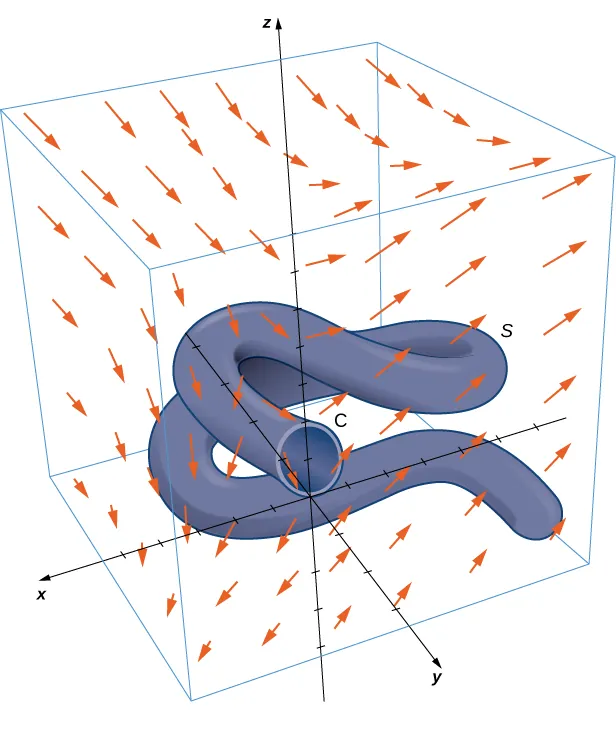
Calculate surface integral [latex]\displaystyle\iint_S\text{curl }{\bf{F}}\cdot{d}{\bf{S}}[/latex], where [latex]S[/latex] is the surface, oriented outward, in Figure 1 and [latex]{\bf{F}}=\langle{z},2xy,x+y\rangle[/latex].
Figure 1. A complicated surface in a vector field.
Note that to calculate [latex]\displaystyle\iint_S\text{curl }{\bf{F}}\cdot{d}{\bf{S}}[/latex] without using Stokes’ theorem, we would need to use the equation to calculate scalar surface integrals. Use of this equation requires a parameterization of [latex]S[/latex]. Surface [latex]S[/latex] is complicated enough that it would be extremely difficult to find a parameterization. Therefore, the methods we have learned in previous sections are not useful for this problem. Instead, we use Stokes’ theorem, noting that the boundary [latex]C[/latex] of the surface is merely a single circle with radius 1.
The curl of [latex]{\bf{F}}[/latex] is [latex]\langle1,1,2y\rangle[/latex]. By Stokes’ theorem,
where [latex]C[/latex] has parameterization [latex]{\bf{r}}(t)=\langle\sin{t},0,1-\cos{t}\rangle[/latex], [latex]0\leq{t}\leq2\pi[/latex]. By the equation to for computing vector line integrals,
An amazing consequence of Stokes’ theorem is that if [latex]S'[/latex] is any other smooth surface with boundary [latex]C[/latex] and the same orientation as [latex]S[/latex], then [latex]\displaystyle\iint_S\text{curl }{\bf{F}}\cdot{d}{\bf{S}}=\displaystyle\int_C{\bf{F}}\cdot{d}{\bf{r}}=0[/latex] because Stokes’ theorem says the surface integral depends on the line integral around the boundary only.
Surface Independence
In the previous example, we calculated a surface integral simply by using information about the boundary of the surface. In general, let [latex]S_1[/latex] and [latex]S_2[/latex] be smooth surfaces with the same boundary [latex]C[/latex] and the same orientation. By Stokes’ theorem:
Therefore, if [latex]\displaystyle\iint_{S_1}\text{curl }{\bf{F}}\cdot{d}{\bf{S}}[/latex] is difficult to calculate but [latex]\displaystyle\iint_{S_2}\text{curl }{\bf{F}}\cdot{d}{\bf{S}}[/latex] is easy to calculate, Stokes’ theorem allows us to calculate the easier surface integral. In the previous example, we could have calculated [latex]\displaystyle\iint_{S}\text{curl }{\bf{F}}\cdot{d}{\bf{S}}[/latex] by calculating [latex]\displaystyle\iint_{S^\prime}\text{curl }{\bf{F}}\cdot{d}{\bf{S}}[/latex], where [latex]S'[/latex] is the disk enclosed by boundary curve [latex]C[/latex] (a much simpler surface to work with).
Surface Independence and Path Independence
The equation [latex]{\displaystyle\iint_{S_1}\text{curl }{\bf{F}}\cdot{d}{\bf{S}}=\displaystyle\int_C{\bf{F}}\cdot{d}{\bf{r}}=\displaystyle\iint_{S_2}\text{curl }{\bf{F}}\cdot{d}{\bf{S}}}[/latex] shows that flux integrals of curl vector fields are surface independent in the same way that line integrals of gradient fields are path independent.
Recall that if [latex]\mathbf{F}[/latex] is a two-dimensional conservative vector field defined on a simply connected domain, [latex]f[/latex] is a potential function for [latex]\mathbf{F}[/latex], and [latex]C[/latex] is a curve in the domain of [latex]\mathbf{F}[/latex], then [latex]\displaystyle\int_C{\bf{F}}\cdot{d}{\bf{r}}[/latex] depends only on the endpoints of [latex]C[/latex]. Therefore if [latex]C'[/latex] is any other curve with the same starting point and endpoint as [latex]C[/latex], then [latex]\displaystyle\int_C{\bf{F}}\cdot{d}{\bf{r}}=\displaystyle\int_{C^\prime}{\bf{F}}\cdot{d}{\bf{r}}[/latex].
In other words, the value of the integral depends on the boundary of the path only; it does not depend on the path itself.
Analogously, suppose that [latex]S[/latex] and [latex]S'[/latex] are surfaces with the same boundary and same orientation, and suppose that [latex]\mathbf{G}[/latex] is a three-dimensional vector field that can be written as the curl of another vector field [latex]\mathbf{F}[/latex] (so that [latex]\mathbf{F}[/latex] is like a “potential field” of [latex]\mathbf{G}[/latex]). By Stokes’ theorem:
Therefore, the flux integral of [latex]{\bf{G}}[/latex] does not depend on the surface, only on the boundary of the surface. Flux integrals of vector fields that can be written as the curl of a vector field are surface independent in the same way that line integrals of vector fields that can be written as the gradient of a scalar function are path independent.
Calculate the line integral [latex]\displaystyle\int_C{\bf{F}}\cdot{d}{\bf{r}}[/latex], where [latex]{\bf{F}}=\langle{x}y,x^2+y^2+z^2,yz\rangle[/latex] and [latex]C[/latex] is the boundary of the parallelogram with vertices [latex](0, 0, 1)[/latex], [latex](0, 1, 0)[/latex], [latex](2, 0, -1)[/latex], and [latex](2, 1, -2)[/latex].
To calculate the line integral directly, we need to parameterize each side of the parallelogram separately, calculate four separate line integrals, and add the result. This is not overly complicated, but it is time-consuming.
By contrast, let’s calculate the line integral using Stokes’ theorem. Let [latex]S[/latex] denote the surface of the parallelogram. Note that [latex]S[/latex] is the portion of the graph of [latex]z=1-x-y[/latex] for [latex](x, y)[/latex] varying over the rectangular region with vertices [latex](0, 0)[/latex], [latex](0, 1)[/latex], [latex](2, 0)[/latex], and [latex](2, 1)[/latex] in the [latex]xy[/latex]-plane. Therefore, a parameterization of [latex]S[/latex] is [latex]\langle{x},y,1-x-y\rangle[/latex], [latex]0\leq{x}\leq2, \ 0\leq{y}\leq1[/latex]. The curl of [latex]{\bf{F}}[/latex] is [latex]-\langle{z},0,x\rangle[/latex], and Stokes’ theorem and the equation to calculate scalar surface integrals give