Surface Integral of a Vector Field
With the idea of orientable surfaces in place, we can now define a surface integral of a vector field. The definition is analogous to the definition of the flux of a vector field along a plane curve.
Flux of a Vector Field Along a Curve
If [latex]\mathbf{F}[/latex] is a two-dimensional vector field and [latex]C[/latex] is a plane curve, then the flux of [latex]\mathbf{F}[/latex] along [latex]C[/latex] involves chopping [latex]C[/latex] into small pieces, choosing a point inside each piece, and calculating [latex]\mathbf{F} \cdot \mathbf{N}[/latex] at the point (where [latex]\mathbf{N}[/latex] is the unit normal vector at the point).
The definition of a surface integral of a vector field proceeds in the same fashion, except now we chop surface [latex]S[/latex] into small pieces, choose a point in each (two-dimensional) piece, and calculate [latex]\mathbf{F} \cdot \mathbf{N}[/latex] at the point.
To place this definition in a real-world setting, let [latex]S[/latex] be an oriented surface with unit normal vector [latex]\mathbf{N}[/latex]. Let [latex]\mathbf{v}[/latex] be a velocity field of a fluid flowing through [latex]S[/latex], and suppose the fluid has density [latex]\rho(x,y,z)[/latex].
Imagine the fluid flows through [latex]S[/latex], but [latex]S[/latex] is completely permeable so that it does not impede the fluid flow (Figure 4). The mass flux of the fluid is the rate of mass flow per unit area. The mass flux is measured in mass per unit time per unit area.
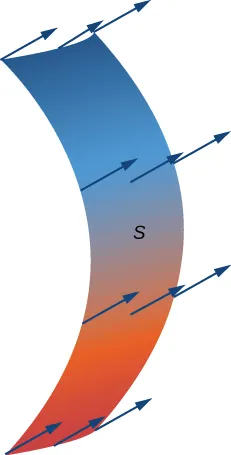
How could we calculate the mass flux of the fluid across [latex]S[/latex]?
The rate of flow, measured in mass per unit time per unit area, is [latex]\rho \mathbf{v}[/latex]. To calculate the mass flux across [latex]S[/latex], chop [latex]S[/latex] into small pieces [latex]S_{ij}[/latex].
If [latex]S_{ij}[/latex] is small enough, then it can be approximated by a tangent plane at some point [latex]P[/latex] in [latex]S_{ij}[/latex]. Therefore, the unit normal vector at [latex]P[/latex] can be used to approximate [latex]\mathbf{N}(x,y,z)[/latex] across the entire piece [latex]S_{ij}[/latex], because the normal vector to a plane does not change as we move across the plane.
The component of the vector [latex]\rho \mathbf{v}[/latex] at [latex]P[/latex] in the direction of [latex]\mathbf{N}[/latex] is [latex]\rho \mathbf{v} \cdot \mathbf{N}[/latex] at [latex]P[/latex]. Since [latex]S_{ij}[/latex] is small, the dot product [latex]\rho \mathbf{v} \cdot \mathbf{N}[/latex] changes very little as we vary across [latex]S_{ij}[/latex], and therefore [latex]\rho \mathbf{v} \cdot \mathbf{N}[/latex] can be taken as approximately constant across [latex]S_{ij}[/latex].
To approximate the mass of fluid per unit time flowing across [latex]S_{ij}[/latex] (and not just locally at point [latex]P[/latex]), we need to multiply [latex](\rho \mathbf{v} \cdot \mathbf{N})(P)[/latex] by the area of [latex]S_{ij}[/latex]. Therefore, the mass of fluid per unit time flowing across [latex]S_{ij}[/latex] in the direction of [latex]\mathbf{N}[/latex] can be approximated by [latex](\rho \mathbf{v} \cdot \mathbf{N}) \Delta S_{ij}[/latex], where [latex]\mathbf{N}[/latex], [latex]\rho[/latex], and [latex]\mathbf{v}[/latex] are all evaluated at [latex]P[/latex] (Figure 5).
This is analogous to the flux of two-dimensional vector field [latex]\mathbf{F}[/latex] across plane curve [latex]C[/latex], in which we approximated flux across a small piece of [latex]C[/latex] with the expression [latex](\mathbf{F} \cdot \mathbf{N}) \Delta s[/latex].
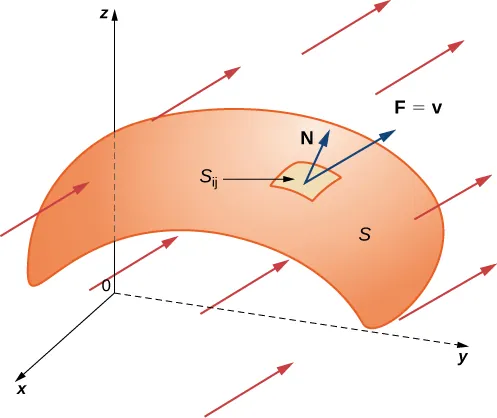
To approximate the mass flux across [latex]S[/latex], form the sum [latex]\displaystyle\sum_{i=1}^m\displaystyle\sum_{j=1}^n(\rho{\bf{v}}\cdot{\bf{N}})\nabla{S_{ij}}[/latex] As pieces [latex]S_{ij}[/latex] get smaller, this sum gets arbitrarily close to the mass flux. Therefore, the mass flux is:
[latex]\displaystyle\iint_s\rho{\bf{v}}\cdot{\bf{N}}dS=\displaystyle\lim_{m,n\to\infty}\displaystyle\sum_{i=1}^m\displaystyle\sum_{j=1}^n(\rho{\bf{v}}\cdot{\bf{N}})\nabla{S_{ij}}[/latex].
This is a surface integral of a vector field. Letting the vector field [latex]\rho \mathbf{v}[/latex] be an arbitrary vector field [latex]\mathbf{F}[/latex] leads to the following definition.
surface integral of a vector field
Let [latex]\mathbf{F}[/latex] be a continuous vector field with a domain that contains oriented surface [latex]S[/latex] with unit normal vector [latex]\mathbf{N}[/latex]. The surface integral of [latex]\mathbf{F}[/latex] over [latex]S[/latex] is:
[latex]\displaystyle\iint_S{\bf{F}}\cdot{d}S=\displaystyle\iint_S{\bf{F}}\cdot{\bf{N}}{d}S[/latex].
This integral is also called the flux of [latex]\mathbf{F}[/latex] across [latex]S[/latex].
Computing Surface Integrals of Vector Fields
Just as with vector line integrals, surface integral [latex]\displaystyle\iint_S{\bf{F}}\cdot{\bf{N}}{d}S[/latex] is easier to compute after surface [latex]S[/latex] has been parameterized. Let [latex]\mathbf{r}(u,v)[/latex] be a parameterization of [latex]S[/latex] with parameter domain [latex]D[/latex].
The unit normal vector is given by [latex]\mathbf{N} = \frac{\mathbf{t}_u \times \mathbf{t}_v}{||\mathbf{t}_u \times \mathbf{t}_v||}[/latex]. Using the surface integral formula for scalar-valued functions, we have:
[latex]\begin{aligned} \displaystyle\iint_S{\bf{F}}\cdot{\bf{N}}{d}S&=\displaystyle\iint_S{\bf{F}}\cdot{\bf{N}}{d}S \\ &=\displaystyle\iint_S{\bf{F}}\cdot\frac{{\bf{t}}_u\times{\bf{t}}_v}{||{\bf{t}}_u\times{\bf{t}}_v||}dS \\ &=\displaystyle\iint_D\left({\bf{F}}({\bf{r}}(u,v))\cdot\frac{{\bf{t}}_u\times{\bf{t}}_v}{||{\bf{t}}_u\times{\bf{t}}_v||}\right)||{\bf{t}}_u\times{\bf{t}}_v||dA \\ &=\displaystyle\iint_D({\bf{F}}({\bf{r}}(u,v))\cdot({\bf{t}}_u\times{\bf{t}}_v))dA \end{aligned}[/latex].
Notice that the magnitude terms cancel, simplifying the computation considerably.
computing surface integrals
For a vector field [latex]\mathbf{F}[/latex] and oriented surface [latex]S[/latex] with parameterization [latex]\mathbf{r}(u,v)[/latex] over domain [latex]D[/latex]:
[latex]\displaystyle\iint_S{\bf{F}}\cdot{\bf{N}}{d}S=\displaystyle\iint_D({\bf{F}}({\bf{r}}(u,v))\cdot({\bf{t}}_u\times{\bf{t}}_v))dA[/latex].