Orientation of a Surface
When we defined scalar line integrals, we didn’t need to worry about an orientation of the curve of integration. The same was true for scalar surface integrals—we didn’t need to worry about an “orientation” of the surface of integration.
However, when we defined vector line integrals, the curve of integration needed an orientation. We needed the notion of an oriented curve to define a vector line integral without ambiguity. Similarly, when we define a surface integral of a vector field, we need the notion of an oriented surface.
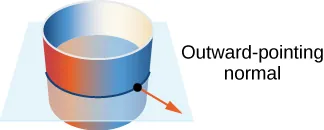
An oriented surface is given an “upward” or “downward” orientation or, in the case of surfaces such as a sphere or cylinder, an “outward” or “inward” orientation.
Orientable Surfaces
Let [latex]S[/latex] be a smooth surface. For any point [latex](x, y, z)[/latex] on [latex]S[/latex], we can identify two unit normal vectors [latex]\mathbf{N}[/latex] and [latex]-\mathbf{N}[/latex].
If it is possible to choose a unit normal vector [latex]\mathbf{N}[/latex] at every point [latex](x, y, z)[/latex] on [latex]S[/latex] so that [latex]\mathbf{N}[/latex] varies continuously over [latex]S[/latex], then [latex]S[/latex] is orientable. Such a choice of unit normal vector at each point gives the orientation of surface [latex]S[/latex].
orientable surface
A smooth surface [latex]S[/latex] is orientable if it is possible to choose a unit normal vector [latex]\mathbf{N}[/latex] at every point [latex](x, y, z)[/latex] on [latex]S[/latex] so that [latex]\mathbf{N}[/latex] varies continuously over [latex]S[/latex].
The choice of [latex]\mathbf{N}[/latex] determines the orientation of the surface.
Examples of Orientable Surfaces
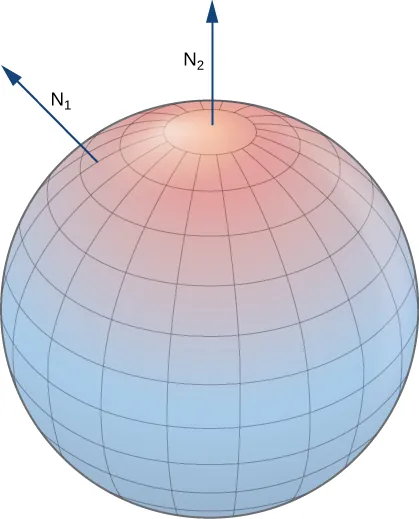
Closed surfaces such as spheres are orientable. If we choose the outward normal vector at each point on the surface of the sphere, then the unit normal vectors vary continuously. This is called the positive orientation of the closed surface (Figure 1).
We also could choose the inward normal vector at each point to give an “inward” orientation, which is the negative orientation of the surface.
A portion of the graph of any smooth function [latex]z = f(x,y)[/latex] is also orientable. If we choose the unit normal vector that points “above” the surface at each point, then the unit normal vectors vary continuously over the surface. We could also choose the unit normal vector that points “below” the surface at each point.
To get such an orientation, we parameterize the graph of [latex]f[/latex] in the standard way: [latex]\mathbf{r}(x,y) = \langle x, y, f(x,y) \rangle[/latex], where [latex]x[/latex] and [latex]y[/latex] vary over the domain of [latex]f[/latex]. Then [latex]\mathbf{t}_x = \langle 1, 0, f_x \rangle[/latex] and [latex]\mathbf{t}_y = \langle 0, 1, f_y \rangle[/latex], and therefore the cross product [latex]\mathbf{t}_x \times \mathbf{t}_y[/latex] (which is normal to the surface at any point) is [latex]\langle -f_x, -f_y, 1 \rangle[/latex].
Since the [latex]z[/latex]-component of this vector is one, the corresponding unit normal vector points “upward,” and the upward side of the surface is chosen to be the “positive” side.
Finding an Orientation
Let [latex]S[/latex] be a smooth orientable surface with parameterization [latex]\mathbf{r}(u,v)[/latex]. For each point [latex]\mathbf{r}(a,b)[/latex] on the surface, vectors [latex]\mathbf{t}_u[/latex] and [latex]\mathbf{t}_v[/latex] lie in the tangent plane at that point.
Vector [latex]\mathbf{t}_u \times \mathbf{t}_v[/latex] is normal to the tangent plane at [latex]\mathbf{r}(a,b)[/latex] and is therefore normal to [latex]S[/latex] at that point. Therefore, the choice of unit normal vector:
[latex]\mathbf{N} = \frac{\mathbf{t}_u \times \mathbf{t}_v}{||\mathbf{t}_u \times \mathbf{t}_v||}[/latex]
gives an orientation of surface [latex]S[/latex].
Nonorientable Surfaces
Since every curve has a “forward” and “backward” direction (or, in the case of a closed curve, a clockwise and counterclockwise direction), it is possible to give an orientation to any curve. Hence, it is possible to think of every curve as an oriented curve. This is not the case with surfaces, however. Some surfaces cannot be oriented; such surfaces are called nonorientable.
Essentially, a surface can be oriented if the surface has an “inner” side and an “outer” side, or an “upward” side and a “downward” side. Some surfaces are twisted in such a fashion that there is no well-defined notion of an “inner” or “outer” side.
The classic example of a nonorientable surface is the Möbius strip. To create a Möbius strip, take a rectangular strip of paper, give the piece of paper a half-twist, and then glue the ends together (Figure 3).
Because of the half-twist in the strip, the surface has no “outer” side or “inner” side. If you imagine placing a normal vector at a point on the strip and having the vector travel all the way around the band, then (because of the half-twist) the vector points in the opposite direction when it gets back to its original position. Therefore, the strip really only has one side.

Since some surfaces are nonorientable, it is not possible to define a vector surface integral on all piecewise smooth surfaces. This is in contrast to vector line integrals, which can be defined on any piecewise smooth curve.