Implicit Differentiation
In single-variable calculus, we learned how to find [latex]\frac{dy}{dx}[/latex] when [latex]y[/latex] is defined implicitly as a function of [latex]x[/latex]. The technique involved differentiating both sides of an equation with respect to [latex]x[/latex], then solving for the derivative. Partial derivatives give us an alternative approach to this problem.
Implicit Differentiation for Single-Variable Functions
Implicit differentiation gives us a method for finding [latex]\frac{dy}{dx}[/latex] when [latex]y[/latex] is defined implicitly as a function of [latex]x[/latex]. The method involves differentiating both sides of the equation with respect to [latex]x[/latex], then solving for [latex]\frac{dy}{dx}[/latex].
Consider the ellipse defined by the equation [latex]x^{2}+3y^{2}+4y-4=0[/latex].
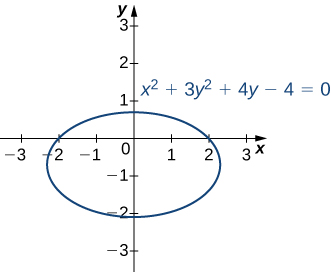
This equation implicitly defines [latex]y[/latex] as a function of [latex]x[/latex]. As such, we can find the derivative [latex]dy/dx[/latex] using the method of implicit differentiation:
[latex]\hspace{8cm} \begin{align} \frac{d}{dx}(x^2+3y^2+4y-4)&=\frac{d}{dx}(0) \\ 2x+6y\frac{dy}{dx}+4\frac{dy}{dx}&=0 \\ (6y+4)\frac{dy}{dx}&=-2x \\ \frac{dy}{dx}&=-\frac{x}{3y+2}. \end{align}[/latex]
We can also define a function [latex]z=f(x,y)[/latex] using the left-hand side of the equation. Then [latex]f(x,y)=x^{2}+3y^{2}+4y-4[/latex], and the ellipse [latex]x^{2}+3y^{2}+4y-4=0[/latex] can be described by [latex]f(x,y)=0[/latex]. This gives us an alternative approach to calculating [latex]\frac{dy}{dx}[/latex].
implicit differentiation of a function of two or more variables
Suppose [latex]z=f(x,y)[/latex] defines [latex]y[/latex] implicitly as a function [latex]y=g(x)[/latex] via the equation [latex]f(x,y)=0[/latex]. Then
[latex]\dfrac{dy}{dx}=-\dfrac{\partial f/\partial x}{\partial f/\partial y}[/latex]
provided [latex]f_y(x,y)\neq 0[/latex].
If the equation [latex]f(x,y,z)=0[/latex] defines [latex]z[/latex] implicitly as a differentiable function of [latex]x[/latex] and [latex]y[/latex], then
[latex]\dfrac{\partial z}{\partial x}=-\dfrac{\partial f/\partial x}{\partial f/\partial z}[/latex] and [latex]\dfrac{\partial z}{\partial y}=-\dfrac{\partial f/\partial y}{\partial f/\partial z}[/latex]
as long as [latex]f_z(x,y,z)\neq 0[/latex].
This formula is a direct consequence of the chain rule. If [latex]y[/latex] is defined implicitly as a function of [latex]x[/latex] via [latex]f(x,y)=0[/latex], we can apply the chain rule to find [latex]\frac{dy}{dx}[/latex]:
[latex]\hspace{8cm} \begin{align} \frac{d}{dx}f(x,y)&=\frac{d}{dx}(0) \\ \frac{\partial f}{\partial x}\cdot\frac{dx}{dx}+\frac{\partial f}{\partial y}\cdot\frac{dy}{dx}&=0 \\ \frac{\partial f}{\partial x}+\frac{\partial f}{\partial y}\cdot\frac{dy}{dx}&=0. \end{align}[/latex]
Solving for [latex]\frac{dy}{dx}[/latex] gives us the formula. The formulas for three variables can be derived similarly.
Let’s return to the ellipse example using this new approach. With [latex]f(x,y)=x^{2}+3y^{2}+4y-4[/latex], we calculate:
[latex]\hspace{10cm} \begin{align} \frac{\partial f}{\partial x}&=2x \\ \frac{\partial f}{\partial y}&=6y+4. \end{align}[/latex]
Then the formula gives:
[latex]\large{\frac{dy}{dx}=-\frac{\partial f/\partial x}{\partial f/\partial y}=-\frac{2x}{6y+4}=-\frac{x}{3y+2}},[/latex]
which is the same result we obtained using the traditional implicit differentiation method.
Why Use Partial Derivatives? This method can be more efficient than traditional implicit differentiation, especially for complicated equations. Instead of differentiating the entire equation and solving for [latex]\frac{dy}{dx}[/latex], you just find two partial derivatives and plug them into the formula.
- Calculate [latex]dy/dx[/latex] if [latex]y[/latex] is implicitly as a function of [latex]x[/latex] via the equation [latex]3x^{2}-2xy+y^{2}+4x-6y-11=0[/latex]. What is the equation of the tangent line to the graph of this curve at point [latex](2, 1)[/latex]?
- Calculate [latex]\partial z/\partial x[/latex] and [latex]\partial z/\partial y[/latex], given [latex]x^2e^y-yze^x=0[/latex].
