Continuity
In single-variable calculus, we studied continuity of functions and saw how it relied on limits. The definition of continuity for functions of two variables follows the same pattern, with three key conditions that must be satisfied.
Continuity of a Function of One Variable
A function [latex]f(x)[/latex] is continuous at point [latex]x=a[/latex] if three conditions hold:
- [latex]f(a)[/latex] exists.
- [latex]\underset{x\to a}{\text{lim}}f(x)[/latex] exists.
- [latex]\underset{x\to a}{\text{lim}}f(x)=f(a)[/latex].
These three conditions are necessary for continuity of a function of two variables as well.
continuity of a function of two variables
A function [latex]f\,(x,\ y)[/latex] is continuous at a point [latex](a,\ b)[/latex] in its domain if:
- [latex]f\,(a,\ b)[/latex] exists.
- [latex]\displaystyle{\lim_{(x,\ y)\to{(a,\ b)}}}f\,(x,\ y)[/latex] exists.
- [latex]\displaystyle{\lim_{(x,\ y)\to(a,\ b)}}f\,(x,\ y)=f\,(a,\ b)[/latex].
Properties of Continuous Functions
Continuity can also be defined using the epsilon-delta definition. A function of two variables is continuous at a point [latex](x_0,y_0)[/latex] in its domain if for every [latex]\epsilon>0[/latex] there exists [latex]\delta>0[/latex] such that, whenever [latex]\sqrt{(x-x_0)^2+(y-y_0)^2}<\delta[/latex], we have [latex]|f(x,y)-f(x_0,y_0)|<\epsilon[/latex].
This definition can be combined with the epsilon-delta definition of continuity for functions of one variable to prove the following theorems.
sum of continuous functions
If [latex]f(x,y)[/latex] is continuous at [latex](x_0,y_0)[/latex], and [latex]g(x,y)[/latex] is continuous at [latex](x_0,y_0)[/latex], then [latex]f(x,y)+g(x,y)[/latex] is continuous at [latex](x_0,y_0)[/latex].
product of continuous functions
If [latex]g(x)[/latex] is continuous at [latex]x_0[/latex], and [latex]h(y)[/latex] is continuous at [latex]y_0[/latex], then [latex]f(x,y)=g(x)h(y)[/latex] is continuous at [latex](x_0,y_0)[/latex].
composition of continuous functions
Let [latex]g[/latex] be a function of two variables continuous at [latex](x_0,y_0)\in{D}[/latex], and define [latex]z_0=g(x_0,y_0)[/latex]. Let [latex]f[/latex] be a function of one variable continuous at [latex]z_0[/latex]. Then [latex]f\circ g[/latex] is continuous at [latex](x_0,y_0)[/latex].
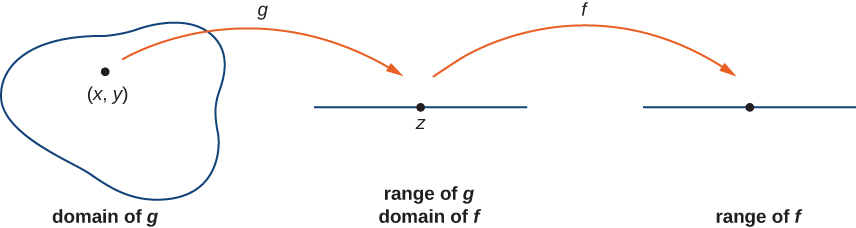
We can use these theorems to show continuity of functions in the following example.