Interior Points and Boundary Points
To study continuity and differentiability of a function of two or more variables, we first need to learn some new terminology.
interior and boundary points
Let [latex]S[/latex] be a subset of [latex]\mathbb{R}^{2}[/latex].
- A point [latex]P_0[/latex] is an interior point of [latex]S[/latex] if there is a [latex]\delta[/latex] disk centered around [latex]P_0[/latex] contained completely in [latex]S[/latex].
- A point [latex]P_0[/latex] is a boundary point of [latex]S[/latex] if every [latex]\delta[/latex] disk centered around [latex]P_0[/latex] contains points both inside and outside [latex]S[/latex]
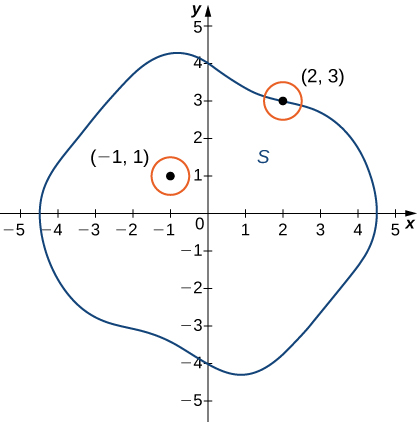
open and closed sets
Let [latex]S[/latex] be a subset of [latex]\mathbb{R}^{2}[/latex].
- [latex]S[/latex] is an open set if every point of [latex]S[/latex] is an interior point.
- [latex]S[/latex] is a closed set if it contains all its boundary points.
An example of an open set is a [latex]\delta[/latex] disk. If we include the boundary of the disk, then it becomes a closed set. A set that contains some, but not all, of its boundary points is neither open nor closed. For example, if we include half the boundary of a [latex]\delta[/latex] disk but not the other half, then the set is neither open nor closed.
connected sets and regions
Let [latex]S[/latex] be a subset of [latex]\mathbb{R}^{2}[/latex].
- An open set [latex]S[/latex] is connected if it cannot be represented as the union of two or more disjoint, nonempty open subsets.
- A set [latex]S[/latex] is a region if it is open, connected, and nonempty.
Limits at Boundary Points
The definition of a limit of a function of two variables requires the [latex]\delta[/latex] disk to be contained inside the domain of the function. However, if we wish to find the limit of a function at a boundary point of the domain, the [latex]\delta[/latex] disk is not contained inside the domain. By definition, some points of the [latex]\delta[/latex] disk are inside the domain and some are outside.
Therefore, we need only consider points that are inside both the [latex]\delta[/latex] disk and the domain of the function. This leads to the definition of the limit of a function at a boundary point.
limit at a boundary point
Let [latex]f[/latex] be a function of two variables, and suppose [latex](a,\ b)[/latex] is on the boundary of the domain of [latex]f[/latex]. Then
[latex]\underset{(x,y)\to(a,b)}{\text{lim}}f(x,y)=L[/latex]
if for any [latex]\epsilon>0[/latex], there exists [latex]\delta>0[/latex] such that
[latex]|f(x,y)-L|<\epsilon[/latex] whenever [latex]0<\sqrt{(x-a)^{2}+(y-b)^{2}}<\delta[/latex]
for all points [latex](x,\ y)[/latex] inside the domain of [latex]f[/latex].

