Projectile Motion
Now let’s apply vector functions to a real-world scenario: understanding how gravity affects objects moving through the air. This situation—where an object moves with an initial velocity but experiences only the force of gravity—is called projectile motion. It describes everything from golf balls and baseballs to arrows and cannonballs. We’ll ignore air resistance in our analysis.
Setting Up the Coordinate System
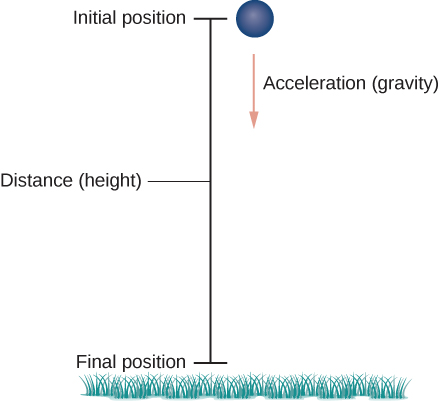
We place ourselves at the origin with the positive [latex]y[/latex]-axis pointing up, the negative [latex]y[/latex]-axis pointing down, and the positive [latex]x[/latex]-axis pointing forward (away from the thrower). Since gravity acts downward, Newton’s second law tells us the force from gravity equals the mass times the acceleration due to gravity: [latex]F_{g}=mg[/latex], where [latex]F_{g}[/latex] is the gravitational force and [latex]g[/latex] is the acceleration due to gravity at Earth’s surface.
The value of [latex]g[/latex] is approximately [latex]32 ft/sec^{2}[/latex] in the English system and approximately [latex]9.8 m/sec^{2}[/latex] in the metric system. Since gravity acts downward, we write the gravitational force as [latex]F_{g}=-mg{\bf{j}}[/latex], as shown in Figure 1.
Deriving the Position Equation
Newton’s second law states that [latex]F=m{\bf{a}}[/latex], where [latex]{\bf{a}}[/latex] is the acceleration vector. This force must equal the gravitational force at all times:
[latex]\begin{array}{ccc}\hfill {F} & =\hfill & {F_{g}} \hfill \\ \hfill {m{\bf{a}}}& =\hfill & {-mg{\bf{j}}} \hfill \\ \hfill {{\bf{a}}}& =\hfill & {-g{\bf{j}}}\hfill \end{array}[/latex]
Since the acceleration vector is the derivative of the velocity vector, we can write:
[latex]{{\bf{v}}'(t)=-g{\bf{j}}}[/latex]
Taking the antiderivative of both sides:
[latex]\begin{array}{ccc}\hfill {{\bf{v}}(t)} & =\hfill & {\int -g{\bf{j}}dt} \hfill \\ \hfill & =\hfill & {-gt{\bf{j}}+{\bf{C}}_{1}}\hfill \end{array}[/latex]
To find the constant vector [latex]{\bf{C}}{1}[/latex], we use the initial velocity [latex]{\bf{v}}{0}={\bf{v}}(0)[/latex]. This gives us [latex]{\bf{C}}{1}={\bf{v}}{0}[/latex], so:
[latex]{\bf{v}}(t)=-gt{\bf{j}}+{\bf{v}}_{0}[/latex]
Since velocity is the derivative of position, we have:
[latex]{\bf{s}}'(t)=-gt{\bf{j}}+{\bf{v}}_{0}[/latex]
Taking the antiderivative again:
[latex]\begin{array}{ccc}\hfill {{\bf{s}}(t)} & =\hfill & {\int -gt{\bf{j}}+{\bf{v}}{0}dt} \hfill \\ \hfill & =\hfill & {-\frac{1}{2}gt^{2}{\bf{j}}+{\bf{v}}{0}t+{\bf{C}}_{2}}\hfill \end{array}[/latex]
Using the initial position [latex]{\bf{s}}{0}={\bf{s}}(0)[/latex], we find [latex]{\bf{C}}{2}={\bf{s}}_{0}[/latex]. This gives the position at any time:
[latex]{\bf{s}}(t)=-\frac{1}{2}gt^{2}{\bf{j}}+{\bf{v}}{0}t+{\bf{s}}{0}[/latex]
Projectile Launched at an Angle
Suppose an object is thrown upward from the origin at an angle [latex]\theta[/latex] to the horizontal with initial speed [latex]v_{0}[/latex]. We can assume [latex]{\bf{s}}_{0}={\bf{0}}[/latex] by placing the origin at the launch point (Figure 2).
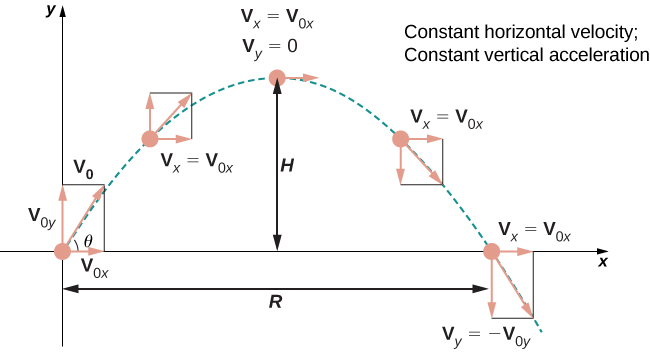
We can express the initial velocity as [latex]{\bf{v}}{0}=v{0}\cos\theta{\bf{i}}+v_{0}\sin\theta{\bf{j}}[/latex]. The position equation becomes:
[latex]\begin{array}{ccc}\hfill {{\bf{s}}(t)} & =\hfill & {-\frac{1}{2}gt^{2}{\bf{j}}+v_{0}t\cos\theta{\bf{i}}+v_{0}t\sin\theta{\bf{j}}} \hfill \\ \hfill & =\hfill & {v_{0}t\cos\theta{\bf{i}}+(v_{0}t\sin\theta-\frac{1}{2}gt^{2}){\bf{j}}}\hfill \end{array}[/latex]
components of projectile motion
- The coefficient of [latex]{\bf{i}}[/latex] represents the horizontal distance from the origin at time [latex]t[/latex]
- The maximum horizontal distance (at the same initial and final altitude) is called the range [latex]R[/latex]
- The coefficient of [latex]{\bf{j}}[/latex] represents the altitude at time [latex]t[/latex]
- The maximum altitude is called the height [latex]H[/latex]
- Find the maximum height of the cannonball.
- How long will it take for the cannonball to splash into the sea?
- How far out to sea will the cannonball hit the water?

Figure 3. The flight of a cannonball (ignoring air resistance) is projectile motion.
Maximum Range of a Projectile
One final question: what is the maximum distance a projectile can travel given its initial speed? To answer this, we assume the projectile is fired from ground level and returns to ground level. The equation of projectile motion is:
[latex]{{\bf{s}}(t)=v_{0}t\cos\theta{\bf{i}}+(v_{0}t\sin\theta-\frac{1}{2}gt^{2}){\bf{j}}}[/latex]
Setting the vertical component equal to zero and solving for [latex]t[/latex]:
[latex]\begin{array}{ccc}\hfill {v_{0}t\sin\theta-\frac{1}{2}gt^{2}} & =\hfill & {0} \hfill \\ \hfill {t(v_{0}\sin\theta-\frac{1}{2}gt)}& =\hfill & {0}\hfill \end{array}[/latex]
This gives [latex]t=0[/latex] or [latex]t=\frac{2v_{0}\sin\theta}{g}[/latex]. Substituting the second value into [latex]{\bf{s}}(t)[/latex]:
[latex]\begin{array}{ccc}\hfill{{\bf{s}}\big(\frac{2v_{0}\sin{\theta}}{g}\big)} & =\hfill & {v_{0}\big(\frac{2v_{0}\sin{\theta}}{g}\big)\cos{\theta{\bf{i}}}+\Big(v_{0}\big(\frac{2v_{0}\sin{\theta}}{g}\big)\sin{\theta}-\frac{1}{2}g\big(\frac{2v_{0}\sin{\theta}}{g}\big)^{2}\Big){\bf{j}}} \hfill \\ \hfill & =\hfill & {\bigg(\frac{2v^2_0\sin{\theta}\cos{\theta}}{g}\bigg){\bf{i}}}\hfill \\ \hfill & =\hfill & {\frac{v^2_0\sin{2\theta}}{g}{\bf{i}}.}\hfill \\ \hfill \end{array}[/latex]
Thus, the expression for the range of a projectile fired at an angle [latex]\theta[/latex] is
[latex]\large{R=\frac{v^2_0\sin{2\theta}}{g}{\bf{i}}}.[/latex]
range of a projectile
The range of a projectile fired at angle [latex]\theta[/latex] with initial speed [latex]v_{0}[/latex] is:
[latex]R=\frac{v^2_0\sin 2\theta}{g}[/latex]
To maximize the range, take the derivative with respect to [latex]\theta[/latex] and set it equal to zero:
[latex]\begin{align} \frac{d}{d\theta}\left(\frac{v_{0}^2\sin 2\theta}{g}\right) & =0 \\ \frac{2v_{0}^2\cos 2\theta}{g} & = 0 \\ \theta & = 45^\circ \end{align}[/latex]
In the absence of air resistance, the angle that maximizes range is [latex]45^\circ[/latex]. At this angle, the range is:
[latex]R=\frac{v^2_0}{g}[/latex]
This result assumes the projectile is launched and lands at the same altitude.