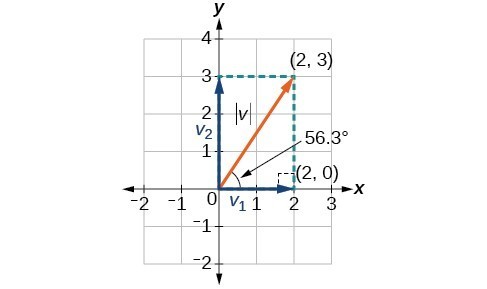
In some applications involving vectors, it is helpful for us to be able to break a vector down into its components. Vectors are comprised of two components: the horizontal component is the [latex]x[/latex] direction, and the vertical component is the [latex]y[/latex] direction. For example, we can see in the graph that the position vector [latex]\langle 2,3\rangle[/latex] comes from adding the vectors v1 and v2. We have v1 with initial point [latex]\left(0,0\right)[/latex] and terminal point [latex]\left(2,0\right)[/latex].
Using the Pythagorean Theorem, the magnitude of v1 is 2, and the magnitude of v2 is 3. To find the magnitude of v, use the formula with the position vector.
Thus, the magnitude of [latex]\boldsymbol{v}[/latex] is [latex]\sqrt{13}[/latex] and the direction is [latex]{56.3}^{\circ }[/latex] off the horizontal.
Find the components of the vector [latex]\boldsymbol{v}[/latex] with initial point [latex]\left(3,2\right)[/latex] and terminal point [latex]\left(7,4\right)[/latex].
The horizontal component is [latex]{\boldsymbol{v}}_{1}=\langle 4,0\rangle[/latex] and the vertical component is [latex]{\boldsymbol{v}}_{2}=\langle 0,2\rangle[/latex].
Finding the Unit Vector in the Direction of v
In addition to finding a vector’s components, it is also useful in solving problems to find a vector in the same direction as the given vector, but of magnitude 1. We call a vector with a magnitude of 1 a unit vector. We can then preserve the direction of the original vector while simplifying calculations.
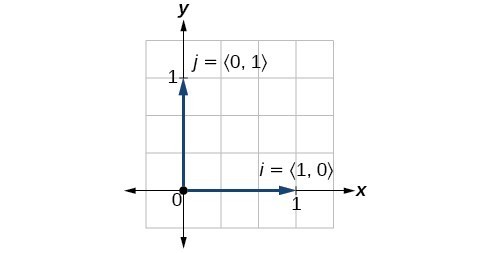
Unit vectors are defined in terms of components. The horizontal unit vector is written as [latex]\boldsymbol{i}=\langle 1,0\rangle[/latex] and is directed along the positive horizontal axis. The vertical unit vector is written as [latex]\boldsymbol{j}=\langle 0,1\rangle[/latex] and is directed along the positive vertical axis.
unit vector
If [latex]\boldsymbol{v}[/latex] is a nonzero vector, then [latex]\dfrac{\boldsymbol{v}}{|\boldsymbol{v}|}[/latex] is a unit vector in the direction of [latex]\boldsymbol{v}[/latex]. Any vector divided by its magnitude is a unit vector. Notice that magnitude is always a scalar, and dividing by a scalar is the same as multiplying by the reciprocal of the scalar.
Find a unit vector in the same direction as [latex]\boldsymbol{v}=\langle -5,12\rangle[/latex].
Verify that the magnitude of the unit vector equals 1. The magnitude of [latex]-\frac{5}{13}\boldsymbol{i}+\frac{12}{13}\boldsymbol{j}[/latex] is given as
The vector [latex]u=\frac{-5}{13}[/latex] i [latex]+\frac{12}{13}[/latex] j is the unit vector in the same direction as v [latex]=\langle -5,12\rangle[/latex].
Given a vector [latex]v[/latex] with initial point [latex]P=\left({x}_{1},{y}_{1}\right)[/latex] and terminal point [latex]Q=\left({x}_{2},{y}_{2}\right)[/latex], v is written as
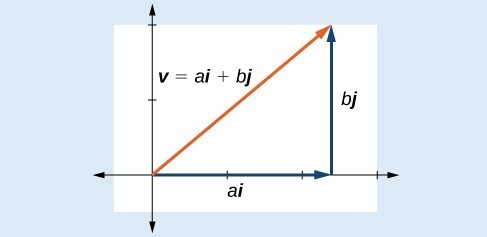
The position vector from [latex]\left(0,0\right)[/latex] to [latex]\left(a,b\right)[/latex], where [latex]\left({x}_{2}-{x}_{1}\right)=a[/latex] and [latex]\left({y}_{2}-{y}_{1}\right)=b[/latex], is written as v = ai + bj. This vector sum is called a linear combination of the vectors i and j.
The magnitude of v = ai + bj is given as [latex]|\boldsymbol{v}|=\sqrt{{a}^{2}+{b}^{2}}[/latex].
Given a vector [latex]\boldsymbol{v}[/latex] with initial point [latex]P=\left(2,-6\right)[/latex] and terminal point [latex]Q=\left(-6,6\right)[/latex], write the vector in terms of [latex]\boldsymbol{i}[/latex] and [latex]\boldsymbol{j}[/latex].
Begin by writing the general form of the vector. Then replace the coordinates with the given values.
Given initial point [latex]{P}_{1}=\left(-1,3\right)[/latex] and terminal point [latex]{P}_{2}=\left(2,7\right)[/latex], write the vector [latex]\boldsymbol{v}[/latex] in terms of [latex]\boldsymbol{i}[/latex] and [latex]\boldsymbol{j}[/latex].
Begin by writing the general form of the vector. Then replace the coordinates with the given values.
Write the vector [latex]\boldsymbol{u}[/latex] with initial point [latex]P=\left(-1,6\right)[/latex] and terminal point [latex]Q=\left(7,-5\right)[/latex] in terms of [latex]\boldsymbol{i}[/latex] and [latex]\boldsymbol{j}[/latex].
Calculating the Component Form of a Vector: Direction
We have seen how to draw vectors according to their initial and terminal points and how to find the position vector. We have also examined notation for vectors drawn specifically in the Cartesian coordinate plane using [latex]i\text{and}j[/latex]. For any of these vectors, we can calculate the magnitude. Now, we want to combine the key points, and look further at the ideas of magnitude and direction.
Calculating direction follows the same straightforward process we used for polar coordinates. We find the direction of the vector by finding the angle to the horizontal. We do this by using the basic trigonometric identities, but with |v| replacing r.
vector components
Given a position vector [latex]\boldsymbol{v}=\langle x,y\rangle[/latex] and a direction angle [latex]\theta[/latex],
Thus, [latex]\boldsymbol{v}=x\boldsymbol{i}+y\boldsymbol{j}=|\boldsymbol{v}|\cos \theta \boldsymbol{i}+|v|\sin \theta \boldsymbol{j}[/latex], and magnitude is expressed as [latex]|\boldsymbol{v}|=\sqrt{{x}^{2}+{y}^{2}}[/latex].
Write a vector with length 7 at an angle of 135° to the positive x-axis in terms of magnitude and direction.
Using the conversion formulas [latex]x=|\boldsymbol{v}|\cos \theta i[/latex] and [latex]y=|\boldsymbol{v}|\sin \theta j[/latex], we find that