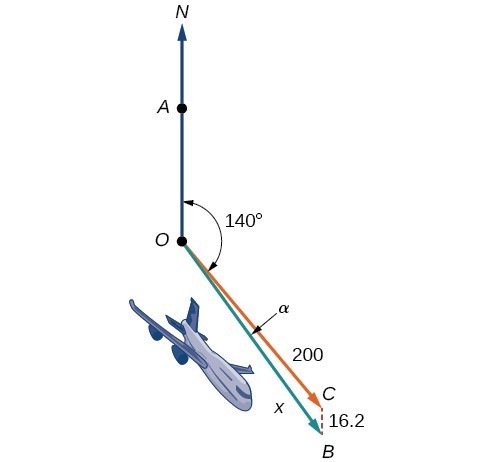
The ground speed is represented by [latex]x[/latex] in the diagram, and we need to find the angle [latex]\alpha[/latex] in order to calculate the adjusted bearing, which will be [latex]140^\circ +\alpha[/latex].
Notice in Figure 19, that angle [latex]BCO[/latex] must be equal to angle [latex]AOC[/latex] by the rule of alternating interior angles, so angle [latex]BCO[/latex] is 140°. We can find [latex]x[/latex] by the Law of Cosines:
[latex]\begin{align}{x}^{2}&={\left(16.2\right)}^{2}+{\left(200\right)}^{2}-2\left(16.2\right)\left(200\right)\cos \left(140^\circ \right) \\ &=45,226.41 \\ x&=\sqrt{45,226.41} \\ &=212.7 \end{align}[/latex]
The ground speed is approximately 213 miles per hour. Now we can calculate the bearing using the Law of Sines.
[latex]\begin{align}\frac{\sin \alpha }{16.2}&=\frac{\sin \left(140^\circ \right)}{212.7} \\ \sin \alpha &=\frac{16.2\sin \left(140^\circ \right)}{212.7} \\ &=0.04896 \\ {\sin }^{-1}&\left(0.04896\right)=2.8^\circ \end{align}[/latex]
Therefore, the plane has a SE bearing of 140°+2.8°=142.8°. The ground speed is 212.7 miles per hour.