- Find function values for the sine and cosine of the special angles.
- Use reference angles to evaluate trigonometric functions.
- Evaluate sine and cosine values using a calculator.
To define our trigonometric functions, we begin by drawing a unit circle, a circle centered at the origin with radius 1. The angle (in radians) that [latex]t[/latex] intercepts forms an arc of length [latex]s[/latex]. Using the formula [latex]s=rt[/latex], and knowing that [latex]r=1[/latex], we see that for a unit circle, [latex]s=t[/latex].
For any angle [latex]t[/latex], we can label the intersection of the terminal side and the unit circle as by its coordinates, [latex]\left(x,y\right)[/latex]. The coordinates [latex]x[/latex] and [latex]y[/latex] will be the outputs of the trigonometric functions [latex]f\left(t\right)=\cos t[/latex] and [latex]f\left(t\right)=\sin t[/latex], respectively. This means [latex]x=\cos t[/latex] and [latex]y=\sin t[/latex].
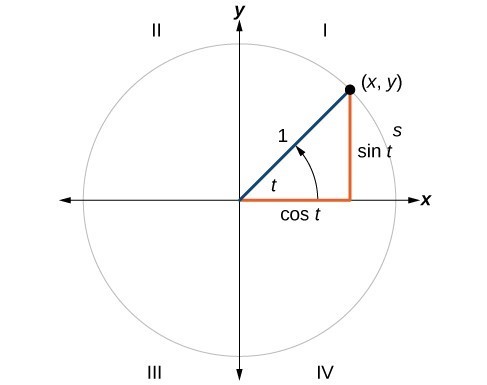
unit circle
A unit circle has a center at [latex]\left(0,0\right)[/latex] and radius [latex]1[/latex] . In a unit circle, the length of the intercepted arc is equal to the radian measure of the central angle [latex]1[/latex].
Let [latex]\left(x,y\right)[/latex] be the endpoint on the unit circle of an arc of arc length [latex]s[/latex]. The [latex]\left(x,y\right)[/latex] coordinates of this point can be described as functions of the angle.
Defining Sine and Cosine Functions
Now that we have our unit circle labeled, we can learn how the [latex]\left(x,y\right)[/latex] coordinates relate to the arc length and angle. The sine function relates a real number [latex]t[/latex] to the y-coordinate of the point where the corresponding angle intercepts the unit circle. More precisely, the sine of an angle [latex]t[/latex] equals the y-value of the endpoint on the unit circle of an arc of length [latex]t[/latex]. In Figure 2, the sine is equal to [latex]y[/latex]. Like all functions, the sine function has an input and an output. Its input is the measure of the angle; its output is the y-coordinate of the corresponding point on the unit circle.
The cosine function of an angle [latex]t[/latex] equals the x-value of the endpoint on the unit circle of an arc of length [latex]t[/latex]. In Figure 3, the cosine is equal to [latex]x[/latex].
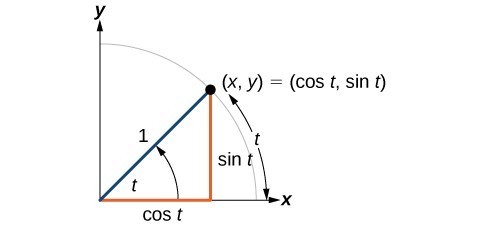
Because it is understood that sine and cosine are functions, we do not always need to write them with parentheses: [latex]\sin t[/latex] is the same as [latex]\sin \left(t\right)[/latex] and [latex]\cos t[/latex] is the same as [latex]\cos \left(t\right)[/latex]. Likewise, [latex]{\cos }^{2}t[/latex] is a commonly used shorthand notation for [latex]{\left(\cos \left(t\right)\right)}^{2}[/latex]. Be aware that many calculators and computers do not recognize the shorthand notation. When in doubt, use the extra parentheses when entering calculations into a calculator or computer.
sine and cosine functions
If [latex]t[/latex] is a real number and a point [latex]\left(x,y\right)[/latex] on the unit circle corresponds to an angle of [latex]t[/latex], then
- The sine of [latex]t[/latex] is equal to the y-coordinate of point [latex]P:\sin t=y[/latex].
- The cosine of [latex]t[/latex] is equal to the x-coordinate of point [latex]P: \text{cos}t=x[/latex].
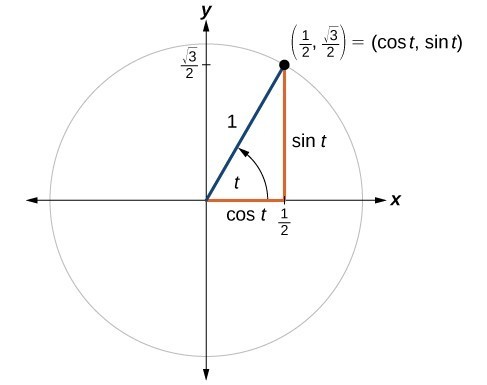
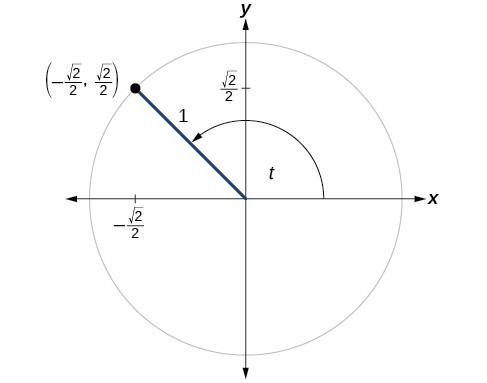
Finding Sines and Cosines of Angles on an Axis
For quadrantral angles, the corresponding point on the unit circle falls on the x- or y-axis. In that case, we can easily calculate cosine and sine from the values of [latex]x[/latex] and [latex]y[/latex].
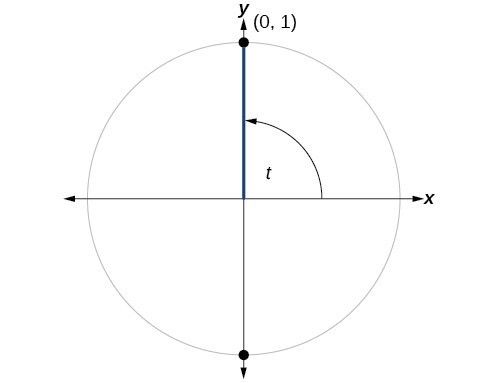 Using our definitions of cosine and sine,