transformed functions
The formula for a transformed function is [latex]g(x) = \pm a \cdot f\big(\pm b(x - h)\big) + k[/latex] where:
- [latex]\pm a[/latex] describes the vertical reflection and stretch/compression
- [latex]\pm b[/latex] describes the horizontal reflection and stretch/compression
- [latex]h[/latex] describes the horizontal shift, and
- [latex]k[/latex] describes the vertical shift
- Find the parent function. If it’s not given to you, check the toolkit functions.
- Identify any shifts.
- Identify any reflections, stretches or compresses.
- Write the function using [latex]g(x) = a \cdot f\big(b(x - h)\big) + k[/latex]
Writing Functions Given the Transformed Graph
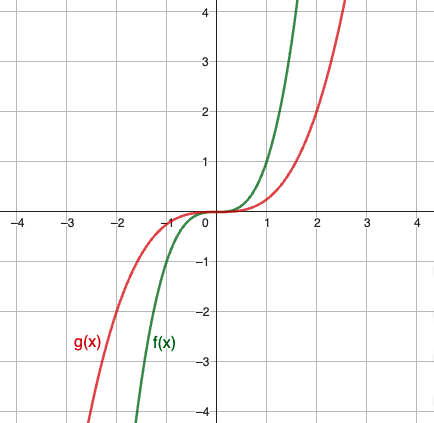 The graph shows two function: The toolkit function [latex]f(x) = x^3[/latex] (green) and [latex]g(x)[/latex] (red). Relate this new function [latex]g\left(x\right)[/latex] to [latex]f\left(x\right)[/latex], and then find a formula for [latex]g\left(x\right)[/latex].
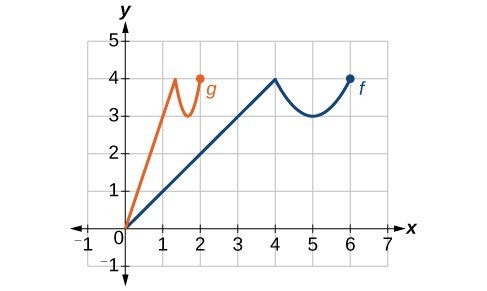 Relate the function [latex]g\left(x\right)[/latex] to [latex]f\left(x\right)[/latex].