Identifying Horizontal Shifts
We just saw that the vertical shift is a change to the output, or outside, of the function. We will now look at how changes to input, on the inside of the function, change its graph and meaning. A shift to the input results in a movement of the graph of the function left or right in what is known as a horizontal shift.
horizontal shift
A horizontal shift occurs when you add or subtract a constant value to the input [latex]x[/latex] of the function [latex]f(x)[/latex].
This shifts the graph of the function horizontally.
- Rightward shift: If you subtract a constant [latex]c[/latex] from [latex]x[/latex] before applying the function [latex]f[/latex], the graph of the function shifts to the right by [latex]c[/latex] units.
[latex]g(x) = f(x-c)[/latex]
- Leftward shift: If you add a constant [latex]c[/latex] to [latex]x[/latex] before applying the function [latex]f[/latex], the graph of the function shifts to the left by [latex]c[/latex] units.
[latex]h(x) = f(x+c)[/latex]
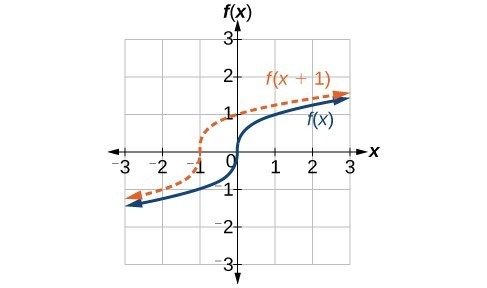 Original Function [latex]f(x)[/latex]
- The solid blue curve represents the original function [latex]\sqrt[3]{x}[/latex].
- The function [latex]f(x)[/latex] passes through the origin [latex](0,0)[/latex] because [latex]\sqrt[3]{0} = 0[/latex].
Horizontally Shifted Function [latex]f(x+1)[/latex]
- The dashed orange curve represents the function [latex]f(x+1) = \sqrt[3]{x+1}[/latex].
- Each point on the graph of [latex]f(x+1)[/latex] is exactly [latex]1[/latex] unit to the left of the corresponding point on the graph of [latex]f(x)[/latex].
- For example:
- If [latex]x=0[/latex], then [latex]\sqrt[3]{0+1} = \sqrt[3]{1} = 1[/latex].
- If [latex]x=-2[/latex], then [latex]\sqrt[3]{-2+1} = \sqrt[3]{-1} = -1[/latex].
A horizontal shift involves moving the graph of a function left or right without altering its shape. In this case, adding [latex]1[/latex] to the input of the function [latex]f(x) = \sqrt[3]{x}[/latex] results in a horizontal shift of the graph to the left by [latex]1[/latex] unit.
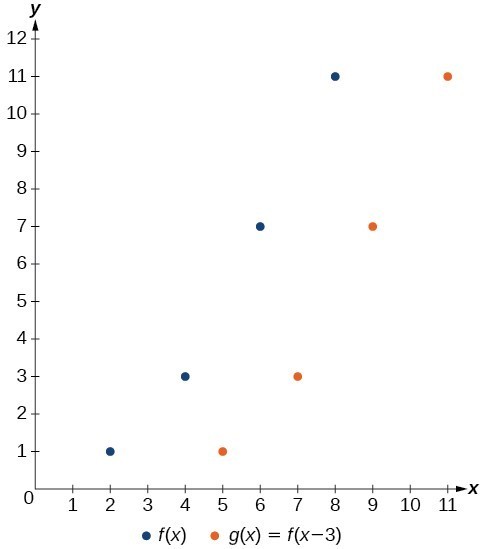
How To: Given a tabular function, create a new row to represent a horizontal shift.
- Identify the input row or column.
- Determine the magnitude of the shift.
- Add the shift to the value in each input cell.
A function [latex]f\left(x\right)[/latex] is given below. Create a table for the function [latex]g\left(x\right)=f\left(x - 3\right)[/latex].
| [latex]x[/latex] | 2 | 4 | 6 | 8 |
| [latex]f\left(x\right)[/latex] | 1 | 3 | 7 | 11 |