Using Even and Odd Trigonometric Functions
To be able to use our six trigonometric functions freely with both positive and negative angle inputs, we should examine how each function treats a negative input. As it turns out, there is an important difference among the functions in this regard.
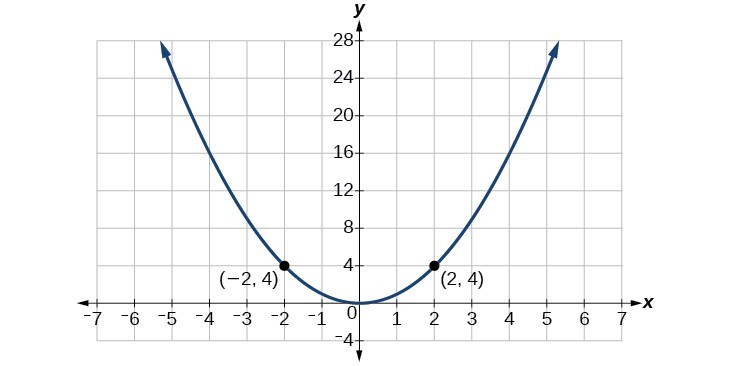
The function [latex]f\left(x\right)={x}^{2}[/latex] is an even function.
[latex]f\left(x\right)={x}^{3}[/latex] is an odd function, one such that two inputs that are opposites have outputs that are also opposites. That means [latex]f\left(-x\right)=-f\left(x\right)[/latex].
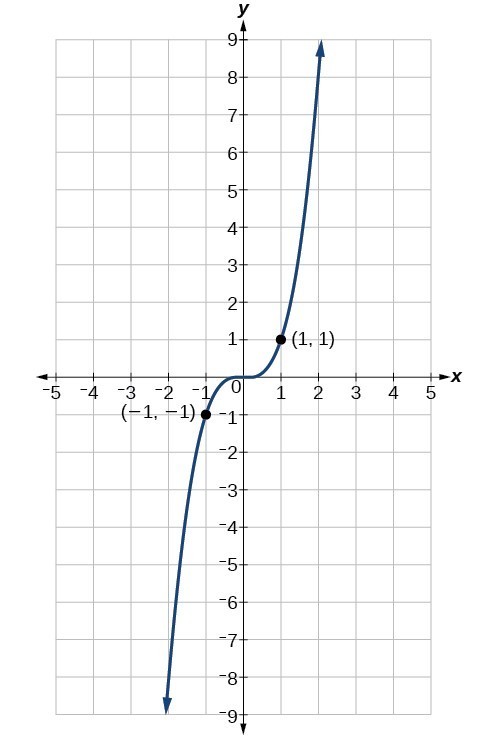
The function [latex]f\left(x\right)={x}^{3}[/latex] is an odd function.
Consider the function [latex]f\left(x\right)={x}^{2}[/latex]. The graph of the function is symmetrical about the y-axis. All along the curve, any two points with opposite x-values have the same function value. This matches the result of calculation: [latex]{\left(4\right)}^{2}={\left(-4\right)}^{2}[/latex], [latex]{\left(-5\right)}^{2}={\left(5\right)}^{2}[/latex], and so on. So We can test whether a trigonometric function is even or odd by drawing a unit circle with a positive and a negative angle. The sine of the positive angle is [latex]y[/latex]. The sine of the negative angle is −y. The sine function, then, is an odd function. We can test each of the six trigonometric functions in this fashion. The results are shown in in the table below.
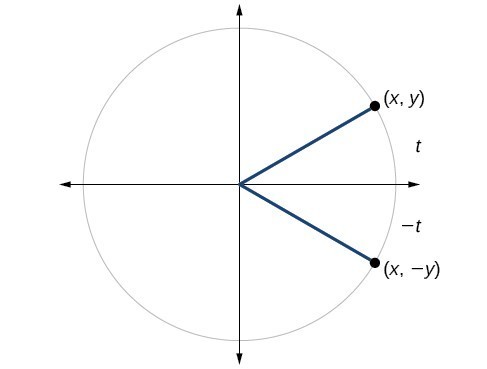
| [latex]\begin{array}{l}\sin t=y\hfill \\ \sin \left(-t\right)=-y\hfill \\ \sin t\ne \sin \left(-t\right)\hfill \end{array}[/latex] | [latex]\begin{array}{l}\text{cos}t=x\hfill \\ \cos \left(-t\right)=x\hfill \\ \cos t=\cos \left(-t\right)\hfill \end{array}[/latex] | [latex]\begin{array}{l}\text{tan}\left(t\right)=\frac{y}{x}\hfill \\ \tan \left(-t\right)=-\frac{y}{x}\hfill \\ \tan t\ne \tan \left(-t\right)\hfill \end{array}[/latex] |
| [latex]\begin{array}{l}\sec t=\frac{1}{x}\hfill \\ \sec \left(-t\right)=\frac{1}{x}\hfill \\ \sec t=\sec \left(-t\right)\hfill \end{array}[/latex] | [latex]\begin{array}{l}\csc t=\frac{1}{y}\hfill \\ \csc \left(-t\right)=\frac{1}{-y}\hfill \\ \csc t\ne \csc \left(-t\right)\hfill \end{array}[/latex] | [latex]\begin{array}{l}\cot t=\frac{x}{y}\hfill \\ \cot \left(-t\right)=\frac{x}{-y}\hfill \\ \cot t\ne cot\left(-t\right)\hfill \end{array}[/latex] |
even and odd trigonometric functions
- An even function is one in which [latex]f\left(-x\right)=f\left(x\right)[/latex].
- An odd function is one in which [latex]f\left(-x\right)=-f\left(x\right)[/latex].
Cosine and secant are even:
[latex]\begin{gathered}\cos \left(-t\right)=\cos t \\ \sec \left(-t\right)=\sec t \end{gathered}[/latex]
Sine, tangent, cosecant, and cotangent are odd:
[latex]\begin{gathered}\sin \left(-t\right)=-\sin t \\ \tan \left(-t\right)=-\tan t \\ \csc \left(-t\right)=-\csc t \\ \cot \left(-t\right)=-\cot t \end{gathered}[/latex]*