- Find exact values of the other trigonometric functions secant, cosecant, tangent, and cotangent
- Use properties of even and odd trigonometric functions.
- Recognize and use fundamental identities.
- Evaluate trigonometric functions with a calculator.
Find exact values of the trigonometric functions secant, cosecant, tangent, and cotangent
To define the remaining functions, we will once again draw a unit circle with a point [latex]\left(x,y\right)[/latex] corresponding to an angle of [latex]t[/latex],. As with the sine and cosine, we can use the [latex]\left(x,y\right)[/latex] coordinates to find the other functions.
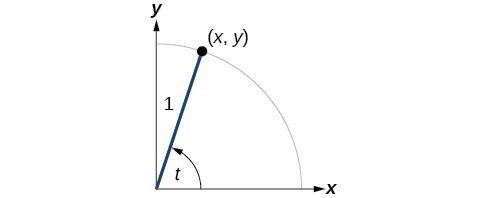
The first function we will define is the tangent. The tangent of an angle is the ratio of the y-value to the x-value of the corresponding point on the unit circle. The tangent of angle [latex]t[/latex] is equal to [latex]\frac{y}{x},x\ne 0[/latex]. Because the y-value is equal to the sine of [latex]t[/latex], and the x-value is equal to the cosine of [latex]t[/latex], the tangent of angle [latex]t[/latex] can also be defined as [latex]\frac{\sin t}{\cos t},\cos t\ne 0[/latex]. The tangent function is abbreviated as [latex]\tan[/latex]. The remaining three functions can all be expressed as reciprocals of functions we have already defined.
- The secant function is the reciprocal of the cosine function. The secant of angle [latex]t[/latex] is equal to [latex]\frac{1}{\cos t}=\frac{1}{x},x\ne 0[/latex]. The secant function is abbreviated as [latex]\sec[/latex].
- The cotangent function is the reciprocal of the tangent function. The cotangent of angle [latex]t[/latex] is equal to [latex]\frac{\cos t}{\sin t}=\frac{x}{y},y\ne 0[/latex]. The cotangent function is abbreviated as [latex]\cot[/latex].
- The cosecant function is the reciprocal of the sine function. The cosecant of angle [latex]t[/latex] is equal to [latex]\frac{1}{\sin t}=\frac{1}{y},y\ne 0[/latex]. The cosecant function is abbreviated as [latex]\csc[/latex].
Tangent, Secant, Cosecant, and Cotangent
If [latex]t[/latex] is a real number and [latex]\left(x,y\right)[/latex] is a point where the terminal side of an angle of [latex]t[/latex] radians intercepts the unit circle, then
[latex]\begin{gathered}\tan t=\frac{y}{x},x\ne 0\\ \sec t=\frac{1}{x},x\ne 0\\ \csc t=\frac{1}{y},y\ne 0\\ \cot t=\frac{x}{y},y\ne 0\end{gathered}[/latex]
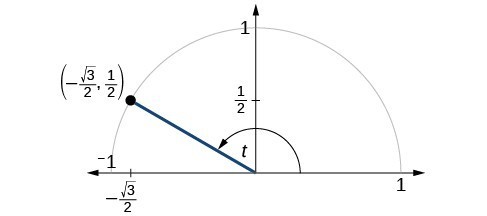
The point [latex]\left(\frac{\sqrt{2}}{2},-\frac{\sqrt{2}}{2}\right)[/latex] is on the unit circle. Find [latex]\sin t,\cos t,\tan t,\sec t,\csc t[/latex], and [latex]\cot t[/latex].
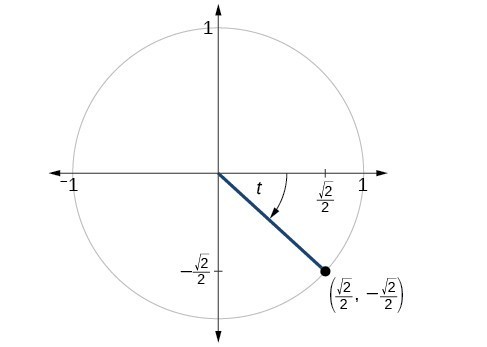
Because we know the sine and cosine values for the common first-quadrant angles, we can find the other function values for those angles as well by setting [latex]x[/latex] equal to the cosine and [latex]y[/latex] equal to the sine and then using the definitions of tangent, secant, cosecant, and cotangent. The results are shown in the table below.
| Angle | [latex]0[/latex] | [latex]\frac{\pi }{6},\text{ or }{30}^{\circ}[/latex] | [latex]\frac{\pi }{4},\text{ or } {45}^{\circ }[/latex] | [latex]\frac{\pi }{3},\text{ or }{60}^{\circ }[/latex] | [latex]\frac{\pi }{2},\text{ or }{90}^{\circ }[/latex] |
| Cosine | 1 | [latex]\frac{\sqrt{3}}{2}[/latex] | [latex]\frac{\sqrt{2}}{2}[/latex] | [latex]\frac{1}{2}[/latex] | 0 |
| Sine | 0 | [latex]\frac{1}{2}[/latex] | [latex]\frac{\sqrt{2}}{2}[/latex] | [latex]\frac{\sqrt{3}}{2}[/latex] | 1 |
| Tangent | 0 | [latex]\frac{\sqrt{3}}{3}[/latex] | 1 | [latex]\sqrt{3}[/latex] | Undefined |
| Secant | 1 | [latex]\frac{2\sqrt{3}}{3}[/latex] | [latex]\sqrt{2}[/latex] | 2 | Undefined |
| Cosecant | Undefined | 2 | [latex]\sqrt{2}[/latex] | [latex]\frac{2\sqrt{3}}{3}[/latex] | 1 |
| Cotangent | Undefined | [latex]\sqrt{3}[/latex] | 1 | [latex]\frac{\sqrt{3}}{3}[/latex] | 0 |