Solving a System of Nonlinear Equations Using Elimination
We have seen that substitution is often the preferred method when a system of equations includes a linear equation and a nonlinear equation. However, when both equations in the system have like variables of the second degree, solving them using elimination by addition is often easier than substitution. Generally, elimination is a far simpler method when the system involves only two equations in two variables (a two-by-two system), rather than a three-by-three system, as there are fewer steps.
ellipse
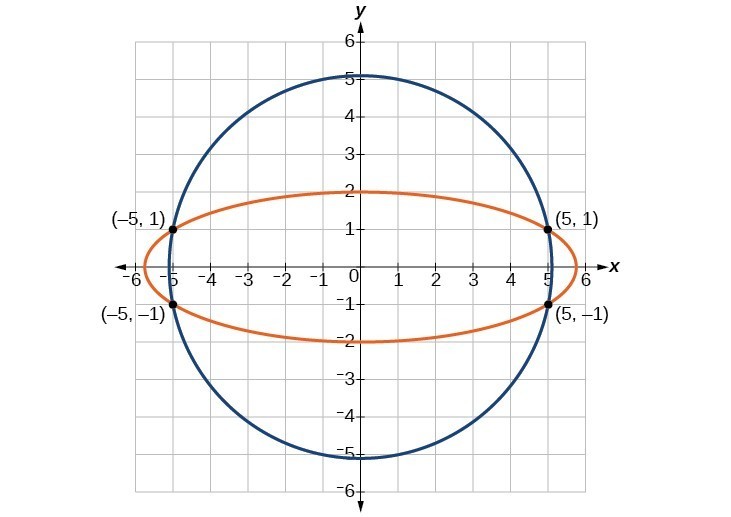
An ellipse is defined as the set of all points where the sum of the distances from two fixed points (the foci) is a constant. It is an “elongated” or “squashed” circle, characterized by a center, a major axis (the longest diameter) and a minor axis (the shortest diameter) perpendicular to the major axis. A circle is a special case of an ellipse where the two foci are at the same location
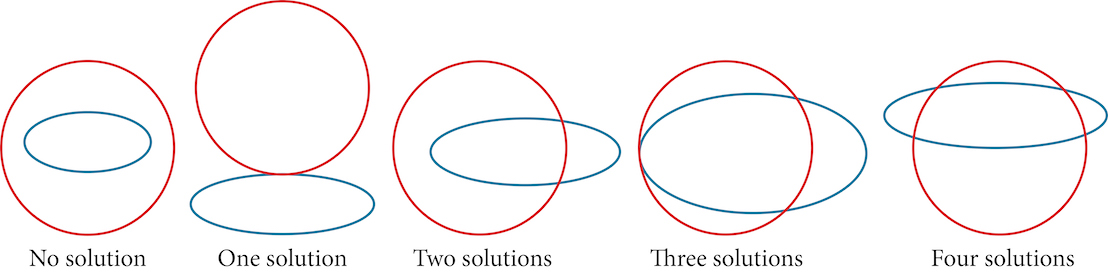
possible types of solutions for the points of intersection of a circle and an ellipse
The figure below illustrates possible solution sets for a system of equations involving a circle and an ellipse.
- No solution. The circle and ellipse do not intersect. One shape is inside the other or the circle and the ellipse are a distance away from the other.
- One solution. The circle and ellipse are tangent to each other, and intersect at exactly one point.
- Two solutions. The circle and the ellipse intersect at two points.
- Three solutions. The circle and the ellipse intersect at three points.
- Four solutions. The circle and the ellipse intersect at four points.