Intersection of a Circle and a Line
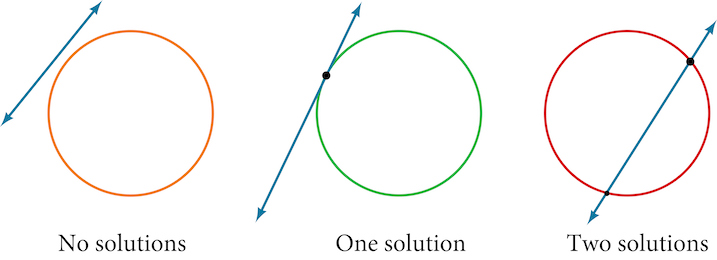
Just as with a parabola and a line, there are three possible outcomes when solving a system of equations representing a circle and a line.
possible types of solutions for the points of intersection of a circle and a line
The graph below illustrates possible solution sets for a system of equations involving a circle and a line.
No solution. The line does not intersect the circle.
One solution. The line is tangent to the circle and intersects the circle at exactly one point.
Two solutions. The line crosses the circle and intersects it at two points.
How To: Given a system of equations containing a line and a circle, find the solution.
Solve the linear equation for one of the variables.
Substitute the expression obtained in step one into the equation for the circle.
Solve for the remaining variable.
Check your solutions in both equations.
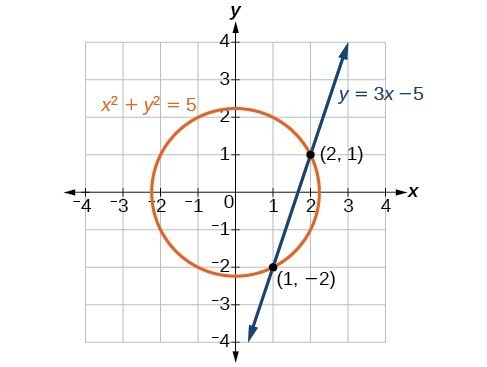
Find the intersection of the given circle and the given line by substitution.
[latex]\begin{gathered}{x}^{2}+{y}^{2}=5 \\ y=3x - 5 \end{gathered}[/latex]
Show Solution
One of the equations has already been solved for [latex]y[/latex]. We will substitute [latex]y=3x - 5[/latex] into the equation for the circle.
[latex]\begin{gathered}{x}^{2}+{\left(3x - 5\right)}^{2}=5\\ {x}^{2}+9{x}^{2}-30x+25=5\\ 10{x}^{2}-30x+20=0\end{gathered}[/latex]
Now, we factor and solve for [latex]x[/latex].
[latex]\begin{gathered}10\left({x}^{2}-3x+2\right)=0 \\ 10\left(x - 2\right)\left(x - 1\right)=0 \\ x=2 \hspace{5mm} x=1 \end{gathered}[/latex]
Substitute the two x -values into the original linear equation to solve for [latex]y[/latex].
[latex]\begin{align}y&=3\left(2\right)-5 \\ &=1 \\[3mm] y&=3\left(1\right)-5 \\ &=-2 \end{align}[/latex]
The line intersects the circle at [latex]\left(2,1\right)[/latex] and [latex]\left(1,-2\right)[/latex], which can be verified by substituting these [latex]\left(x,y\right)[/latex] values into both of the original equations.