Systems of Linear Equations in Two Variables: Learn It 5
Identifying Inconsistent Systems of Equations Containing Two Variables
Now that we have several methods for solving systems of equations, we can use the methods to identify inconsistent systems. Recall that an inconsistent system consists of parallel lines that have the same slope but different [latex]y[/latex] -intercepts. They will never intersect. When searching for a solution to an inconsistent system, we will come up with a false statement, such as [latex]12=0[/latex].
Clearly, this statement is a contradiction because [latex]9\ne 13[/latex]. Therefore, the system has no solution.
The second approach would be to first manipulate the equations so that they are both in slope-intercept form. We manipulate the first equation as follows.
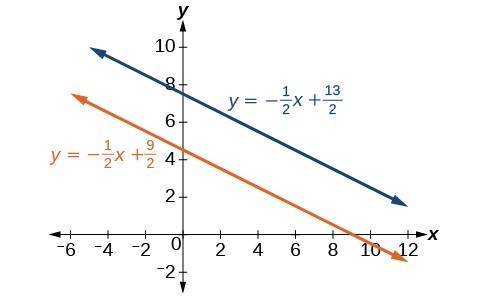
Writing the equations in slope-intercept form confirms that the system is inconsistent because all lines will intersect eventually unless they are parallel. Parallel lines will never intersect; thus, the two lines have no points in common. The graphs of the equations in this example are shown below.
Expressing the Solution of a System of Dependent Equations Containing Two Variables
Recall that a dependent system of equations in two variables is a system in which the two equations represent the same line. Dependent systems have an infinite number of solutions because all of the points on one line are also on the other line.
After using substitution or addition method to solve the system of equation, the resulting equation will be an identity, such as [latex]0=0[/latex].
To write the solution of a dependent system, solve one equation for one variable, such as [latex]y = mx+b[/latex].The solution is often written in set notation as:
Let’s use the addition method since neither equation is in the format of [latex]x=[/latex] or [latex]y=[/latex].
Let’s focus on eliminating [latex]x[/latex]. If we multiply both sides of the first equation by [latex]-3[/latex], then we will be able to eliminate the [latex]x[/latex] -variable.
We can see that there will be an infinite number of solutions that satisfy both equations. This is a dependent system.
We can also see that this is a dependent system by graphing both equations:
Solution
If we rewrote one (or both) equations in the slope-intercept form, we might know what the solution would look like before adding. Let’s look at what happens when we convert the system to slope-intercept form.
After a little algebra, we found that these two equations were exactly the same. We then wrote the general solution as [latex]\left(x, -\frac{1}{3}x+\frac{2}{3}\right)[/latex]. Why would we write the solution this way? In some ways, this representation tells us a lot. It tells us that [latex]x[/latex] can be anything, [latex]x[/latex] is [latex]x[/latex]. It also tells us that [latex]y[/latex] is going to depend on [latex]x[/latex], just like when we write a function rule. In this case, depending on what you put in for [latex]x[/latex], [latex]y[/latex] will be defined in terms of [latex]x[/latex] as [latex]-\frac{1}{3}x+\frac{2}{3}[/latex].
In other words, there are infinitely many (x,y) pairs that will satisfy this system of equations, and they all fall on the line [latex]f(x)-\frac{1}{3}x+\frac{2}{3}[/latex].