Use sum and difference formulas for sine, cosine, and tangent
Use sum and difference formulas to verify identities.
Use sum and difference formulas to verify identities
Verifying an identity means demonstrating that the equation holds for all values of the variable. It helps to be very familiar with the identities or to have a list of them accessible while working the problems.
How To: Given an identity, verify using sum and difference formulas.
Begin with the expression on the side of the equal sign that appears most complex. Rewrite that expression until it matches the other side of the equal sign. Occasionally, we might have to alter both sides, but working on only one side is the most efficient.
Look for opportunities to use the sum and difference formulas.
Rewrite sums or differences of quotients as single quotients.
If the process becomes cumbersome, rewrite the expression in terms of sines and cosines.
We see that the identity is verified. In many cases, verifying tangent identities can successfully be accomplished by writing the tangent in terms of sine and cosine.
Verify the identity: [latex]\tan \left(\pi -\theta \right)=-\tan \theta[/latex].
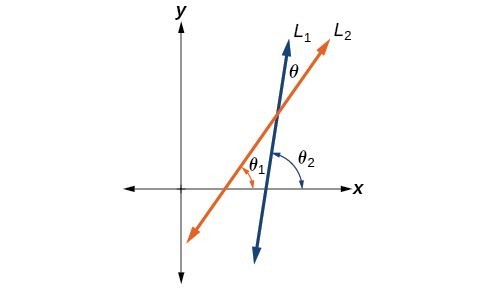
Let [latex]{L}_{1}[/latex] and [latex]{L}_{2}[/latex] denote two non-vertical intersecting lines, and let [latex]\theta[/latex] denote the acute angle between [latex]{L}_{1}[/latex] and [latex]{L}_{2}[/latex]. Show that
where [latex]{m}_{1}[/latex] and [latex]{m}_{2}[/latex] are the slopes of [latex]{L}_{1}[/latex] and [latex]{L}_{2}[/latex] respectively. (Hint: Use the fact that [latex]\tan {\theta }_{1}={m}_{1}[/latex] and [latex]\tan {\theta }_{2}={m}_{2}[/latex]. )
Using the difference formula for tangent, this problem does not seem as daunting as it might.
For a climbing wall, a guy-wire [latex]R[/latex] is attached 47 feet high on a vertical pole. Added support is provided by another guy-wire [latex]S[/latex] attached 40 feet above ground on the same pole. If the wires are attached to the ground 50 feet from the pole, find the angle [latex]\alpha[/latex] between the wires.
Let’s first summarize the information we can gather from the diagram. As only the sides adjacent to the right angle are known, we can use the tangent function. Notice that [latex]\tan \beta =\frac{47}{50}[/latex], and [latex]\tan \left(\beta -\alpha \right)=\frac{40}{50}=\frac{4}{5}[/latex]. We can then use difference formula for tangent.
Occasionally, when an application appears that includes a right triangle, we may think that solving is a matter of applying the Pythagorean Theorem. That may be partially true, but it depends on what the problem is asking and what information is given.
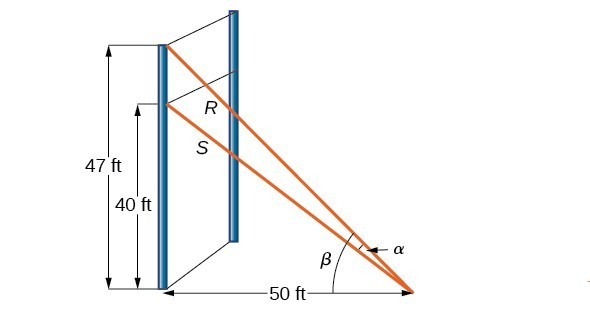 For a climbing wall, a guy-wire [latex]R[/latex] is attached 47 feet high on a vertical pole. Added support is provided by another guy-wire [latex]S[/latex] attached 40 feet above ground on the same pole. If the wires are attached to the ground 50 feet from the pole, find the angle [latex]\alpha[/latex] between the wires.