Sum and Difference Identities: Learn It 1

  • Use sum and difference formulas for sine, cosine, and tangent
  • Use sum and difference formulas to verify identities.

Finding the exact value of the sine, cosine, or tangent of an angle is often easier if we can rewrite the given angle in terms of two angles that have known trigonometric values.

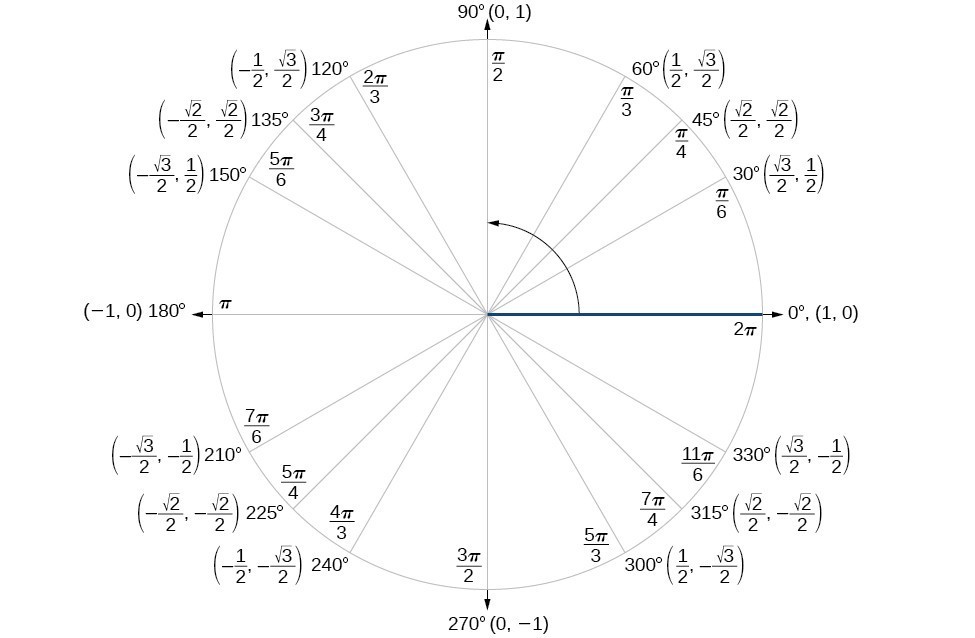
The unit circle contains all of the special angles along with their cosine and sine values. Remember that each ordered pair is in the form [latex](\cos x,\sin x)[/latex].Diagram of the unit circle with points labeled on its edge. P point is at an angle a from the positive x axis with coordinates (cosa, sina). Point Q is at an angle of B from the positive x axis with coordinates (cosb, sinb). Angle POQ is a - B degrees. Point A is at an angle of (a-B) from the x axis with coordinates (cos(a-B), sin(a-B)). Point B is just at point (1,0). Angle AOB is also a - B degrees. Radii PO, AO, QO, and BO are all 1 unit long and are the legs of triangles POQ and AOB. Triangle POQ is a rotation of triangle AOB, so the distance from P to Q is the same as the distance from A to B.

Use sum and difference formulas for cosine

We will begin with the sum and difference formulas for cosine, so that we can find the cosine of a given angle if we can break it up into the sum or difference of two of the special angles.

sum and difference of cosine

Sum formula for cosine

[latex]\cos \left(\alpha +\beta \right) = \cos \alpha \cos \beta -\sin \alpha \sin \beta[/latex]


Difference formula for cosine

[latex]\cos \left(\alpha -\beta \right) = \cos \alpha \cos \beta +\sin \alpha \sin \beta[/latex]

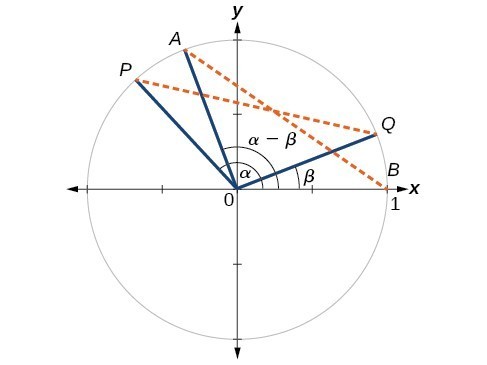
First, we will prove the difference formula for cosines. Let’s consider two points on the unit circle. Point [latex]P[/latex] is at an angle [latex]\alpha[/latex] from the positive x-axis with coordinates [latex]\left(\cos \alpha ,\sin \alpha \right)[/latex] and point [latex]Q[/latex] is at an angle of [latex]\beta[/latex] from the positive x-axis with coordinates [latex]\left(\cos \beta ,\sin \beta \right)[/latex]. Note the measure of angle [latex]POQ[/latex] is [latex]\alpha -\beta[/latex].Label two more points: [latex]A[/latex] at an angle of [latex]\left(\alpha -\beta \right)[/latex] from the positive x-axis with coordinates [latex]\left(\cos \left(\alpha -\beta \right),\sin \left(\alpha -\beta \right)\right)[/latex]; and point [latex]B[/latex] with coordinates [latex]\left(1,0\right)[/latex]. Triangle [latex]POQ[/latex] is a rotation of triangle [latex]AOB[/latex] and thus the distance from [latex]P[/latex] to [latex]Q[/latex] is the same as the distance from [latex]A[/latex] to [latex]B[/latex].


Diagram of the unit circle with points labeled on its edge. P point is at an angle a from the positive x axis with coordinates (cosa, sina). Point Q is at an angle of B from the positive x axis with coordinates (cosb, sinb). Angle POQ is a - B degrees. Point A is at an angle of (a-B) from the x axis with coordinates (cos(a-B), sin(a-B)). Point B is just at point (1,0). Angle AOB is also a - B degrees. Radii PO, AO, QO, and BO are all 1 unit long and are the legs of triangles POQ and AOB. Triangle POQ is a rotation of triangle AOB, so the distance from P to Q is the same as the distance from A to B.

We can find the distance from [latex]P[/latex] to [latex]Q[/latex] using the distance formula.

[latex]\begin{align}{d}_{PQ}&=\sqrt{{\left(\cos \alpha -\cos \beta \right)}^{2}+{\left(\sin \alpha -\sin \beta \right)}^{2}} \\ &=\sqrt{{\cos }^{2}\alpha -2\cos \alpha \cos \beta +{\cos }^{2}\beta +{\sin }^{2}\alpha -2\sin \alpha \sin \beta +{\sin }^{2}\beta } \end{align}[/latex]

Then we apply the Pythagorean identity and simplify.

[latex]\begin{align} &=\sqrt{\left({\cos }^{2}\alpha +{\sin }^{2}\alpha \right)+\left({\cos }^{2}\beta +{\sin }^{2}\beta \right)-2\cos \alpha \cos \beta -2\sin \alpha \sin \beta } \\ &=\sqrt{1+1 - 2\cos \alpha \cos \beta -2\sin \alpha \sin \beta } \\ &=\sqrt{2 - 2\cos \alpha \cos \beta -2\sin \alpha \sin \beta } \end{align}[/latex]

Similarly, using the distance formula we can find the distance from [latex]A[/latex] to [latex]B[/latex].

[latex]\begin{align}{d}_{AB}&=\sqrt{{\left(\cos \left(\alpha -\beta \right)-1\right)}^{2}+{\left(\sin \left(\alpha -\beta \right)-0\right)}^{2}} \\ &=\sqrt{{\cos }^{2}\left(\alpha -\beta \right)-2\cos \left(\alpha -\beta \right)+1+{\sin }^{2}\left(\alpha -\beta \right)} \end{align}[/latex]

Applying the Pythagorean identity and simplifying we get:

[latex]\begin{align} &=\sqrt{\left({\cos }^{2}\left(\alpha -\beta \right)+{\sin }^{2}\left(\alpha -\beta \right)\right)-2\cos \left(\alpha -\beta \right)+1}\\ &=\sqrt{1 - 2\cos \left(\alpha -\beta \right)+1}\\ &=\sqrt{2 - 2\cos \left(\alpha -\beta \right)} \end{align}[/latex]

Because the two distances are the same, we set them equal to each other and simplify.

[latex]\begin{align} \sqrt{2 - 2\cos \alpha \cos \beta -2\sin \alpha \sin \beta }&=\sqrt{2 - 2\cos \left(\alpha -\beta \right)} \\ 2 - 2\cos \alpha \cos \beta -2\sin \alpha \sin \beta &=2 - 2\cos \left(\alpha -\beta \right) \end{align}[/latex]

Finally, we subtract [latex]2[/latex] from both sides and divide both sides by [latex]-2[/latex].

[latex]\begin{align}\cos \alpha \cos \beta +\sin \alpha \sin \beta =\cos \left(\alpha -\beta \right)\end{align}[/latex]

Thus, we have the difference formula for cosine. We can use similar methods to derive the cosine of the sum of two angles.

How To: Given two angles, find the cosine of the difference between the angles.

  1. Write the difference formula for cosine.
  2. Substitute the values of the given angles into the formula.
  3. Simplify.
Using the formula for the cosine of the difference of two angles, find the exact value of [latex]\cos \left(\frac{5\pi }{4}-\frac{\pi }{6}\right)[/latex].

Find the exact value of [latex]\cos \left(\frac{\pi }{3}-\frac{\pi }{4}\right)[/latex].

Find the exact value of [latex]\cos \left({75}^{\circ }\right)[/latex].

Find the exact value of [latex]\cos \left({105}^{\circ }\right)[/latex].