- Evaluate 2 × 2 and 3 × 3 determinants.
- Use Cramer’s Rule to solve a system of equations in two variables.
- Use Cramer’s Rule to solve a system of three equations in three variables.
We have learned how to solve systems of equations in two variables and three variables, and by multiple methods: substitution, addition, Gaussian elimination, using the inverse of a matrix, and graphing. Some of these methods are easier to apply than others and are more appropriate in certain situations. In this section, we will study two more strategies for solving systems of equations.
Evaluating the Determinant of a 2×2 Matrix
A determinant is a real number that can be very useful in mathematics because it has multiple applications, such as calculating area, volume, and other quantities. Here, we will use determinants to reveal whether a matrix is invertible by using the entries of a square matrix to determine whether there is a solution to the system of equations. Perhaps one of the more interesting applications, however, is their use in cryptography. Secure signals or messages are sometimes sent encoded in a matrix. The data can only be decrypted with an invertible matrix and the determinant. For our purposes, we focus on the determinant as an indication of the invertibility of the matrix. Calculating the determinant of a matrix involves following the specific patterns that are outlined in this section.
determinant of a 2 x 2 matrix
The determinant of a [latex]2\text{ }\times \text{ }2[/latex] matrix, given
is defined as

Notice the change in notation. There are several ways to indicate the determinant, including [latex]\mathrm{det}\left(A\right)[/latex] and replacing the brackets in a matrix with straight lines, [latex]|A|[/latex].
[latex]A=\left[\begin{array}{cc}5& 2\\ -6& 3\end{array}\right][/latex]
Evaluating the Determinant of a 3 × 3 Matrix
Finding the determinant of a 2×2 matrix is straightforward, but finding the determinant of a 3×3 matrix is more complicated. One method is to augment the 3×3 matrix with a repetition of the first two columns, giving a 3×5 matrix. Then we calculate the sum of the products of entries down each of the three diagonals (upper left to lower right), and subtract the products of entries up each of the three diagonals (lower left to upper right). This is more easily understood with a visual and an example.
Find the determinant of the 3×3 matrix.
- Augment [latex]A[/latex] with the first two columns.
[latex]\mathrm{det}\left(A\right)=\left\rvert\begin{array}{ccc}{a}_{1}& {b}_{1}& {c}_{1}\\ {a}_{2}& {b}_{2}& {c}_{2}\\ {a}_{3}& {b}_{3}& {c}_{3}\end{array}\right\rvert \left.\begin{array}{c}{a}_{1}\\ {a}_{2}\\ {a}_{3}\end{array}\begin{array}{c}{b}_{1}\\ {b}_{2}\\ {b}_{3}\end{array}\right\rvert[/latex]
- From upper left to lower right: Multiply the entries down the first diagonal. Add the result to the product of entries down the second diagonal. Add this result to the product of the entries down the third diagonal.
- From lower left to upper right: Subtract the product of entries up the first diagonal. From this result subtract the product of entries up the second diagonal. From this result, subtract the product of entries up the third diagonal.
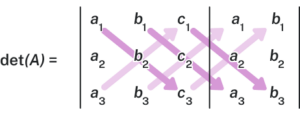
The algebra is as follows:
[latex]A=\left[\begin{array}{ccc}0& 2& 1\\ 3& -1& 1\\ 4& 0& 1\end{array}\right][/latex]
Yes, but for larger matrices it is best to use a graphing utility or computer software.