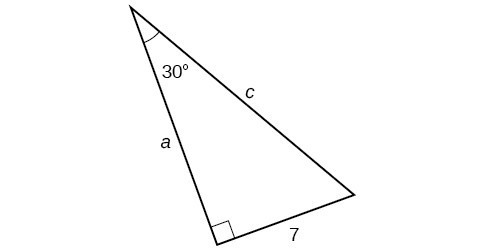
In previous examples, we evaluated the sine and cosine in triangles where we knew all three sides. But the real power of right-triangle trigonometry emerges when we look at triangles in which we know an angle but do not know all the sides.
How To: Given a right triangle, the length of one side, and the measure of one acute angle, find the remaining sides.
For each side, select the trigonometric function that has the unknown side as either the numerator or the denominator. The known side will in turn be the denominator or the numerator.
Write an equation setting the function value of the known angle equal to the ratio of the corresponding sides.
Using the value of the trigonometric function and the known side length, solve for the missing side length.
Find the unknown sides of the triangle.
We know the angle and the opposite side, so we can use the tangent to find the adjacent side.