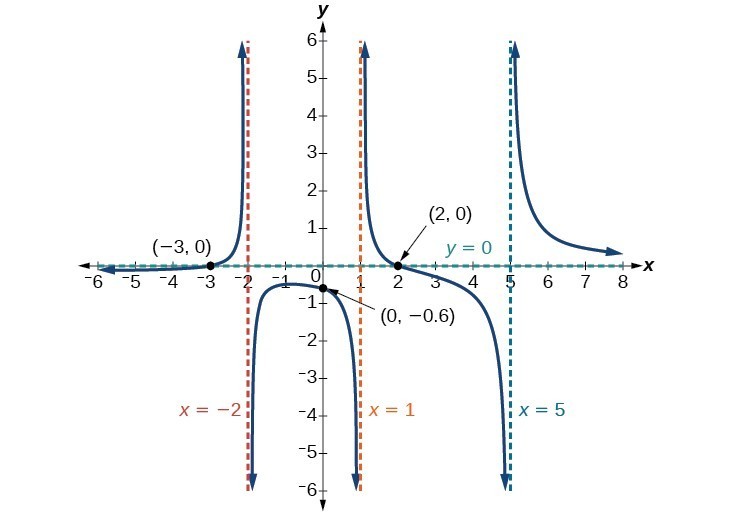
Finding Intercepts of Rational Functions
In a rational function of the form [latex]r(x)=\dfrac{P(x)}{Q(x)}[/latex],
- Find the vertical intercept (the [latex]y[/latex]-intercept) by evaluating [latex]r(0)[/latex]. That is, replace all the input variables with [latex]0[/latex] and calculate the result.
- Find the horizontal intercept(s) (the [latex]x[/latex]-intercepts) by solving [latex]r(x)=0[/latex]. Since the function is undefined where the denominator equals zero], set the numerator equal to zero to find the horizontal intercepts of the function.
- Note that the graph of a rational function may not possess a vertical- or horizontal-intercept.
intercepts of rational functions
A rational function will have a [latex]y[/latex]-intercept when the input is zero, if the function is defined at zero. A rational function will not have a [latex]y[/latex]-intercept if the function is not defined at zero.
[latex]\\[/latex]
Likewise, a rational function will have [latex]x[/latex]-intercepts at the inputs that cause the output to be zero. Since a fraction is only equal to zero when the numerator is zero, [latex]x[/latex]-intercepts can only occur when the numerator of the rational function is equal to zero.