- Figure out which values make a rational expression impossible to calculate (like dividing by zero)
Rational Expressions and Undefined Values
A rational expression is an algebraic expression that can be written as the quotient of two polynomials, [latex]P(x)[/latex] and [latex]Q(x)[/latex], where [latex]Q(x) \neq 0[/latex]. It takes the general form:
[latex]\frac{P(x)}{Q(x)}[/latex]
where [latex]P(x)[/latex] is the numerator and [latex]Q(x)[/latex] is the denominator.
The domain of a rational expression includes all real numbers except those that make the denominator equal to zero. When the denominator equals zero, the expression is undefined. This concept is rooted in the fundamental principle that division by zero is impossible in mathematics.
rational expressions and undefined values
A rational expression is undefined when its denominator equals zero.
- Isolate the denominator.
- Set the denominator equal to zero.
- Solve the resulting equation.
The solutions to this equation are the values that make the rational expression undefined.
Determine the value(s) of [latex]x[/latex] for which the following rational expression is undefined:
[latex]\frac{x^2 - 4}{x - 2}[/latex]
Find the values of [latex]x[/latex] that make the following rational expression undefined:
[latex]\frac{x^2 + 3x}{x^2 - 4}[/latex]
Determine all values of [latex]x[/latex] for which the following rational expression is undefined:
[latex]\frac{2x^2 - 5}{x^3 - x}[/latex]
Undefined values in rational expressions correspond to vertical asymptotes in their graphs. As [latex]x[/latex] approaches an undefined value, the expression approaches infinity or negative infinity, creating a vertical line that the graph approaches but never crosses.
For example, in the graph of [latex]y = \frac{1}{x - 2}[/latex]:
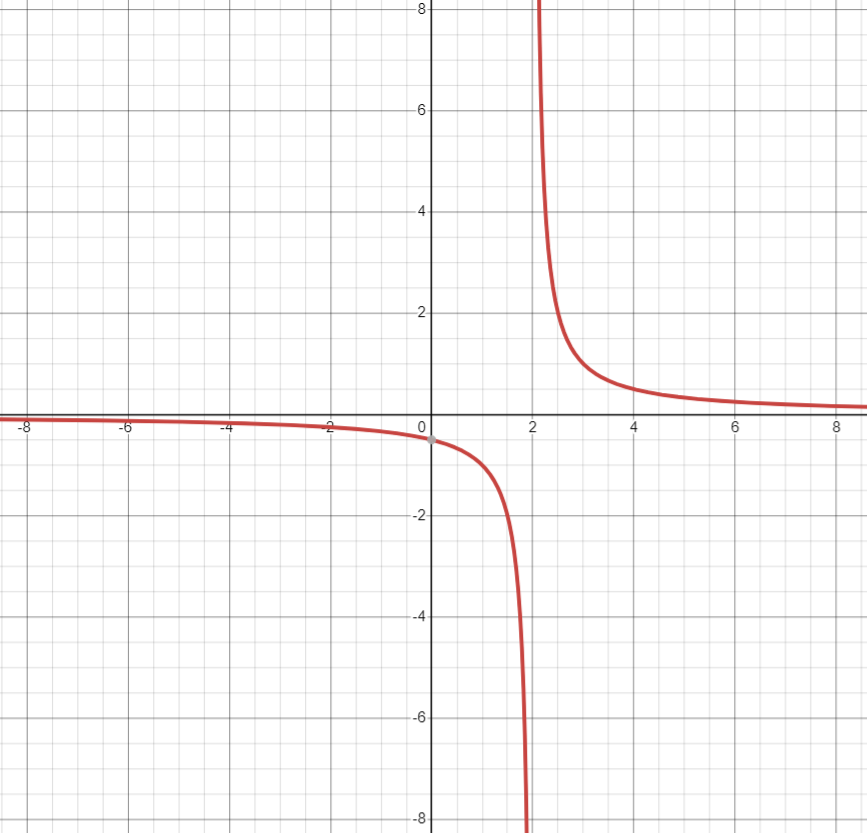
- As [latex]x[/latex] approaches [latex]2[/latex] from the left, [latex]y[/latex] approaches positive infinity.
- As [latex]x[/latex] approaches [latex]2[/latex] from the right, [latex]y[/latex] approaches negative infinity.
- The line [latex]x = 2[/latex] is a vertical asymptote of the graph.
Common Mistakes to Avoid
- Forgetting to check for undefined values before simplifying.
- Assuming only linear terms in the denominator can cause undefined values.
- Neglecting to factor completely when dealing with higher degree polynomials.
- Confusing zero values of the numerator with undefined values.
- Find the length of a circular arc.
- Find the area of a sector of a circle.
- Use linear and angular speed to describe motion on a circular path.
Finding the Length of a Circular Arc
The Main Idea
The length of a circular arc tells us how far along the circle’s edge we travel when sweeping out an angle. The key is that the angle must be measured in radians, because radians directly connect an angle to the arc length. If [latex]\theta[/latex] is the central angle in radians and [latex]r[/latex] is the circle’s radius, then the arc length is given by [latex]s = r\theta[/latex]. This formula works because radians are defined as arc length divided by radius.
Quick Tips: Finding Arc Length
- Use the formula: [latex]s = r\theta[/latex], where [latex]s[/latex] is arc length, [latex]r[/latex] is radius, and [latex]\theta[/latex] is in radians.
- Covert first if needed: If the angle is given in degrees, convert to radians before using the formula.
- Check the units: The arc length will be in the same unit as the radius (e.g., if [latex]r[/latex] is in cm, [latex]s[/latex] will be in cm).
- Fraction of the circle: You can also think of arc length as a fraction of the whole circumference:
- [latex]s = \dfrac{\theta}{2\pi}\cdot (2\pi r)[/latex].
- Real-world connection: Arc length is like the “distance walked” along the edge of the circle — useful for wheels, gears, and circular tracks.
Finding the Area of a Sector
The Main Idea
A sector of a circle is like a slice of pizza — it’s the region between two radii and the arc that connects them. The area of that slice depends on how big the angle is and how large the circle is. If the radius is [latex]r[/latex] and the central angle is [latex]\theta[/latex] in radians, then the area of the sector is given by [latex]A = \tfrac{1}{2}r^2\theta[/latex]. This formula works because radians directly connect angle size to the fraction of the circle’s area.
Quick Tips: Finding Area of a Sector
- Use the formula: [latex]A = \tfrac{1}{2}r^2\theta[/latex], where [latex]\theta[/latex] is in radians.
- Convert if necessary: If the angle is in degrees, convert to radians before plugging it in.
- Check the units: The area will be in square units (e.g., [latex]\text{cm}^2[/latex]) if the radius is in cm.
- Fraction of the whole circle: The formula also comes from [latex]\dfrac{\theta}{2\pi}\cdot \pi r^2[/latex]; the fraction of the circle’s total area.
- Think pizza or pie: A small angle gives a skinny slice, a big angle gives a bigger slice — the formula measures the “size of the slice.”
[latex]\\\\[/latex]
[latex]\\\\[/latex]
[latex]\\\\[/latex]
Describing Motion on a Circular Path
The Main Idea
When an object moves along a circular path, we can describe its motion in two connected ways: angular speed and linear speed. Angular speed measures how fast the angle changes (in radians per unit of time), while linear speed measures how fast the distance along the arc changes (in distance per unit of time). The two are tied together by the radius:
[latex]v = r\omega[/latex], where [latex]v[/latex] is linear speed, [latex]r[/latex] is the radius, and [latex]\omega[/latex] is angular speed. This relationship lets us move between “spinning speed” (angular) and “traveling speed” (linear).
Quick Tips: Finding Area of a Sector
- Linear speed formula: [latex]\omega = \dfrac{\theta}{t}[/latex], where [latex]\theta[/latex] is in radians and [latex]t[/latex] is time.
- Angular speed formula: [latex]v = \dfrac{s}{t}[/latex], where [latex]s[/latex] is the arc length traveled.
- Connect them: Use [latex]s = r\theta[/latex] to link the two formulas, giving [latex]v = r\omega[/latex].
- Units Matter:
- Linear speed: feet per second, meters per second, etc.
- Angular speed: radians per second (or per minute).
- Think Real-World: On a spinning wheel, all points share the same angular speed, but points farther from the center move faster linearly.
[latex]\\\\[/latex]
[latex]\\\\[/latex]
[latex]\\\\[/latex]