Equations of Quadratic Functions
Let’s start by examining the general form of a quadratic function, which is the most basic way to express these equations mathematically.
general form of a quadratic function
The general form of a quadratic function presents the function in the form
[latex]f\left(x\right)=a{x}^{2}+bx+c[/latex]
where [latex]a[/latex], [latex]b[/latex], and [latex]c[/latex] are real numbers and [latex]a\ne 0[/latex].
If [latex]a>0[/latex], the parabola opens upward. If [latex]a<0[/latex], the parabola opens downward.
We can use the general form of a parabola to find the equation for the axis of symmetry.
axis of symmetry
The axis of symmetry is the vertical line that passes through the vertex of the parabola. The axis of symmetry can be found with [latex]x=-\dfrac{b}{2a}[/latex] for a quadratic in the form [latex]ax^2+bx+c[/latex].
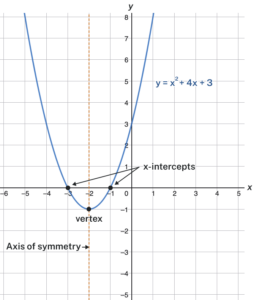
The figure below shows the graph of the quadratic function written in general form as [latex]y={x}^{2}+4x+3[/latex]. In this form, [latex]a=1,\text{ }b=4[/latex], and [latex]c=3[/latex]. Because [latex]a>0[/latex], the parabola opens upward. The axis of symmetry is [latex]x=-\dfrac{4}{2\left(1\right)}=-2[/latex]. This also makes sense because we can see from the graph that the vertical line [latex]x=-2[/latex] divides the graph in half. The vertex always occurs along the axis of symmetry. For a parabola that opens upward, the vertex occurs at the lowest point on the graph, in this instance, [latex]\left(-2,-1\right)[/latex]. The [latex]x[/latex]-intercepts, those points where the parabola crosses the [latex]x[/latex]-axis, occur at [latex]\left(-3,0\right)[/latex] and [latex]\left(-1,0\right)[/latex].
Given a quadratic function in general form, find the vertex of the parabola.
One reason we may want to identify the vertex of the parabola is that this point will inform us where the maximum or minimum value of the output occurs, [latex]k[/latex], and where it occurs, [latex]h[/latex].
vertex of the parabola
If we are given the general form of a quadratic function:
[latex]f(x)=ax^2+bx+c[/latex]
We can define the vertex, [latex](h,k)[/latex], by doing the following:
- Identify [latex]a[/latex], [latex]b[/latex], and [latex]c[/latex].
- Find [latex]h[/latex], the [latex]x[/latex]-coordinate of the vertex, by substituting [latex]a[/latex] and [latex]b[/latex] into [latex]h=-\dfrac{b}{2a}[/latex].
- Find [latex]k[/latex], the [latex]y[/latex]-coordinate of the vertex, by evaluating [latex]k=f\left(h\right)=f\left(-\dfrac{b}{2a}\right)[/latex]
standard form of a quadratic function
The standard form of a quadratic function presents the function in the form
[latex]f\left(x\right)=a{\left(x-h\right)}^{2}+k[/latex]
where [latex]\left(h,\text{ }k\right)[/latex] is the vertex.
Because the vertex appears in the standard form of the quadratic function, this form is also known as the vertex form of a quadratic function.